The ILF was set up in 1988 as a standalone fund which people with severe disabilities could apply to for extra money to pay for added care and support. That additional funding made it possible for people to live independently in their homes, rather than in residential care. For some people, the ILF paid for entire care packages. For others, ILF money was used to top up council funding for care. Most of the people who appear in these videos require round-the-clock care which – unsurprisingly – comes with a price tag.
In 2010, the Independent Living Fund was closed to new applicants.
“In terms of independent living, this is the single most regressive action that the Condems could have taken,” DPAC’s Linda Burnip emailed to say. Indeed.
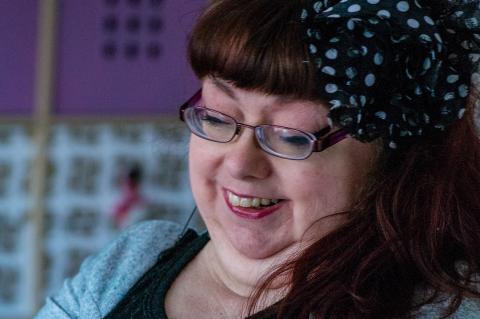
In this video, Penny Pepper – an Islington journalist and writer who has been receiving ILF payments for about 15 years – gives her views on the planned devolution.
The video starts with a few comments from Pepper about a letter (she’s holding it in the video) on the ILF closure which she received from her local MP Emily Thornberry – a letter that she says “doesn’t have any balls.”
Pepper requires round-the-clock care support. Islington council funds just over half of that. The ILF pays for the rest.
She believes that an independent funding structure like the ILF – run by people with disabilities themselves – is crucial to ensuring funding for people with complex needs.
She also says that she has found the political response to the government’s devolution proposal discouraging, to say the least. You’ll see in the video that she’s particularly disappointed with the response from Emily Thornberry, her local MP (I’ve asked Thornberry for her views on her own representation of people on this issue and had nothing back. Will keep you posted on developments if there are any).
Sophie Partridge
In this video, freelance creative practitioner Sophie Partridge, who is also a long-term ILF recipient and who also lives in Islington, voices similar concerns about a lack of political representation. She thinks that people with disabilities tend to serve as pawns in funding wars.
Any loss of care funding and hours could see her forced into residential care – an option that she says she will not contemplate. She says that councils should have fought harder to keep the ILF intact.
The lack of information that councils appear to have – or, at least, are prepared to release – about upcoming ILF responsibilities is purely amazing. Islington council (which part-funds care packages for Sophie Partridge and Penny Pepper) told me that it couldn’t predict whether or not it could match ILF funding, because the council “did not yet know the total amount to be devolved to local authorities.” Neither did the council know if it would need to fund extra staff, saying: “we do not yet know whether additional resources will be provided as part of the transition.” The council merely said, fluffily, that it would “always seek to meet people’s eligible needs in an appropriate way within available council resources.”
“Within available council resources.” Not a phrase to inspire confidence in this era.
Neither is this sentence [from the DWP]. “All disabled people, including those transferring from the ILF, will continue to be protected by a local authority safety net that guarantees disabled people get the support they need,” runs the fantasy that the DWP has posing as a ILF press release. A couple of weeks ago, I had an utterly painful phone conversation with a DWP press officer who insisted (and insisted) that the department’s ILF devolution plans must not be reported as a “cut.” I can see from your website that you write about cuts and this is not a cut! the press officer said several times. Loudly. It’s not a cut!
A very big turnout today with people protesting at Jeremy Hunt’s plans to close Lewisham Hospital’s new A&E department and intensive care, maternity and children’s services. Career git Hunt will make a decision on the closures at the beginning of February.
The march went from Lewisham roundabout to Mountsfield Park. There were a lot of people talking today about upping the ante with occupations and so on.
I upload this video to give you an idea of scale. There were thousands of people there (I’ve heard 15,000 – it was definitely up there). There were thousands of people at the 24 November campaign march as well. There’s been very little said about either in the mainstream press. The growing resistance to this government – and to austerity generally, no matter who is peddling it – continues to be airbrushed from the picture, but that can’t and won’t last forever.
“The decision on the future of Lewisham A&E is due at the start of February. We must keep up the pressure. JOIN THE DEMO on SATURDAY 26th JANUARY to show Jeremy Hunt what we think of the proposals to close Lewisham Hospital A&E, Intensive Care and some children’s and maternity services!
Assemble at Lewisham roundabout (by Lewisham station) at 12 noon on Saturday 26th January. March past our hospital to Mountsfield Park for rally, music and giant petition.”
Utter chaos last night as Ealing’s overview and scrutiny committee considered the cabinet’s 22 January decision to close two important services for people with learning difficulties – the Learning Curve training-to-employment service and the Stirling Road daycentre. I haven’t seen such a shambles for a while, which is saying something in this cuts environment.
There was outrage as the chair tried to restrict a presentation by speakers from the Power Group – a group made up of people with learning difficulties who the council is specifically supposed to negotiate with – to three minutes. (By startling contrast, the chair later told members of the public off for not giving director of adult services Stephen Day adequate chance to speak when he was rattling on about the “savings” these closures will purportedly achieve).
In the end, people from the Power Group got five minutes or so to state their concerns about the closures and the shoddy manner in which they’d been “consulted” about the council’s plans, before they were hurried off stage. That was as repulsive as anything I’ve seen. Everyone should be entitled to speak and if people need a bit longer, they should get that. Everyone who has something to say should have the chance to say it.
People were trying to say that they didn’t approve of the closure decision, didn’t feel they’d been given anything like enough time to consider it (“we were told about it, but we weren’t told about it until it was too late” said one speaker), were worried about the overwhelmingly negative response to the closures from people who use the services and their families, and felt the council had often failed to provide the large-print and illustrated explanatory literature that some people require. They should have been given an hour to speak if they’d wanted it. That would certainly have beat hearing from Stephen Day ad infinitum. The whole thing was an absolute wreck.
Unions revealed that people at Learning Curve and Stirling Road and their families had been given even less notice and time to consider the closures than staff – about 25 days, it was said. There were gasps as it became clear that the council had yet to formally needs-assess people who attended Learning Curve to confirm the personal budgets they’ll be entitled to – and horror as speakers confirmed that up to 100 people who attend Learning Curve won’t be entitled to paid support or services at all.
As I note in the post below this update, the council claims in cabinet papers that after closure, it will “provide individual budgets for all eligible customers. People will be able to choose either a council-managed or cash-budget option and will be offered professional guidance and advice to develop their support plans, and arrange their services.” The very big problem with this is that a lot of people won’t meet the council’s criteria for “eligible customers.” According to the council’s own cabinet reports (page 3, point 2.6.5), at least 96 of the 144 people at Learning Curve won’t be eligible. Some live out of the borough and will need to apply to their own local boroughs for support. Others who live in the borough won’t be eligible, because their needs won’t be considered serious enough. This is crucial. Many people who attend Learning Curve have, or will be, placed in the Moderate or Low needs categories when the council assesses them against Fair Access to Care criteria – the standards councils use to determine eligibility for funding for care and support services. Ealing council – like so many others in this harsh funding environment – no longer funds people in the Moderate or Low needs bands.
Council officers said they could push through all assessments by about the middle of year. A disability assessments officer stood up to say that was rubbish – that the assessment process was too complex and extensive for that and that she knew at least one person who’d been waiting for an assessment for two years. Some expert or other was trucked out to inform everyone that the days of “institutional”-type facilities like daycentres were behind us. This is the usual “this isn’t a cut – it’s an advance in social ideology” line that councils inevitably try and run at these things. It’s generally rubbish.
For one thing, as one parent whose son has completed two computer-skills certificates there said, Learning Curve is a training-to-work service – it aims to help people acquire skills that will lead to employment. She was very sure that Learning Curve was not an “institution.” She saw it as the service that might just help her 28-year-old son into a job, which is something she desperately wants for him.
For another thing, not everyone will be entitled to the personal budgets that the council keeps trying to assure everyone will release people from “institutions” like daycentres and allow them to “purchase” replacement services. Saying that these cuts are all about embracing the future is disingenous in the extreme. People won’t be “freed” from an “institution” when Learning Curve closes. They’ll be left standing on the side of the road with stuff-all. As we’ve already seen, by the council’s own admission, at least 96 of the 144 people at Learning Curve won’t be eligible for financial support. There was also a great deal of debate about the purchasing power of personal budgets – I’ll be posting more on this, but it was said last night that personal budgets weren’t substantial enough to allow people to buy equivalent services from the private and third sectors.
So. It was rowdy, it was angry and it was a complete bloody shambles. Council leader Julian Bell turned up to say a few words (largely some cowardly rot about having delegated responsibility for the closure to officers) and was given very short shrift. His “central government cuts are forcing our hand” line went down like a cup of the cold proverbial. As well it might. People are sick of it.
—————–
Update Wedneday 23 January: in front of a full gallery last night and with a lot of verbal handwringing, if you can have such a thing – “it’s with a heavy heart that we make this decision,” etc – the cabinet voted for the closures. People who use the centres and their families were furious. The decision now goes to Overview and Scrutiny in February. I spoke to the chair of that committee briefly after last night’s meeting and he seemed worried. Parents are complaining about the council’s consultation processes with people with learning difficulties – they feel the consultation was rushed, not adequately geared towards people with learning difficulties and that feedback from representative groups was ignored. More on this soon.
————-
Original post:
This is the first in a series of posts I’m planning on Ealing council’s plans to close a training organisation and a daycentre for people with learning disabilities. The aim is to broaden this out into wider reporting about the consulting and treatment of people with learning disabilities as further council cuts are made and as the government continues with the ESA work capability assessment and brings in the overall benefit cap, the bedroom tax, council tax benefit cuts, DLA to PIP testing and universal credit. In the past few months, a number of people with learning disabilities and parents and carers have been in touch to talk about their growing concerns.
On Tuesday 22 January (see meeting item 7 here), Ealing council’s cabinet is due to make a decision that will radically affect the lives of a group of adults with learning disabilities, and their families and carers.
Learning Curve is, in the council’s definition – “a fully accredited training centre, which provides training in basic skills, preparation for work, job seeking skills, office practice and retail and information technology… it also supports disabled adults in work and can help find work experience placements…its aim is to help people obtain the skills needed to get into work.“
Stirling Road “provides a wide range of services… sport and leisure, health promotion, community based projects, work-based training and travel assistance. The service is provided to promote and support people to become more independent and access their community through community-based projects.”
It won’t for much longer, though – unless people can kick up enough rough to stall the juggernaut.
“There’s nothing else like it. I didn’t have to explain anything to them – the staff understood his needs,” said the mother of a young man who has earned computer skills certificates at Learning Curve and wants to work towards paid employment if he can find it (I’ll be posting more interviews and feedback from people involved as things unfold).
On 15 and 16 January 2013, the Upper Tribunal is due to hear a claim for judicial review brought by two disabled people supported by the Mental Health Resistance Network. They are arguing that the Work Capability Assessment discriminates against people with impaired mental, cognitive and intellectual functions (called “people with mental health disabilities” for short), and that the DWP should make adjustments to the Work Capability Assessment process to minimise the disadvantages that people with mental health disabilities face in being assessed for ESA.
The reason that the ESA process discriminates against people with mental health disabilities is that the process requires ESA applicants to self-report how their ability to work is affected by their disability. While this is challenging enough for many people with physical disabilities, it can be a distressing, and sometimes an impossible task for many people with mental health disabilities. This is because some people with mental health disabilities do not always have insight into their condition, and others may find it difficult to articulate the effect of their disability on their fitness to work for reasons of shame or otherwise. Continue reading →
This is the third article from my series of interviews with people around the country who are affected by this appalling government’s social security cuts. This report is from the northeast and incorporates interviews from June to December 2012. There’s a second article with more interviews to follow.
The interviews are with people who are dealing with a range of issues – employment and support allowance work capability assessments, the bedroom tax and so on. Most of the people interviewed for this article have mental health illnesses. There’s also an interview with a woman who is severely disabled with rheumatoid arthritis and who depends on the soon-to-be closed (the government has just announced this) Independent Living Fund. Mostly, I’ve chosen to interview people who are not in work, or who have been in and out of work throughout their lives – the people who both the Tories and Labour like us to think of as the shirking, non-striving, undeserving poor. You’ll see that things are not quite as simple as all that.
The names of people going through Atos work capability assessments have been withheld and marked *.
——
The realities of Atos, work capability assessments and being thrown off employment and support allowance for people with mental health illnesses:
I am no expert and that is for certain, but there are a few things that I can say for fact. One is that we’d probably know by now if isolating people, throwing them off their meagre benefits and threatening them with homelessness and destitution cured mental health problems.
I’ve yet to see that miracle performed and I’m not the only one who thinks that we’ll be a long while waiting for it.
In the video below (from a Hardest Hit meeting in Newcastle in June 2012), for example, is chief executive of the Mental Health Northeast consortium (MHNE) Lyn Boyd outlining the dire realities of the phonecalls and feedback about social security cuts, employment and support allowance applications and Atos work capability assessments that MHNE has dealt with in recent times.
“A lot of our member groups [MHNE has over 300] were getting in touch with us and saying that they were really concerned about the people that they were working with and the impact that work capability assessments were having,” Lyn Boyd told that Hardest Hit meeting. “Individuals who didn’t belong to any organisation were getting in touch with us in very distressed states – not knowing where to turn or where to go for help.”
The threat (and reality, for some) of losing vital benefits and fears of not being believed in assessment were pushing people to dangerous places. A 2012 MHNE survey showed, among other things, that clients feel like ending their lives as they felt unable to cope with the stress of appealing [Atos] decisions [to find them fit for work]. “I have one lady,” Boyd said, “who was engaging in some voluntary activity. This person was doing extremely well and would probably have been fit for work and looking for work…but the assessment has made that person actually suicidal and now they’re needing more support than ever.”
Anecdotal evidence of long queues for help is not hard to find: “The community mental health team is overwhelmed…I’ve had to fight for what I’ve got so far, even when I’ve had a relapse and the police have been called and things like that,” Steve, 54, tells me in an interview below. (In my last article, just as a comparison I talked to a group of men in Weymouth who were on a nightmare roundabout of joblessness, ESA and jobseekers’ applications, compulsory job club attendances, homelessness and breakdown – one said he’d been so stressed by unemployment and homelessness that he’d gone into the local council and asked for a lethal injection).
MHNE staff remain so concerned about the feedback that they are getting about effects of Atos work capability assessments on people with mental health problems that they’re now running a second survey to collect more information about people’s experiences of the employment and support allowance application process in the northeast as cuts deepen.
Even the courts understand that this picture needs a long look. Next week, a case begins which, if won, will put the onus on the DWP to make sure medical evidence from practitioners is sourced from the start of the ESA application process for people who have mental health problems. “It may be,” as the Public Law Project’s Ravi Low-Beer told me for this New Statesman article, “that conditions fluctuate in seriousness, or [people] cannot easily talk about their disability” – which means people can be found fit for work and then pushed into a notoriously stressful appeals process.
And so you have it – support for people with mental health problems in the millennium. History will not rate us highly for it.
In the meantime, you get this:
Steve*, 54, Newcastle.
Just outside of Newcastle, I attend, as a friend, an Atos work capability assessment with Steve, a man in his mid-50s who I have known and been regularly in touch with for about a year.
Steve was diagnosed with schizophrenia when he was 18.
We meet for his WCA appointment at the sprawling concrete business park in which his local Atos assessment centre is housed. The building isn’t as tawdry and hard-to-access as some, although it hardly screams High-End Medical Centre. Harley Street it is not. There’s a reception window, a large, slightly shabby waiting-room filled with chairs and a couple of public toilets at the back.
Such is outsourced medical assessment for disability benefits in the millennium. The message is pretty clear the minute you enter one of these buildings. You may have multiple sclerosis, or arthritis, or cancer, or schizophrenia, or depression, but government is not inclined to stand on ceremony for you. As far as government is concerned, you are a number. You are here to join the back of the queue from the arse-end of the pile.
Steve knows all of this too well. He is a still, observant sort of character: shy, political, mature and affable and easy to talk to once he’s comfortable. He has been on a difficult road – in and out of care and outpatient clinics, part-time jobs, training, voluntary work, phases on benefits – for more than 30 years. He could do without the Tories making his final stretch the hardest, with their incessant blathering about “scroungers” and hardline view that anyone on social security is dross by definition.
“I tell people that I’m a member of society, but I feel on the fringes of it, as if I’m an outlaw.”
Steve has been taking the antipsychotic drug Sulpiride since he was diagnosed. He feels that the decades of medication have worn and slowed him down. He also suffers from severe depression. He says that some days, the drug-fog and depression mean that he struggles to get out of bed – not because he’s tucked up in bed behind “closed blinds, sleeping a life off on benefits,”, as George Osborne would fondly imagine, but because “I hallucinate [especially at night]…I see things like giant squid and things like that…I think I’m being eaten alive. The Sulpiride I take – it’s got quite bad side effects in that my limbs shake every night when I go to bed and keep me up half the night.”
Steve often says that he’d like a job (at the moment, he’s working as a volunteer at a mental health support charity), but he doubts that he’ll be chosen for one, especially in Newcastle as things stand. Unemployment rates in the northeast are among the country’s highest and: “I’m in my 50s. [There are] huge great holes in my CV which have been covered by little bits of volunteering. I’ve either worked part-time, or gone into full-time education, or been on training schemes, or been on the welfare state. The labelling [as someone with schizophrenia] stigmatises and discriminates against you in the minds of employers….as soon as they see your mental health history, you’re out.” Already – “the job centre treats you like something they found on their shoe.”
Not surprisingly, his most productive (to use a word our output-obsessed, striver-fixated political class would applaud) years were the ones when he received the most help.
The first of these constructive stages took place when he worked for his father after his schizophrenia diagnoses and early hospital admissions. “When I first got out of hospital, when I was 18, I was given a job by my dad, so that he could look after me day to day and see how I was doing.” The second good run came when he studied for an ecology degree at a university which offered him counselling. “The university, thank god, picked me up through student services and gave me counselling every week and gave me help to write essays. Otherwise, I wouldn’t have got my degree.”
Perhaps needless to say, things began to fall away as the support did. “I’ve rarely seen psychiatrists since 2004. It was a succession of different psychiatrists who just wanted to go back into the past – what medication I was on and so on.” Now, he says,, the local community mental health team is stretched to its limits and Steve’s behaviour is not viewed, he thinks, as serious enough for priority attention.
“The community mental health team is overwhelmed…I’m not as ill as others, I acknowledge that, but I do think that I need some help and I get very little. I’ve had to fight for what I’ve got so far, even when I’ve had a relapse and the police have been called.”
All he needs, he says, is “to see someone to talk to on a regular basis, just for motivation and reassurance. And to be able to have enough a personal budget to employ someone like a gardener and a cleaner, because I’m conscious of the fact that the neighbours have done most of the garden and I find mowing the lawn very hard – not just physically, but mentally – getting round to it and doing it. I’d also like a psychiatrist just sort of in the background in case things get worse.”
He’s been dreading his WCA. He knows the descriptors that Atos will use to judge his fitness for work and is concerned that they won’t cover the real impacts of his schizophrenia and depression.
So it proves.
The assessment is perfunctory. The room is small and forgettable – it’s bare, except for a desk, a computer, few mismatched chairs and, behind the chairs, a plain gurney. Steve and I sit in two chairs on one side of the desk. The assessor – a friendly-enough individual – sits behind the computer and directs a range of questions to Steve: “Did you get a lift here, or did you come on the train? (On the train). Tell me a bit about how you manage, getting up and dressed in the morning.” The assessor asks Steve to touch the tips of each of his fingers to his thumb. Then, he’s asked to lie on the gurney and to raise one leg and then the other. The whole test takes about 40 minutes.
It’s the vapidness of these tests that is their most striking feature. They are a snapshot of a person’s ability, on that day, to “behave” well enough and to perform basic tasks which an employer might – might – pay someone a small salary for. There’s almost nothing of the wider picture here – certainly little of the fluctuating nature of Steve’s mental health. Steve’s schizophrenia, his terrible depression, his hallucinations, his problems with sleeping, his patterns, his illnesses’ slow grinding down of him over the decades, his struggle to function and to keep his home clean without professional help – these truths are not priorities. Some days, he can cope with change, get about and cope with social engagement. Some days, he can’t.
He receives his final report several weeks later. He is awarded no points in his assessment and is told to apply for jobseekers’ allowance. He says that he plans to appeal.
————-
Paul *, 55, Newcastle
Paul is thin, greying, chatty and, sometimes, a little jittery. The first time we meet, we sit for an hour or so in a small room in an old hospital building in Newcastle. Rain creeps down the windows and neither of us is looking forward to the moment when we must leave the warm building. So, we stretch out the chat.
Paul has brought a lot of paperwork and bags with him – he’s carrying folders, boxes crammed with papers and a couple of old Tesco shopping bags that are filled with plastic takeaway boxes.
We start by talking in a general way about housing (he lives in a council flat), benefits and his fears about the employment and support allowance application form that he expects to receive (the “brown envelope of death,” he calls it). Then, Paul says that he has something to show me.
He pulls an old notebook and a several crumpled photographs out of one of the folders, and passes them to me. The photos show the Tyne and Wear Bridge. A series of small crosses have been penned in black ink here and there on the photos.
Paul points to the crosses. “These show the places where people have jumped off the bridge,” he explains. “Here, here and here. That’s what is happening today.” He says that he has written the dates and times people when have jumped from the bridge in his notebook. “This is where I’m going, too,” he says. “I’ve had kids round the back of my house, hassling me and they destroyed my garden. I have been very psychotic for last few weeks.”
He says that he’s saved up several thousand Gabapentin and other pills to kill himself with. He opens one of the old Tesco shopping bags to show me the stash. It’s impressive. The plastic containers in the bags are crammed to bursting with huge yellow and white pills. Paul also brings out two enormous blister packs that are filled with tablets. He says that he’s getting all these on repeat prescription. The fact that he has this pile at all is the striking point. I have no idea if he will or won’t kill himself, but he’s certainly ready to if he decides to. At the very least, it’s clear that he hasn’t taken this medication for quite a while.
I think about this a month or two later when Iain Duncan Smith, via the ever-discerning Mail, blathers on again about punishing benefit claimants who use drugs and alcohol. Paul isn’t in that category, but cynic in me can picture IDS devising one for him. When the great day comes and the DWP starts testing buckets of piss each morning for evidence of claimant substance use or whatever it is they’ll be doing, I can just imagine that them hauling out a strip of modified litmus to catch out people who are supposed to be on drugs, but aren’t.
—————-
Steve
A few days after he decides to appeal the Atos decision to find him fit for work, Steve, the Newcastle man who has schizophrenia, calls. He’s riled, all right. He’s just been told by a receptionist at his local surgery that his doctor will not write him a sick note (now called a fit note), because Atos found him fit for work. The sick note would sign him off “work” (that is, declare him unfit for work) while he waits for his appeal to be heard and would mean he is eligible for some ESA payment during that time. Without the note, he’s fit for work and not eligible for ESA.
He emails:
“This is an email to confirm that a receptionist at my GPs’ surgery phoned me to say that the doctor had refused to sign any more ESA sicknotes as the DWP, on the basis of an Atos report, had found me fit for work. I was claiming I needed a sicknote on the basis of a chronic psychotic illness – namely schizophrenia, which other GPs were happy to sign before the Atos report. I have not yet seen the disability forum or the local jobcentre on this issue yet as I’m still reeling from the fact that I’ll get no more benefit after today. Please help!”
Steve’s pretty stressed, as anyone would be. He thinks his money is about to be stopped and he has bills to pay. It’s a total shambles. Fortunately, he’s able to get help from the charity he volunteers with. Calls are made and a welfare advisor agrees that Steve is eligible for a fit note and a partial ESA payment, because he’s appealing Atos’ original “fit for work” decision. Steve’s surgery is contacted and a doctor agrees to write the fit note.
The mess takes several days to fix and Steve’s depression, insomnia and night terrors are not helped by it. “They want to punish you [for being on benefits] and get you any way they can,” he says. So much, too, for George Osborne’s imaginary shirkers closing their blinds and sleeping off a life on benefits. In your bloody dreams, George. Most of the people I speak to, like Steve, spend their lives with their hearts in their mouths and wondering who’ll be after their tiny income next. They don’t get much sleep at all.
————
This is a little story about the efforts a small group of us have made to try and get a meeting with Atos mental function champions:
“The short training course in mental health that Atos assessors receive is proving nowhere near adequate to allow them to accurately assess applicants,” MIND was quoted as saying in the review.
Harrington recommended that Atos provide mental, intellectual and cognitive champions in each medical assessment centre, to “spread best practice amongst Atos healthcare professionals in mental, intellectual and cognitive disabilities.”
Fast-forward, then, to November 5 2012, when Mark Hoban, the minister of state for work and pensions, made this rather dazzling announcement:
That’s AMAZING (as in surprising) news, said MHNE’s Lyn Boyd and Kathryne Wray and Alisdair Cameron from Newcastle mental health user-led support group Launchpad when we spoke about it. A mental function champion – a trained person to give support and advice on complex issues as per Harrington’s recommendations – in every assessment centre in the country?
It sounded too good to be true.
And it was.
“There is not a champion in each Atos assessment centre,” the DWP said when I emailed to find out more. “Instead, there are regional champions, with all [Atos] healthcare professionals having access to a telephone advice line where they can access advice from a champion.”
Talk to Atos if you want to know more, the DWP said.
Boyd, Wray, Cameron and I decided that we did want to know more. As we’ve already discussed, they’d long been concerned about the effects of work capability assessments on people with mental health illnesses. They wanted to know how mental function champions worked for those ESA claimants.
So, we contacted Atos and asked to meet with northeast champions to talk about their work. I emailed Atos’ PR manager. She asked for names and questions, which I sent. She didn’t respond, so I sent another email. She didn’t respond to that, so I called her just before Christmas. I couldn’t meet a champion, she said, because I was a journalist, but she would arrange for someone (a “stakeholder liaison officer”) to contact the others.
We’ll keep you posted on that one and see how things unfold. I’ve posted Atos’ response to questions about the role of mental function champions here.
NB: for the record – if Atos does allow MHNE and Launchpad a visit with mental function champions, Boyd, Wray and Cameron want to make clear that they would not consider any such visit a consultation of any kind, or a condoning of the process. They want simply to find out more about the work that these champions do, so that they can report back to their members.
——-
Michael*, 43
Back in meeting-rooms in Newcastle, I spend an afternoon talking with Steve and a man called Michael. Michael is 43 and is on incapacity benefit and disability living allowance. He has borderline personality disorder, severe depression and anxiety and panic attacks.
It seems unlikely that those problems can be bullied away by a punitive government threatening work capability assessments, benefit sanctions and a bedroom tax. One of the reasons I say that is Michael feels that bullying caused a lot of his problems in the first place. Michael comes from the sort of background that the Tories would have us believe everyone can rise to: family violence as a child growing up on Gateshead’s Springwell estate, gang aggression, a young adulthood spent in youth training schemes and so on. Like Steve, he’s been on a hard road for much of his life and like Steve, he feels this government has made it a lot harder.
“I know that this is going to come across really strong, but I think that it’s a social cleansing what they are doing, with the likes of us on benefits,” he says as we talk. “If this was happening in Kosovo, there would be uproar.”
Right now, Michael is concerned about the bedroom tax. He lives alone in a council flat and has a spare room that he may have to pay for. The irony is that he was moved to the flat by his local council in the first place. He was shifted to a new part of town when local gang members found out that he’d he reported their violent behaviour – it wasn’t safe for him to stay after that. “Every time I was going out, I was getting gangs of kids from 15 to 18, effing and blinding and wanting to do us in. When my brother came across one time, they came and attacked him and the double gate and they picked up half of it and put it through the window. That’s how I got moved from where I was.”
His worry now is that he’ll be hounded out of his flat and neighbourhood again – not, this time, by gangsters wielding busted double gates, but by Iain Duncan Smith brandishing the bedroom tax regulations. He wants to stay where he is. “My doctor is there [where he lives]. They know me history. I’m settled there.”
He doubts he’ll work again. Who would employ him and how?
“When you put your [job] application form in, you must declare everything,” Michael says. “If you don’t and they find out that you have got a mental health illness, they can give you your cards.”
“That’s why I always declare it and don’t get interviews for that reason,” Steve says. “You can’t really grasp that there’s hardly anything out there and if you admit to a health problem, you’re basically automatically classed as different anyway and not worthy of things.”
“All I’ve known for the past 30 [sic] years is benefits,” Michael says. “If I was to go to a job now, it would kill us, because I would be frightened. [You need something to help] ease you in.”
——–
This next section is about the government’s plans to close the Independent Living Fund. The fund was set up to help people with severe disabilities. I’ll be writing more on this:
The ILF was set up to pay for extra care for people with severe disabilities so that they could continue to live independently. Laver was one of the people to benefit from the fund.
She developed rheumatoid arthritis more than 25 years ago and now relies entirely on carers to wash, feed and clothe her and get her to the toilet. She says that the ILF pays for about 46 of her carer hours a week. Her local council covers an couple of hours or so a day. Without the care hours that are funded by the ILF, she’d be left in an appalling state: to “sit at my home with only two breaks on my bed to enable me to be washed as I will be wet from having no midmorning and afternoon call.”
The ILF was closed to new applicants in 2010. In 2012, the government ran a “consultation” to decide whether to keep the fund for existing users. It decided not to. The plan is to devolve funding to local councils by 2015. It will not be ringfenced. Laver tells me that she has thought of suicide since that news came in.
“In terms of independent living this is the single most regressive action that the Condems could have taken,” DPAC’s Linda Burnip emails to say.
“All disabled people, including those transferring from the ILF, will continue to be protected by a local authority safety net that guarantees disabled people get the support they need,” the DWP purrs on its website. I also have a pained phone conversation with a DWP press officer who insists on the same – that the money and care will continue when devolved.