Being treated well when you’re on workfare is a bonus. Don’t expect it.

I spent several hours today with a group of people who are just about to finish their first six-month stint on 30-hour-a-week workfare Community Work Placements (CWP). CWP began last year as part of George Osborne’s pointless, punitive Help To Work scheme. With CWP, people on JSA are forced to work for 30 hours a week for six months in charities and local organisations. They have no choice. Refuse to work for free – you’ll be sanctioned.

The people I spoke with today have spent the last six months at Haringey charity Embrace UK where they have worked on – among other things – data sorting and entry, administration, sexual health advice for young people (no DBS/CRB checks – I wrote about that here), youth development schemes (ditto), presentations for new arrivals and homeless groups, marketing support, IT development and radio production. This is a huge range of jobs for which people should be properly paid. The fact that so many tasks are now being done by people who are made to do those tasks on workfare schemes ought to be of concern for everyone. I’ve said it before: paid work as a concept is under real threat as people who are forced to work for nothing carry out more and more jobs. As one of the men on CWP at Embrace UK said to me when we spoke late last year – people in so-called white-collar work may not be particularly aware that “their” kind of job is being done now for nothing. “They’ll have doctors and lawyers on workfare soon,” he said. You laugh, but you wonder as well. As I’ve said before as well, I think people who aren’t yet affected by these things have a vague (and snobbish) idea that workfare means a bit of weeding in public parks (a job that also should be properly paid, by the way). I don’t think everyone grasps the reach that workfare increasingly has.

Anyway. The people I spoke with this morning had one big question. They wanted to know what would happen to them when this first six-month placement ended. Nobody I spoke to had a paid job to go to (CWP = another winning government welfare-to-work scheme. Not). Their concern was that their nasty workfare-placement company Urban Futures would shove them into a new placement with another charity. They worried that the next place would be extremely unpleasant – that the work would be filthy and hard (which is no joke, particularly when you’re in your 50s) and the management cruel. There is reason to fear, if you ask me. I’ve spoken with people on CWP workfare at Haringey charities who are sent into the streets to do bucket collections. They must stand outside in all weathers with buckets and collect money. “I did a couple of days charity bucket collection down out the front of the shops,” a guy called Graham told me outside Urban Futures just before Christmas.

Another person I spoke to today had spent time on CWP at the Marie Curie charity shop at Highbury and Islington (Marie Curie, as we know, supposedly pulled out of workfare in 2012, but seems now to take people on CWP by – erm, accident. Marie Curie no longer answers my questions about this. Ahem. They’ll keep. More on them soon). That person (aged in their 50s) had to “steam clothes and stand on the shop floor putting clothes out. You were on your feet all day, with the manager pushing us to work harder and harder.” Continue reading

Now for our next trick: making elderly JSA claimants grovel to use toilets at jobcentres

More on the sort of ritual humiliation people must now tolerate at jobcentres as a matter of course:

I attended a first JSA signing-on session last week with Tony, who is aged 60. These inaugural signon sessions at this jobcentre are not held as private, one-to-one meetings. People must attend these sessions as part of a group.

This is a big problem in itself, because people don’t always want to reveal their private information in front of ten or 12 strangers. People must fill in their claimant commitment forms as part of this session. They have to write about their histories and work experience, and not everyone wants to ask the questions they have about these things in front of people they don’t know. People might be ex-offenders, or have long gaps in a work history because they have serious drug and alcohol problems. They may have problems with their reading and writing. On this occasion, one person asked me if I could spell out several words for their form.

Anyway. The toilets. Someone in the group asked if there was a public toilet in the building. The adviser who was running the session said No. There was a public toilet at the jobcentre once, but apparently needles were found in it from time to time and the jobcentre closed it. So – that was the end of that. It was simply a case of Too Bad. No alternative was offered. There’s actually a public toilet at the library just round the corner (I am getting on years and so am kind of familiar with the location of pretty much every public latrine in the parts of London I frequent), but nothing was said about that.

This is the sort of thing really gets on my wick. It seems small, but it isn’t. There’s a real vengefulness here. In any other setting, an effort would be made to solve the problem and offer people an alternative. But the normal courtesies aren’t extended to people who claim JSA. Quite the reverse. People who claim JSA are expected to put up with discomfort. They can wet themselves for all anybody cares. The fact that nobody had any choice but to attend the session and stay at it was neither here nor there. And there is no choice. People have to attend these signon sessions if they’re going to get unemployment money. If they don’t attend and stay, they can’t get JSA. The sessions are long – this one went on for more than an hour and people had to wait a while for it to start, so it probably lasted an hour-and-a-half all up. Add on another half-hour for the walk or bus ride there and you’re getting past a couple of hours.

However. The adviser did say that occasionally, an exception was made to the No Toilet rule. People sometimes might be able to use the toilet if they had a special medical problem. Presumably, they had to convince an adviser and/or security guard that their medical problem measured up.

This is exactly what Tony had to do. He’s 60 and not well. After an hour or so, he had to get up in front of the 12 people in the room, interrupt the adviser and whisper a list of his medical problems to see if he could win himself a visit to the toilet. Seriously. Aged 60. Everyone else in the group (the room was small) sat there watching this and trying to work out what was going on, and waiting to see how the adviser would play it. The adviser thought about it and listened some more and in the end, I guess, decided that Tony had a case. So, he told Tony to walk through the main part of the jobcentre to the security guards and to tell them he was allowed to use the toilet. Tony left the room – and returned in a few minutes to take the adviser aside again. He told me afterwards that the guards had said No to his request and sent him back to the room. A bit desperate now, he asked the adviser if he could tell the guards he was allowed to use the toilet. The adviser seemed stressed by this – “I can’t leave the room,” he said – but decided to solve the problem by opening the door and attracting the attention of the security guards across the main waiting area.

So much for dignity. Continue reading

Not allowed to wait inside the jobcentre for signon appointment even though we were COLD….

Decided to write this because I can – I went to the Forest Hill jobcentre in Lewisham earlier this week with someone who had a signon appointment. We got the jobcentre early – probably about 15 minutes before the appointment time (the person I was with didn’t want to be late in case they got in trouble, etc).

Anyway, Security wouldn’t let us wait inside the jobcentre – you know, on the seats in the waiting area. They said we couldn’t come in until about the time of the appointment. I have to say that this got on my nerves very badly, because it was so cold outside. I know people who’ve been banned from jobcentres, but they’re still allowed into other ones to sign on, and anyway – nobody has the right to deepfreeze other people. Life is uncomfortable enough for people at the moment without forcing them to wait outside in the middle of a very cold winter. Thought that was a bit shit.

Jobcentre to claimants: if you want benefits help, ask the local group that campaigns against us

Here’s more evidence of how totally jobcentres have lost the plot/jumped the shark etc:

The Kilburn jobcentre now tells ESA and JSA claimants who need help with their claims to seek advice from the local campaigning group that battles jobcentres. I shit you not. The Kilburn jobcentre is now so utterly unable to solve people’s problems that it tells claimants that a good bet is to get support from the group that regularly protests outside the jobcentre about the jobcentre.

So – we have a scenario where sometimes, the jobcentre staff call the police on the campaigning group when its members leaflet out the front of the jobcentre. Other times, jobcentre staff refer people to the campaigning group for the help that the jobcentre isn’t giving – ie the sort of jobcentre failure that often leads to the protests. What a world. It’s as though some staff at this jobcentre have decided that people will get the best advice in their battles against the DWP and jobcentres if they ask people who actively campaign against the DWP and jobcentres. And you know – although it’s weird, maybe it does make a certain kind of sense. The people at the unemployed workers’ group do have a great deal of expertise and give excellent advice and support to people who have problems with their claims.

They certainly give people more help and support than they get anywhere else. Here’s an example: yesterday, I spent a long time talking with a guy called Tony (there’s a transcript from our discussion below). He hadn’t been able to find assistance at all until the jobcentre sent him to the campaigning group. He definitely needed help, too – he’s 60, unwell (he looked cold and very pale) and he is totally without income. He used to work as a mechanic and restoring cars, but then his health deteriorated and – yeah. This is how it happens. This is how it happens if you age and get sick and forget to get very rich first. Tony was thrown off ESA recently, when Atos found him fit for work. He appealed that decision and has been languishing in the no-man’s land that is mandatory reconsideration ever since (people who challenge a fit-to-work decision can’t go straight to appeal now. They must now wait for the DWP reexamine the original decision at its leisure – that’s mandatory reconsideration). Like most people, Tony has no idea how long he must wait to find out if the fit-to-work decision will be overturned.

In the meantime, Tony has absolutely no money coming in at all. To survive, he’s living with his mother and borrowing money from his brother (his brother, who is retired, turned up at the jobcentre yesterday morning when we were talking to loan Tony some change for phone credit). Tony was trying to find out the best way to hurry up the ESA mandatory reconsideration decision and/or to sign on for JSA. He’d traipsed all over north London (he’s 60, as I say, and has epilepsy and a heart problem) trying and failing to get help at a CAB. He went back to the jobcentre, which was when an adviser told him about the unemployed workers’ group.

“They were sending me from one place to another…then [the jobcentre adviser here at Kilburn] saw me sitting down and said “What’s wrong?” I said “they’ve taken me off ESA.” She said the best thing for me to do was to go to the [unemployed workers’] group. So they [the jobcentre] are saying themselves that they don’t have the people to help.”

He’s probably right about the jobcentre’s lack of staff. I spoke to another guy yesterday morning who was signing on for the first time (he works in removals for an agency and the work he had just ended. His agency could only offer him one day of work this week). His first sign-on session yesterday was due to take place in a group with 12 other people, because “there weren’t enough staff to do one-on-one assessments.”

So that is where we are at. Continue reading

Back soon. In the meantime…

Out & about atm on a few things – back soon.

If you have some time and feel like tearing it up on twitter, go ahead and tweet the work programme provider Urban Futures @urbanfuturesuk and the charity Marie Curie @mariecurieuk and ask them exactly how people came to be placed on the community work placement (CWP) workfare programme at Marie Curie when Marie Curie doesn’t take workfare placements anymore.

I got the answer below (ie it was an accident), but have asked for more detail about the exact processes that companies that provide volunteers to charities must (should) go through when placing volunteers with charities to make sure volunteers aren’t on workfare. How exactly do workfare placement “accidents” like the one described on the link below happen?

Sadly, nobody from either UF or MC is responding to my calls and emails atm, so feel free to get in yourselves.

http://www.katebelgrave.com/2015/01/weve-stopped-taking-people-on-workfare-placements-except-when-we-take-them-by-accident/

We’ve stopped taking people on workfare placements except when we take them by accident…?

Hmm…

I was talking very recently with a group of people who are on a 30-hour-a-week workfare Community Work Placement (CWP) at at Haringey charity. Their workfare provider is the G4S subcontractor Urban Futures, finder of these 30-hour-a-week placements on which people must work or lose their benefits.

Anyway – one member of the group made a startling revelation as we spoke. This person said that until late December 2014, they’d been on a CWP workfare placement in the Marie Curie charity shop in Highbury and Islington.

The thing with that is – Marie Curie supposedly abandoned participation in forced workfare schemes a couple of years ago as a result of successful Boycott Workfare campaigns (shoutout to the Void here who reminded me MC had left).

So I rang Marie Curie and sent through some questions asking how somebody on CWP had ended up on a workfare placement in one of their shops when Marie Curie didn’t participate in workfare schemes, or take people on workfare placements.

The answer I got was intriguing.

Marie Curie’s media guy told me yesterday that Marie Curie does not support work placement schemes where people will lose their benefits if they do not participate – but that sometimes they ended up taking people on such schemes by… accident.

Right.

This bloke said that these accidents come about because disingenuous organisations and work programme providers come to Marie Curie and ask if the charity will take volunteers in its shops without telling Marie Curie that the “volunteers” are actually on forced workfare placements. He talked about the Highbury and Islington case in such a context. “We do try wherever possible to check if we are approached by companies or organisations that are offering us volunteers… but [if] they’re not quite honest with us….and if we do find that this is the case, we do end the relationship with that organisation… We will in many cases offer that volunteer a chance to volunteer with us, but under the deal that they won’t lose any benefits if it is not for them.”

He also said that sometimes, Marie Curie was “not made aware until after the volunteer has left that they were on one of these programmes.”

Intriguing, as I say. I must say that I struggled to imagine a scenario where a lot of people wouldn’t know immediately that someone was on a forced placement, because a) people on such a placement would talk about it and b) they’d be getting someone at the charity to regularly sign their attendance timesheets so that travel costs could be claimed, but it could be that I don’t have much imagination. It does all make you wonder, though. It has, for example, made me wonder how often these sorts of accidents happen and how many people turn up and stay on in workfare placements at organisations that have supposedly pulled out of workfare. At the very least, it makes me wonder how well organisations that have pulled out of workfare police their own anti-workfare policies and exactly how they do it. I think I’ll set aside some time on the weekend to do more wondering about all of this.

I’ve also rung Urban Futures to ask how a CWP provider like themselves – just as an example – would view the sort of placement accident described by Marie Curie. It certainly would be interesting to know Urban Futures’ view of unscrupulous work programme providers who aren always entirely honest about placement motives. I don’t always have much (any) luck when I try to get hold of people at Urban Futures, but you never know. This could be the big moment. I’ll let you know if anything comes through.

In the meantime, stay on alert for any more – err, workfare placement accidents.

Update: Sunday 18 Jan: Urban Futures sadly didn’t return my Friday call, so we’ll have another go this week.

Daily signon and workfare: they don’t think of us as human beings

As we gear up for 2015 and an election that will be at least in part about abusing people who claim benefits and are out of work…

We went back to the infamous North Kensington jobcentre yesterday where people were complaining again about a jobcentre adviser there who they say abuses power. “Got some sort of vendetta against claimants…” one woman told me. “They [jobcentre advisers] don’t understand how we have to live – not pay our rent some days, or take from our gas money some days, only to be thinking to ourselves “do we have a roof over our heads? They are drawing money, so they don’t understand how we have to go through hardship.”

This woman, who has been unemployed now for some years and is getting older and worried about it, was especially angry about the daily JSA signon regime at North Kensington. She must travel to the jobcentre every day to sign on for her JSA and she must do this for three months.

Like most people I speak with, she says that being forced to travel to the jobcentre daily to sign on is ruining any chance she has of finding a job. Like most people too, she felt that the jobcentre was pretty much going out of its way to prevent her from finding employment. I have to say I agree with this line of thinking a lot of the time now. I certainly agreed with it on this occasion. There’s something very strange about the way these places are operating – if operating is the word. At its simplest – if the point of jobcentres was to find people jobs, there’d be a lot more action along those lines, rather than endless obstacles. There’d be phones that people could use to call employers (so many jobcentres have got rid of onsite phones. People have to call employers themselves, with phone credit they do not have). Signon sessions with jobcentre advisers would last more than five minutes and there’d be dedicated support for people who wanted it. There is not. Jobcentre advisers would ring employers on behalf of claimants and set up job interviews then and there. They don’t. I’ve seen none of that sort of thing at the signons I’ve attended with people. It all makes you wonder. It certainly makes me wonder. One thing I’ve started to wonder in particular is if jobcentres like to keep a group of people unemployed for the long-term so that they can channel those people to work programme providers and into useless work skills courses, and keep the lolly flowing in that direction. Those are big businesses, after all, and they need bums on seats.

This woman must attend the jobcentre every day at a different time. Nobody lifts a finger to help her find work while she’s there. And more than that – in her case, the daily signon regime seems actively to have separated her from a drop-in centre where she used a computer, worked on her jobsearch and seemed to get a bit of help. “I haven’t been able to go to my drop-in centre [since I started daily signon]. My drop-in centre is so helpful. I had use of the computer and advisers there. They are a world of good to me, but coming here [to daily signon] means that I cannot get there, because my drop-in centre is [open] from 9 to 12… [For daily signon], I have to come in every single day and I don’t know from one to another what time it is. Today, I came in at ten o’clock. Tomorrow, I’m in at 11.05am. The day after, I might go back to 9am or 3.30pm. I don’t know.”

My first thought was – why not excuse her from daily signon? Why not call the drop-in centre and set something constructive up? As it happens, I know the answer to these questions. Everyone does. People tell me that the point of daily signon is destroy any chances people have of organising cash-in-hand jobs and earning a few quid on the side. Can’t have someone on the bones of their arse finding an extra tenner here and there, and feeling a little less desperate. People might forget that grovelling is supposed to be their main job when they’re out of work. The truth is that daily signon affixes people to JSA and their jobcentre in a very twisted way. They can’t plan anything else. Any other activity has to be organised around that signon appointment and at the last minute. By definition, daily signon can’t improve people’s chances of getting out, because it locks people in. I think the same of the 30-hour-a-week community work placements that I’ll be posting on shortly (have been spending time recently with people on those workfare placements). The overriding impression I get is that these things are designed to keep people who’ve been out of work for a while exactly where they are. Continue reading

Protest, draw and write about whatever you like, as long as it’s not Austerity.

A few thoughts for Saturday:

I think that of all the nauseating shit that various worthies have guffed re: free speech this week, David Cameron’s contribution probably made me hurl the furthest:

“We must be very clear about one thing, which is we should never give up the values that we believe in and defend as part of our democracy and civilisation and believing in a free press, in freedom of expression, in the right of people to write and say what they believe.”

Sounds absolutely fabulous. One thing, though. I wonder if this Free Speech largesse will now be permanently extended to people who want to write, protest and say what they believe about David Cameron. I wonder in particular if it extends to people who want to protest and write against Cameron’s austerity cuts. I know that we were all pleased to discover that the right to pen cartoons in other countries will from this point be defended by a liberal colossus like our leader. I’m just keen to confirm that those who protest and report a little closer to home have the full green light as well.

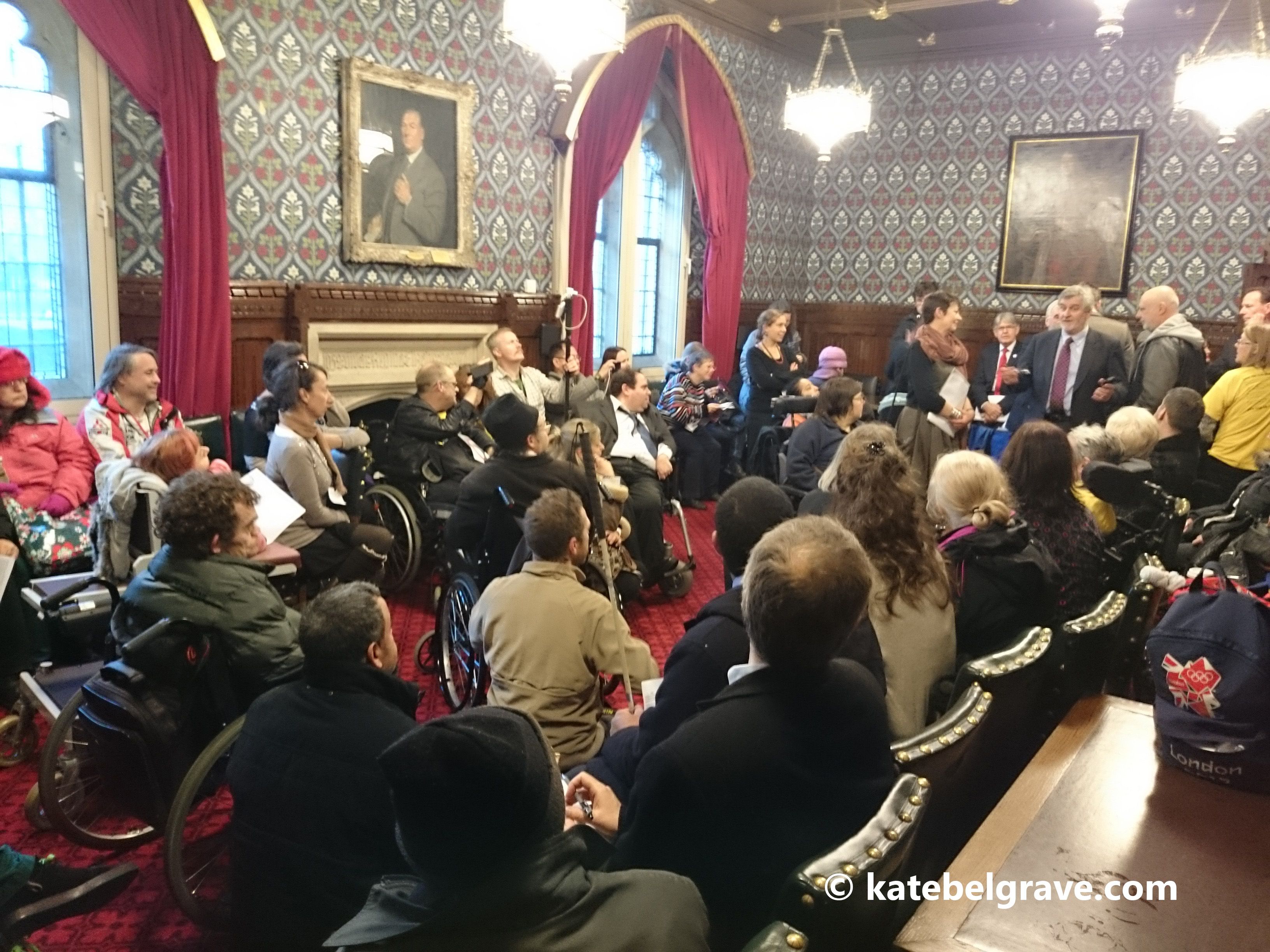
You’ll understand why doubt clouds this part of the picture for me. I don’t want to imply that we’re in totalitarian lockdown yet – I personally have a great deal of freedom and I don’t take it lightly – but things keep happening. They even happened at almost the exact same time that Cameron delivered the above ode to liberty. Here’s an anecdote for you. About 24 hours before Cameron came out with “the right of people to write and say what they believe,” I attended a lobby at parliament with a group of disabled people who’ve been engaged in a bitter three-year fight against a Cameron-government proposal to close the vital Independent Living Fund. This group of people use the ILF to pay for the extra carer hours they need to live independent lives. They can study, work, socialise and get out amongst it like everyone else. You might say that with that support, people have freedom. Without that money, these people will be in a very bad place indeed. It is not an exaggeration to say that some may die if they end up with inadequate care. We are most certainly talking a life and death situation here. We are talking about rights. We’re talking about the right of disabled people to live. That’s why so many people have fought so hard to get news of the ILF cut circulated. Nobody will let it go. Nobody can let it go.

Anyway, a journalist at the lobby started to livestream the event for the benefit of the many disabled people who weren’t able to attend, but who of course wanted to hear what MPs had to say about the future of the ILF. The ILF is due to close in just six months and people are naturally very worried. With a couple of honourable exceptions, the mainstream press has been utterly useless at reporting and campaigning on this funding cut. Livestreaming, protests and campaigner reports have been crucial to getting the news out.

Things were ticking along with the livestream and a number of people – one in tears –  explained their concerns to MPs. Then suddenly, some worthy burst into the room and said You’re Not Allowed To Livestream From Parliament – Turn That Thing Off. Continue reading

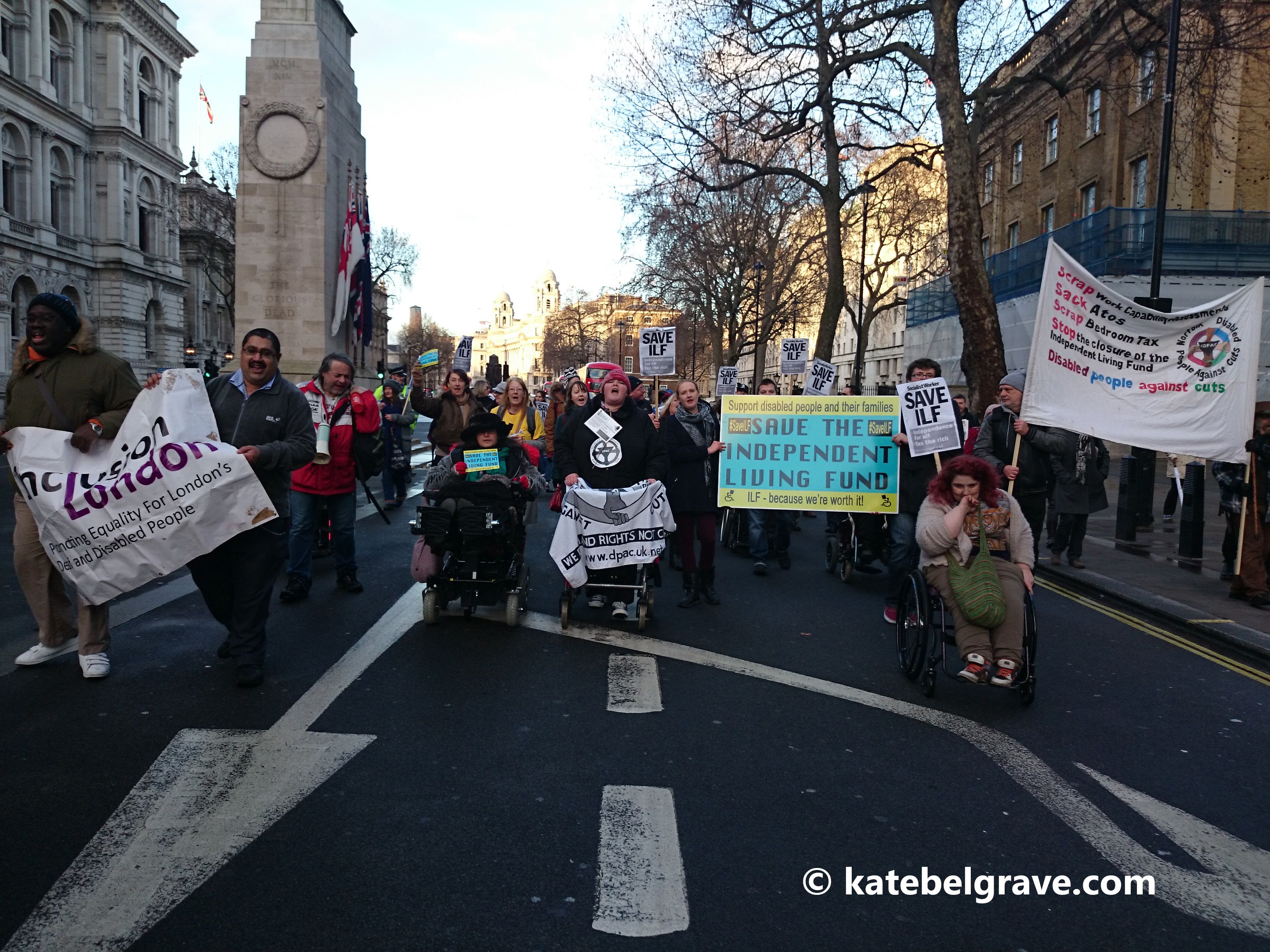
Disabled people block Whitehall and lobby MPs to save the Independent Living Fund

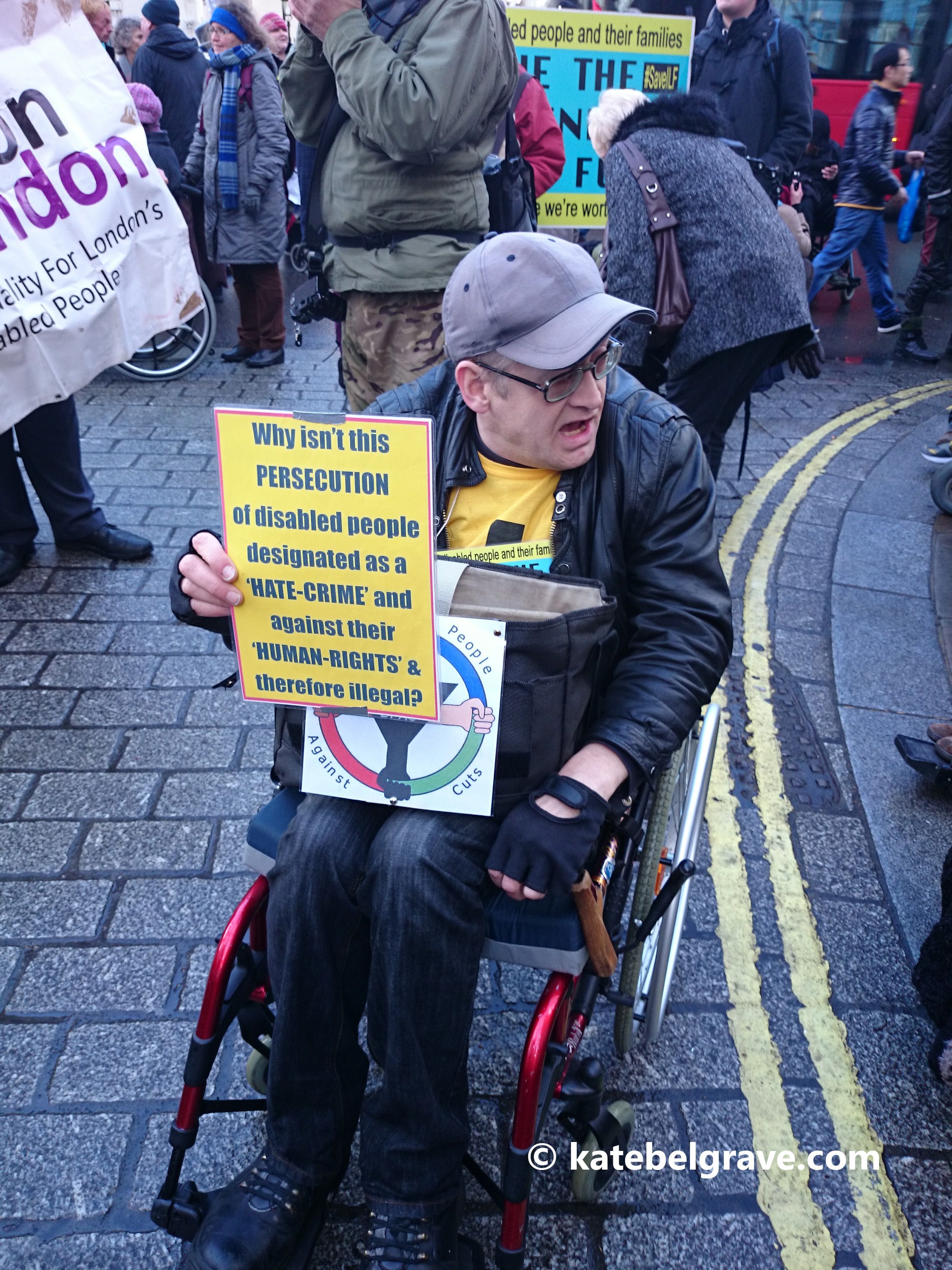
Disabled people and campaigners blocked Whitehall today and lobbied MPs to protest at the government’s plans to close the Independent Living Fund in just six months’ time. Here are a few clips, including one of (another) copper telling protestors that if they didn’t move off the street, they’d be arrested:

As readers of this site will know, the ILF is a fund that disabled people with the highest support needs use to pay for the extra carer hours they need to live independent lives. The government plans to close the fund at the end of June this year (2015). Without that money, these disabled people face lives shut away in carehomes.

Nobody voted for that.

As I’ve said many times before, these protests to save the ILF from closure are vital – to everyone, disabled or not. Saving the ILF is not just about saving a pot of money. It’s about saving the idea that severely disabled people deserve to live – like everybody else. Councils can’t afford to meet the full care costs of this group of disabled people. Some councils have agreed to ringfence devolved funds, but nobody knows how long funds will be devolved or ringfenced for.

I’m already talking to disabled people who rely on council funding for care and have to go without eating or drinking for hours because they can’t get the carer hours that they need. There are six months left to save the ILF. The fight to save it will escalate. Everyone knows how things will end for ILF users if the ILF is closed. This government couldn’t care less, of course. This government is murderous. Thing is – nobody is too convinced that a Labour government will care much, either. Labour has had several years now to commit to keeping the ILF open. Here’s shadow minister for disabled people Kate Green being extremely equivocal about that. I took that film of her towards the end of 2014. This is life and death stuff, so at this very late stage, you’d hope for more than you see in that film.

Save the Independent Living Fund

Save the Independent Living Fund

Save the Independent Living Fund

Save the Independent Living Fund

Pretty sure the government wants death, depression and crime for people who are out of work

A few thoughts as we kick into the year. Interviews from people who’ve been sanctioned at the end of the post:

As you’ll no doubt have read, the work and pensions select committee meets this coming week to hear evidence about benefit sanctions, with sanctioning connected to crime and depression.

Okay. I suppose that hearing will at least draw attention to the sanctions problem and the extent of it. It’s the What Next part that I wonder about. A lot of people know how things are. I spent many hours speaking to JSA claimants at jobcentres in 2014 (have posted some of those interviews below) and at least some of those people had complained to their MPs about sanctions and their treatment at jobcentres. Like many people, I can tell you now that there is absolutely no doubt whatsoever that stopping jobseekers’ allowance – already a meagre amount of money – to people who have nothing leads to crime and depression. You don’t have to look too closely to understand that that is the whole point of the sanctions/jobcentre/work programme exercise: to push anyone who struggles for work to the edge in one way or another and to terrorise everyone else into tolerating rotten pay and treatment just to keep a job. There’s very little mainstream opposition to that idea. I certainly don’t count this.

Three points of note from 2014:

1) Nobody I met ever got a job or even a job interview through their jobcentre. Not a single person. Everyone I met who found work did so through their own networks, applications and contacts. Jobcentres exist to administer goverment benefits policy and to channel people to the work programme and so-called skills courses, in my view. Wonder when jobcentres will be wholly outsourced.

2) Quite a few of the people I met who were signing on were actually employed for some of the time – on zero hours contracts, or short-term contracts, or on such low and irregular pay that they needed hardship loans and some JSA support. This is one of the many reasons why I find Labour’s ongoing justification of sanctions regimes in some form or other utterly misguided (I have other words, but am keeping it clean for the New Year). Pisstaking JSA claimants aren’t the problem. Pisstaking employers are the problem. That’s where the entire political emphasis should be. People I spoke to weren’t signing on for the lulz, believe me. They were signing on because it wasn’t possible for them to support themselves in an ongoing way at current rates and means of pay. Or they were stuck in workfare “jobs” that should have been paid and paid properly. Tinkering with sanctions policy hardly addresses the fact that sanctions in any form are about terrorising people into insecure, low-paid work and keeping them there. Let’s stop pretending that sanctions are about “mutual obligation” and other long-dated bollocks. Continue reading