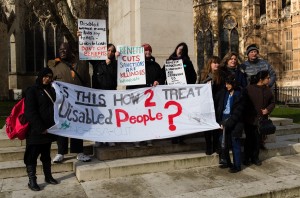
I’m here to highlight the absolutely appalling policy that George Osborne wants to implement to cut the Work Related Activity Group of Employment and Support Allowance to Jobseekers’ Allowance Levels which is a devastating move for over half a million disabled people, especially cancer patients, people like MS patients and people like that who need that additional money for their support needs around their disability, money to eat, money to get to hospital appointments.
To cut the WRAG group of ESA is a totally draconian, callous, inhumane move that will have a devastating impact on many lives
————
I’m Eilidh Whiteford, I’m the SNP’s social justice spokesperson and the reason that I’m here today is because obviously the amendments that the Lord’s passed in the last few weeks that could reverse those cuts to disabled people are coming back to the commons so it is really important that we’re in the debate this afternoon.
————-
My name is Neil Gray I’m the SNP MP for Airdrie & Shotts and the SNP’s Westminster spokesperson for fair work and employment and I’m here today to show solidarity with disabled people who are opposing the government’s attempts to remove the ESA WRAG, and also the reporting obligations on child poverty. We believe that those are incredibly damaging and we want to see the Lords amendments stand.
————
Paula Peters
Vote No to ESA WRAG cuts. Say No and do the right thing by disabled people for once in your lives.
Iain Duncan Smith and government plan to push more sick or disabled people into work. Pity that he and the DWP lie about the support that disabled claimants on JSA and in the ESA WRAG group will find when they’re forced to try and find work through jobcentres:
You’ll hear below a covert recording made last week with a person who used to work as a Disability Employment Adviser (DEA) in a northwest London jobcentre (this person now works in another jobcentre role). DEAs were specialist jobcentre advisers who had time and training to support sick and disabled benefit claimants. Government cut the number of DEAs in jobcentres by 60% by the end of last year. For months now, advisers have been telling me and the disabled claimants I accompany to jobcentre meetings that the loss of DEAs means there is now little support or help for sick and disabled benefit claimants at jobcentres. There doesn’t seem to have been much by way of a replacement service. Advisers say that there generally isn’t resource or time.
Last week at the northwest London jobcentre I was visiting, I asked the adviser in the recording if jobcentres in the area offered much in the way of specialist, back-to-work support for sick or disabled benefit claimants. You’ll hear the adviser say that there is little support for these claimants now that jobcentres are “getting rid of” DEAs. I have recorded other advisers saying very similar things in past months. The adviser in the recording below said that in her current job, she dealt with some people who have “bipolar and schizophrenia or psychosis” diagnoses, [but] “they’ve got to want to get a job for me to work with them.” I took this to mean that people who were longer-term unemployed because of the severity of their conditions and situations were parked and offered little beyond basic signon meetings with advisers and the occasional work programme placement (we knew mutually of claimants who had been in that category for a while):
“When I changed to this job, I had to like not think about those clients anymore and it’s really, really difficult, because I know they are having problems and I know they are struggling and there is no support for them.”
Here’s an example of the struggle that people who are on the rough end of austerity have even to be heard. Thought I’d throw this one up there as just another example from the many I’m working through:
A couple of weeks ago, I decided to go in for an experiment of a kind. I sat with two women who live with their small children in temporary accommodation in Boundary House, a cramped Welwyn Garden City homelessness hostel, and called the Waltham Forest Council press office so that the women could respond directly to a press statement that the council had sent me about standards at Boundary House.
Waltham Forest Council sends homeless families to live in tiny, one-room hostel flats at Boundary House, sometimes for a couple of years at a time. Some families live four to a single-room studio flat. There are and have been all kinds of difficulties at Boundary House. Residents talk about overcrowding, problems with a lack of hot water, problems with security in the building – so, when I first wrote about the place, I sent questions about these sorts of issues to the Waltham Forest council press office. “We will investigate this further if full details are provided,” the council said in a line about the hot water. I saw that line kind of beaming out at me and I thought – Okay. I’ll read that as an invitation and take the council up on it. The hell with it. I’ll call the press office while I’m sitting with Boundary House residents and hand the phone to residents so that they can provide the press office with those “full details” to pass onto the housing department for resolution.
Some might say that it was unorthodox to ring the press office in that way, but I can’t say that I gave or give much of a stuff about that. Residents were saying then that calling the housing department with problems yielded poor results and I personally long ago reached the point where I’ll try anything to get any officer’s attention on these sorts of issues, so in I went. I thought residents might as well give the press office invitation to investigate “full details” further a whirl.
Alas, this idea tanked: the press office didn’t want to speak directly to Boundary House residents. It seemed the office would take details from me, but not from the residents, even though they were a) better acquainted with their own details than I was and b) sitting right there next to me and available to speak. I argued this toss backwards and forwards on the phone with one bloke for about ten minutes. And then, the kicker: when I handed the phone to Alicia Phillips, a young mother who’d been stuck living in one of these tiny, single-room flats in Boundary House with her two young children for two years and who wanted to pass on “full details” of her problems at Boundary House to the council, the press office bloke hung up the phone. I rang the council and ask for a callback, just in case the hanging-up had been some kind of terrible technical mistake. Alas, that callback never came. The press office emailed me after a while, saying that it was probably better if we stuck to their format for communications. Boo.
Here is a recording of the hanging up:
I thought that the hanging-up was off, to say the least. I thought it was off, even knowing the way that press offices operate. I had the pleasure (ahem) of a job as a council press officer back in the day, so I am familiar with the workings of the role therein: an officer takes questions from a journalist, seeks a response from the relevant council officers and councillors, polishes that response until it is beautifully smooth and about 98% meaningless, and then sends a final, finessed result to the journalist. You’ll hear the council say in the recording that I don’t understand how the system works, but I do. I really do. Been there, etc. I understand perfectly well that press officers don’t resolve problems, as such. They collate council responses to problems.
For what they’re worth. As a rule, these responses are completely useless (certainly, most of the ones I sent over the years in the job meant nothing to anyone. They were paper printouts and faxes then, too. I bet people just used them to line the bottoms of budgie cages). It’ll be news to nobody that press office statements are almost entirely concerned with defending a council’s actions and reputation, as opposed to prioritising and addressing the worries of service users. They’re almost admirable the way that they shine no light whatsoever on the situation that you’re trying to get to the bottom of. You really might as well stick a jpeg of a horse’s butt on the end of your article. Still they come, though, and still we ask for them. I vaguely remember being told at journalism school that you must always ask for a council or government department’s view in the interests of “balance.” I’ve stuck with that instruction for reasons that increasingly escape me. I find that as I age, my patience for some of the garbage I’m sent is wearing thin (you should see some of the drivel that the DWP press office has poured into my inbox over the years).
I’m publishing the quote here, because it’s the sort of comment that I’ve heard a lot in the past few years from women who are homeless and/or who are really struggling to make ends meet. They worry that their children will be removed if a council knows that they are struggling financially, or if they break down because they are under pressure and living in poor circumstances. I’ve written about this before: as I say, women have made this sort of comment to me over the years. People clearly believe that the threat of losing children is there. It is a thought and concern that they factor in:
“Like me and my children, we never had a house which is not overcrowded. Never. It has basically been like this a lot, but there was no support from council… Then, if I’ve gone crazy or something, then they would have taken my children away. That’s what I am saying. They draw you into this kind of situation, into this madness and then they say “Oh, you’re not a suitable mother. We’re going to take your children.”
I think about this a lot. I wonder how many people have this thought and concern in their heads. I wonder how many people decide never to challenge a council about their poor living conditions, or to never apply for, say, a discretionary housing payment to help make up their rent, because they don’t want to draw a council’s attention to their problems. For every woman I meet who has decided to protest about her living conditions, there must be plenty who have decided not to. Fear keeps people pretty quiet.
Posting here will less frequent for the next few months while I work on a case studies project. There will be more from this article in that project. You can still get in touch here.