The PIP assessment system is garbage. And dangerous.

This is a story about Capita’s abject failure to adjust its PIP assessment procedures for people who need adjustments.

Here’s a Personal Independence Payment decision letter received last week by Sean (named changed), a man in his 50s who has Asperger’s and severe depression and anxiety:

comply_letter_


You’ll see the letter says that Sean – a long-term Disability Living Allowance recipient – has been denied PIP altogether. He has been denied PIP, because, the letter says, Sean “failed to comply at the assessment centre,” (Sean was assessed for PIP at a Capita assessment centre in earlier this year). That would appear to be that.

Except that it is not. I think this is a significant decision. It is significant because it suggests that Sean’s PIP assessors made no allowances or adjustments for Sean’s mental health and problems dealing with stress at his assessment. Sean says that he got angry and upset at his PIP assessment and that the assessor cut the meeting short, because Sean was clearly not able to cope. Now, Sean has been told that the official interpretation of this event is that he failed to comply at his PIP assessment. He won’t get PIP as a result.

This makes me wonder. It certainly makes me wonder how things pan out for other PIP applicants who have complex spectrum diagnoses and mental health conditions, and who exhibit so-called challenging behaviour in stressful situations such as PIP assessments. Is it One Strike And You’re Out for everybody? Does Capita actually have processes in place to make sure that people who clearly struggle with assessments have other assessment options? Sean says that the Capita assessor suggested a home assessment when his face-to-face meeting was ended – but the home assessment never happened. It turned out that Sean and his GP were responsible for organising a home meeting themselves. (I rang the DWP to try and get to the bottom of all of this and the officer I spoke to said that was how the “system” worked). Sean didn’t realise this. The upshot was that a home visit never took place. Continue reading

Video: jobcentre adviser says disability support is wrecked. Fix this, Mr Green

This one goes out to our new work and pensions secretary Damian Green. What will he do about the destruction of disability support in jobcentres? Hope the answer isn’t Nothing, or Get Lost, Kate.

Throwing this out there as a conversation starter:

I post below a video extract from a meeting at northwest London jobcentre earlier this year.

In the video and the meeting, the jobcentre adviser freely conceded that services for benefit claimants with extra support needs had been wrecked by cuts. More than that: the adviser conceded to me and Linda*, a 51-year-old sick and disabled JSA claimant whose JSA claim had been closed and housing benefit suspended, that “the most vulnerable” claimants who “can’t cope with the complexity of the [benefits] system,” were at extra risk of sanctions, claim closures, housing benefit shutdowns and other bureaucratic screwups because the service had been wrecked by cuts. They were at extra risk because the DWP had radically reduced the number of specialist disability employment advisers in jobcentres. Disability employment advisers were jobcentre advisers who had the time and training to support sick or disabled benefit claimants. They weren’t all great, but some were better than nothing. On occasion, they acted as a buffer between disabled claimants and sanctions. Some would argue in defense of a sick or disabled claimant who missed a meeting, or they’d make sure not to sanction a claimant who couldn’t use a computer and meet online jobsearch requirements.

In various press statements over months, the DWP tried to tell me that DEAs had been replaced by work coaches who offered a tailored service. In reality, jobcentres advisers were telling me and sick or disabled claimants such as Linda that DEAs had been replaced with nothing:

(Video transcript at the end of this post)

You’ll understand why I’m very keen to hear about the sort of plans that our new secretary of state for work and pensions has to address this particular disaster area. I’m not keen on receiving more press releases, or empty statements from the DWP about so-called tailored support for sick or disabled people. I asked the DWP last week about the number of DEAs in jobcentres/how things were coming along, etc. They chucked me a link from an early-June Hansard debate in which already-forgotten DWP head and baton-dropper Stephen Crabb rattled on about plans to double the number of DEAs in jobcentres. If I am honest, this doubling didn’t seem a great result to me, given that the number of DEAs had been cut by more than half in the first place. God knows, too, if any action on the doubling front has or will actually be taken. It is my experience that commitments made by ministers and the DWP don’t always exactly match the reality of the everyday journey on the ground. Let’s add that to the list of issues to explore. I’m keen for Mr Green to open jobcentre doors at all times to journalists, claimant representatives and anybody else who wants to forensically examine the facts of the DWP’s support for sick or disabled benefit claimants.

Continue reading

#PIPFightBack: Day of Action Against PIP tomorrow Wednesday 13 July

From Disabled People Against Cuts:

Personal Independence Payment (PIP) is the replacement for Disability Living Allowance (DLA).

While DLA worked to provide support for the extra costs of being disabled, and the system worked well, the whole PIP system is rotten to the core.

The whole purpose of making the change from DLA to PIP is to remove people’s entitlements to the vital support which DLA provided to help enable disabled people to live a life on more even terms with non disabled people.

With the PIP assessment regime now in place, thousands of people have already lost out and reports of the shoddy nature of the assessments are growing every week. While the success rate at tribunal is high, it is taking up to 6 months or longer for cases to be heard – leaving disabled people struggling.

Read more here and find out about tomorrow’s protest events and online action.

How people are treated like garbage when they are trying to apply for PIP

Here’s an example of the way the Disability Living Allowance to Personal Independence Payment system “works”:

Sean (name changed) is in his 50s. He has an Asperger’s diagnosis and serious depression and anxiety. He struggles to leave his house. He relies on his partner to do much of their shopping and to make many of the endless phone calls that people who must navigate the benefits “system” must make. His partner has a schizophrenia diagnosis.

Sean is in the support group for Employment and Support Allowance. I’ve attended two of his ESA work capability face-to-face assessments in the last few years. Sean and his partner pay the bedroom tax on their so-called “spare” room. They also pay council tax now, because their council tax benefit has been cut. The mail that pours into their letterbox from the DWP and the council is pretty much non-stop. Last year, Sean even received a letter from the DWP which asked him to consider attending so-called work-focused interviews at his local jobcentre. People in the ESA support group are supposed to be exempt from job-finding requirements and activities, but still Sean got that letter. “They are relentless,” he says most times we speak. Indeed.

Now he’s stuck in the shambles that is PIP. Earlier this year, Sean received a letter from the DWP which said that his Disability Living Allowance was about to end and that he should apply for the new Personal Independence Payment. This news and new pile of forms was upsetting enough in itself. Sean says the income that he received in DLA made up an important part of the money he relies on to survive. The thought of losing that money or even part of it was of great concern. He found the PIP application form daunting, but filled it in with the help of a local advice group. The form was submitted. Next, he waited to hear from Capita with a date and time for a PIP face-to-face assessment.

As far as Sean is concerned, this part of things has been dire. Sean says that early in April, right out of the blue, he got a call from someone at Capita who asked if he could attend a PIP face-to-face assessment the very next day. This was not a good approach to make to someone who has Asperger’s and depression, and who struggles with sudden change. Sean was certainly rocked by that call. He and his partner rang to tell me about it. A next-day appointment gave him no time to prepare. For the ESA assessments we’ve attended, Sean’s arranged in advance for his father-in-law to drive him to the assessment centre. He’s also made sure that someone could attend with him. Surely ringing a person with Sean’s health history and asking him to attend a feared assessment the very next morning was reckless. In the extreme.

Continue reading

The future will be wrecked for generations while women and little kids live like this

Think this fractured society will be healed soon? It won’t be while women and little kids live in the rotten conditions described below, and with no way out. Nobody builds a united future when young families must live in chaos and when the social security systems that should support them have been destroyed:

On Monday last week, young mothers who live with their kids in cramped single rooms in the Welwyn Garden City Boundary House homelessness hostel protested at Waltham Forest Council about their living conditions. All the women are homeless. All were placed in the Boundary House flats by Waltham Forest Council. The accommodation at Boundary House is horribly cramped and isolated. Placements at Boundary House are only meant to be short-term. Most of the women I’ve spoken with this year say their councils told them that they’d be in Boundary House for a couple of months at most – but some have been stuck in Boundary House for more than two years (Newham council used to place homeless families in Boundary House as well). The rooms look like this:

flat_interior_

Photo credit: Snapsthoughts http://photos.snapsthoughts.com/

It will surprise nobody to hear that relations between Boundary House residents and Waltham Forest council have reached breaking point. In the video below, you can see the women and council officers yelling at each other as the women descend on the council’s housing office to demand better housing and to make the very valid point that their living conditions are intolerable and that they need better housing:

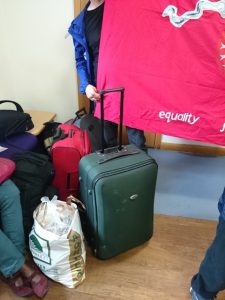
Things are not generally good at places like housing offices and jobcentres these days, whether there’s a protest on or not. Furious homeless families and overstretched frontline staff have been abandoned to fight it out with each other in austerity. Shouting is not unusual. Desperation is certainly not unusual. Security guards are not unusual. When the mothers arrived, the housing office was already very busy. Some people who were waiting to be seen even had their suitcases and belongings with them. I’ve seen that in a number of housing offices in the last year or so. This is how a lot of people live now, if “live” is the word:

Bags__

Bags_

There was a heavy security presence, as there often is at housing offices and jobcentres now. I’ve attended enough meetings at frontline offices to know that you get guards at these places whether there’s a protest on or not.

The Boundary House women have two major problems. The first is that their accommodation is unpleasant, but they must raise their small children in it. The second is that they know their chances of getting money together for anything better start to evaporate as soon as they arrive at Boundary House. The Boundary House women live with their children in small, single-room flats in the hostel. The families only have that one room. Beds, kitchen, clothes and belongings are all crammed into that single space. Each flat has a small, separate bathroom. People complain about cockroaches and woodlice – you can hear the women talking about that in the video above. The building itself is isolated. Boundary House is down a suburban side street. The walk to Welwyn Garden City train station takes a half-hour and from there, people face an expensive (around £300 to £400 a month) commute to London. Continue reading