Finishing up some things atm, so back posting next week.
Back soon
Reply
Finishing up some things atm, so back posting next week.
This is a rant, but let’s have it:
Here’s a short list of long points re: some of Universal Credit’s fatal problems as I see them (literally – these are based in problems that people I’ve interviewed actually have).
1) Universal Credit is based on a truly terrifying government and political class contempt for people in poverty.
I have a lot to say on this, so let’s go:
The main point I want to make is that Universal Credit is based entirely on the (false) premise that people in poverty are solely responsible for that poverty and any problems they have finding work. All Universal Credit problems flow from this political contempt.
The (highly misleading) idea behind Universal Credit (and its strict in-and-out-of-work jobfinding conditionaility) is that people only need a kick up the backside to get out of poverty. With Universal Credit, those kicks take the form of sanctions threats, constant reminders to find more hours in jobs that already pay almost nothing, and days on meaningless, fruitless, privately-provided “employability” courses.
In other words – if you’re poor, stop being poor, or else. That’s it.
This should make everyone furious.
It should make everybody furious, because it is entirely about government shifting blame for societal problems onto the shoulders of people who are least able to respond, or to take the financial burden. There is no acknowledgement whatsoever from government that the problems that land people in poverty might be external – that too many people these days can’t find enough decently-paid work to live on. I see this all the time, as does anyone who frequents foodbanks and jobcentres. It’s real.
Why does government think it has a free pass on this? There is no concession AT ALL to the fact that finding secure work which pays a wage that people can survive and thrive on is difficult, especially in some parts of the country, where it is incredibly difficult (I know this, because I travel around). There is no acknowledgement that government needs to address those problems before pointing the finger at the very people it has abandoned. There is also no concession that money which should be spent on wages and social security keeps disappearing into offshore tax havens. How long will this be tolerated?
Readers of this site will know I regularly interview people who experience these employment difficulties. I’ve interviewed cleaners, carers, housekeepers and people who work in warehouses and in other low-paid jobs. They all have the same problem – insecure employment, variable hours and low wages. They never get ahead. They never will. They never have the money to get ahead. They’re thousands of pounds behind, because they’re in debt. Welfare reforms such as council tax benefit cuts (and court fines for non-payment of council tax) and LHA and benefit caps pushed people into debt even before they were moved to Universal Credit.
As I see it (and I do see it, as I say) government’s answer to its own glaring job creation and wages failures is to set up a system such as Universal Credit and to tell people who receive it that they are responsible for the lack of local jobs and money, and that they need to pull finger to sort problems out. They must fix financial problems by meeting Universal Credit’s strict conditionallity rules and working endless hours for very little money in an unreliable, low-wage economy.
If anybody dares to supplement their non-income by thieving or dealing, they’re chucked in jail (I’ve lost count of the number of people on the breadline I’ve spoken to who’ve done time for such offences. Nobody seems to want to talk about that). It’s just a pity that the same strict rules for behaviour aren’t applied to all these tax dodgers we keep hearing about. Those people walk away from the havoc they create (or fly off in their private jets, or sail away in their yachts, or whatever).
There’s much talk and fury (there should be more) about deaths related to benefit cuts: people dying after being found fit for work and people committing suicide following cuts to their benefits. There’s no doubt that current and one-time government ministers need to do jail time for this. And they will. There will most certainly be a reckoning.
There’s another sort of government destruction of people taking place that I want to raise again here.
It’s hard to quantify, but very obvious when you keep seeing it. A lot of people talk about it.
It’s the all-round annihilation of people’s health via the universal destruction of all the services they rely on – housing, care and income help in particular. The life expectancies of people in these situations MUST be adversely affected (to say the very least) by this all-round destruction. I really don’t care if anyone thinks such a statement is hysterical. It isn’t.
I know what I see. I keep interviewing people who are assaulted by government cuts on all fronts. Assault is not too strong a word.
People live in cheap rented housing which is disgusting and full of mould (I’ve posted pictures of some places I’ve been in below). This is the only housing that people can afford on LHA rates. I’ve interviewed people who live in tiny, grotty, falling-apart static caravans because they can’t afford anything else.
People’s care services have disappeared, because they can just about achieve the daily basics such as shopping and dressing on their own. They’re left to it as a result. No matter that they struggle with other aspects of running a home, such as keeping the tiny places they must rent clean and clear of mould (you can see that in the pictures below).
They are getting older, but must drag themselves to weekly jobcentre meetings to talk about work they’ll never get. They’re banned from jobcentres because they lose their tempers (perfectly understandably) when the DWP insists they apply for jobs that everyone knows they’re not eligible for. They’re thrown out of jobcentres when they try to drop in the sick notes their doctors must keep writing to cover people’s very obviously deteriorating health. The hours I’ve spent posting or delivering sick notes to the DWP and jobcentres for people who everyone at the jobcentres knows is neither fit nor eligible for work – I tell you what.
The “lucky” people are supported by collectives such as the Kilburn Unemployed Workers’ group who really do make herculean efforts to keep things afloat for people. Other people just rot.
There’s no doubt in my mind that each of these problems hacks away at people’s health. Together and over time, these problems are dynamite. Because I see people again and again, I see the deterioration as it gathers pace over time – the weight loss, the worsening diabetes and respiratory health, and the decline in mobility. It’s neither hysterical nor naive to say that. I spend most of my time out talking with people who are in these situations.
People like me and plenty of others know what we see. We’re not the ones who are hysterical or in denial. Seriously. This is not exaggeration, or hysteria, or even the dreaded fake news. Fake news is the sort of thing you find in the average DWP press release – press releases which say, for example, that the DWP provides “tailored” services for sick and disabled people, even while jobcentre advisers are telling you that the DWP does nothing of the kind. I think that every mainstream outlet which publishes a DWP justification-for-policy statement at the moment is publishing fake news.
—————
Here are some pictures of places I’ve taken in the last few years.
You can’t tell me that the health of the people who lived in these places hasn’t been affected by these cramped, mouldly, filthy conditions. Anyone who says otherwise really is naive.
The man who lived in the first two places (he has learning difficulties and diabetes) has recently been found sheltered housing thanks to the efforts of the Kilburn Unemployed Workers’ Group.
Mould in one-room studio flats in London (kitchen, bed, living space all in one room):


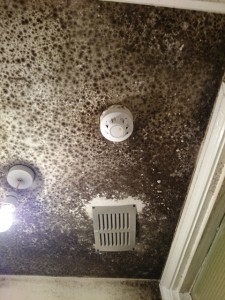
Man in his 60s living in an old static caravan (Oldham):


Time to share a few observations on that sanctimonious school of thought which says a) people shouldn’t give money to street homelessness people because they’ll buy booze and b) that the money should instead go to charities which “help” street drinkers.
I LOATHE that line. It implies that street homeless people aren’t entitled to the autonomy everyone else enjoys when it comes to spending/wasting money. It also implies that people who won’t/can’t stop using should be sidelined.
Which they must not be.
Let’s have a story:
Here is a picture I took recently of James, 50.

James is from Oldham. I met James in September last year. Since then, we’ve had lunch and played pool on the free table at the Ark in Oldham every month or so. I spoke to James last night. We’ll meet up again on Friday.
James has been in and out of street homelessness for years. I’m guessing that the drinking has everything to do with that. We’ve talked about it. In the time I’ve known him, James has been been banned from malls and various soup kitchens for aggro when pissed. When I saw James at the end of September, he was street homeless again. He’d just been turfed out of the temporary accommodation he’d lived in for several months:
“Don’t know what happened. The landlord come round last week and told us all to get out.”
Recently, James took a thrashing, as you can see. I met him at a Sally army lunch the day after it happened. He still had blood on his clothes. He had two black eyes, bruises down both sides of his face, a deep slash across his nose and a burn on his scalp where his head had been set alight for some reason. He wouldn’t show me the burn. He kept pulling his hat down.
“They told me it [the burn] is the shape of Ireland,” James said.
He also said, “I’m sick of people talking about it.”
I got a note from the DWP FOI yesterday to tell me a response to an FOI request that I sent last month about deductions from Universal Credit for tax credit debt would be delayed.
Of course – that’s happened before and not just to me. The point I making today is that I can’t get anything from the department on any front. The press office wouldn’t give me even a one line response to use about a fortnight ago for a question about private companies which do or don’t run Universal Credit contact centres (the department sent me a list I had and then I had to send another FOI. I couldn’t understand why the DWP wouldn’t just tell me who ran the contact centres).
And then there’s the fact that people’s requests for their own benefits paperwork go unanswered by the department.
Don’t like it.
Readers of this site will know I’ve written regularly about Maggie (name changed), a 41-year-old Northampton woman with a schizophrenia diagnosis.
Maggie has been sectioned in the past and has spent time in hospital.
Maggie receives the Employment and Support Allowance benefit. Up until recently, Maggie was in the ESA Support Group, which is the group for people with the highest support needs.
The DWP suddenly changed that about a month ago. Maggie was sent to a Maximus face-to-face assessment. She got a letter at the end of September which told her that her ESA claim had been downgraded. She was now in the ESA work related activity group (which means that she must attend jobcentre meetings about finding work) and her benefit money had been cut.

The DWP did not tell Maggie why it had suddenly decided she was able to look for work and live on less money. Her condition has not changed. It’s actually worsened since local mental health support services were cut. No reasons for this decision were included in the DWP’s letter.
Maggie rang the DWP to ask the department to send her a list of reasons for this decision to push her into the ESA WRAG group. The DWP said it would send her those reasons by post. That was three weeks ago. The list of reasons has not arrived. Maggie can’t properly challenge the decision to change her benefits without understanding exactly what it was about her condition that the DWP thought had changed.
However – the DWP HAS managed to send other post to Maggie in the last few weeks. The department sent her a letter which told her in no uncertain terms that she must turn up to her jobcentre for a work-related interview, or risk benefit sanctions. The DWP has no problem getting that sort of letter – ie a threatening letter – in the post. That part of the system works absolutely fine.
That letter about the work interview at the jobcentre arrived almost immediately after the letter which told Maggie that her benefit had been cut (I was actually speaking to Maggie on the phone about the first letter when the second one dropped through the door). Maggie had to attend that first work-focused interview at her jobcentre last week.
I am getting very, very sick of this. You think the sex scandals in parliament are bad. This sort of story is as bad and worse. This is cutting off support to people in great need and dropping them in it.
With one pen-stroke, David Gauke and the rest of the DWP’s geniuses cut money and support to someone who has previously been hospitalised because her mental health condition is so serious. Nobody gives a stuff about that, of course, or about the effects that such letters have on people whose are already struggling to keep things going. After cutting her money, all the DWP offered Maggie by way of “support” (ha) was a threat about attending a jobcentre meeting.
How do Gauke and his bureaucrats still get paychecks for running this intentionally disastrous system – the system that people in the greatest need in our society must use? The situation I’ve described above is exactly the sort of scenario that sets desperate and unsupported people up for suicide attempts – horrible threats, pressure and reduced money, and nobody to help (welfare support and advice in Northampton is hard to come by). It isn’t even subtle.
So much for government taking mental health seriously. Do me a favour.
I won’t be letting this one go.
“[We] move [a homeless family] into [temporary accommodation] and of course it is full of cold and damp, and things don’t work, and there’s rats running around…”
“….I do remember somebody who did actually have a hole in the ceiling and rain was coming through.”
“Mostly, it’s mould is the biggest problem….you get some terrible places.”
“[When placing people in other boroughs]…They [the originating council] don’t have the resources to go and look at the accommodation before they move people into it.”
This is the second article in a series I’m writing with a housing officer who has worked (and still works) in council housing offices across London and Greater London*. There’s a transcript from this interview at the end of this post.
For this article, I asked the officer whether London councils inspect accommodation before they place homeless households in it. I was especially interested in checks on temporary accommodation when London councils send homeless households to other boroughs.
I asked, because I’ve interviewed quite a few people who’ve been disgusted at the standard of the accommodation that they and their families have been placed in both in and out of borough.
Councils ALWAYS insist to these tenants that temporary accommodation in other boroughs has been and is inspected, either by council officers, or by companies which manage that accommodation.
“That’s bullshit,” the officer told me (a view that tenants usually share).
“The biggest problem with accommodation is – obviously, a lot of councils are having to get accommodation out of their borough. [It’s] not always a long way out of the borough, but maybe the next borough, or the borough after that one.
They [the originating council] don’t have the resources to go and look at the accommodation before they move people into it.
They’ll ring up and say, “well, as long as they’ve got a gas safety certificate and an electrical safety certificate…” other than that, they ask the landlord, “is the accommodation nice and clean and all that?”
They’ll [the landlord] be like, “yeah, of course it is [laughs]…[then you] move somebody in there and of course it is full of cold and damp, and things don’t work, and there’s rats running around…”
“….I do remember somebody who did actually have a hole in the ceiling and rain was coming through. That was obviously somebody who got moved straight away… but obviously, they [the council] didn’t know that when they placed that person there. The landlord didn’t mention the hole in the roof, strangely enough.”
“Mostly, it’s mould is the biggest problem. That is a problem, because it’s health. It affects some people’s health and clothes, and everything else…you get some terrible places. It doesn’t even have to be that bad. You know if there is mould there, you ain’t going to get rid of it very easily.”
Keeping a record of these things:
Yesterday morning, I made two calls to the DWP’s Debt Management “helpline” – the 0345 850 0293 number that people who receive benefits, including Universal Credit, must use to sort out problems with debt money that the DWP deducts from people’s Universal Credit payments.
I had to call twice yesterday (I didn’t have all the information that DWP Debt Management required the first time around. Unfortunately, I had to make the first call to find that out). I was on hold for more than 20 minutes both times to that 0345 850 0293 DWP Debt Management helpline, as you can see in the image below. I also called the line on Friday and was on hold for more than ten minutes, before I had to hang up to deal with something else.
As far as I can tell, this number has a charge. (I have a phone contract which covers those charges – that’s why I make calls for people who don’t). I hope this is one of the numbers that David Gauke has decided will be free soon. All helplines lines should have been free in the first place (I’d ask the DWP’s press office where things are at on all of these lines, but their answer to all my questions these days is to submit an FOI. So I have).
People who ring the DWP Debt Management helpline only ring that number because they have a debt problem and are in serious financial hardship. They can least afford extra charges for phone calls:

I was calling on behalf of young woman who claims Universal Credit and whose story I’ve been covering. She is concerned about deductions for child tax credit debt that the DWP is taking from her Universal Credit payments. She disputes the tax credit debt. The DWP has taken over tax credit debt recovery for Universal Credit claimants from the HMRC.
Trying to get to the bottom of disputes and problems with deductions from benefits like this literally takes forever. It really does. It drives people out of their minds. The whole “process,” is unbelievably stressful. I can’t emphasis strongly enough the difficulties we’re having just finding the right people to talk to – or getting through to anyone at all.
I called Universal Credit on Friday to try and understand who to contact. We wanted to do two things – challenge the tax credit debt and stop the reductions from benefit. Universal Credit said we’d have to speak to the HMRC about challenging the tax credit debt decision, and then to DWP Debt Management about stopping or reducing the deductions the DWP was taking from the Universal Credit payments each month.
Universal Credit gave me two different numbers to call. There was no suggestion that Universal Credit could just me put through to DWP Debt Management. I had to make new calls all over again. I’ve literally spent the time I’ve had available since then on hold to DWP Debt Management.
I post this, because I want to keep talking about the problems that people who are on the lowest incomes and most in need have with these systems. Waiting on hold to a debt management department for more than 20 minutes when you’ve got a serious debt and income problem is dreadful. It really is. People have complicated situations, too. I had to call Debt Management twice yesterday, as I say, because I didn’t have all the information needed when I made the first call. That sort of thing happens all the time. It meant I had to find the information, dial DWP Debt Management again and wait another 20+ minutes for the phone to be answered.
This really is the sort of thing that has people climbing the walls.
Not a trick question…
Readers of this site will know I’ve been working with a young woman in Colchester who receives Universal Credit. She is very concerned about the random amounts of money that the DWP suddenly started to deduct from her Universal Credit payments for an alleged tax credit debt.
The woman disputes the debt. She wants a chance to challenge it and to stop the deductions.
The DWP is taking over collection of tax credit debt from the HMRC for Universal Credit claimants. People are complaining that the DWP has started to deduct tax credit debt repayments without notice from their Universal Credit payments each month.
Problem is – people who want to challenge these deductions run into bureaucratic problems at every turn. It’s very hard not to feel this is intentional. It really, really is. Here’s an interview I posted yesterday with an Oldham woman who has the same tax credit debt problem.
Three weeks ago, the Colchester woman asked the DWP to send her a full statement and breakdown of her alleged tax credit debt. She wanted a statement which showed the debt and listed all repayments deducted from her benefits and tax credit claims for to date.
She’s found getting that information impossible.
On the phone, she was passed from the HMRC to the DWP to the DWP Debt Management department.
The DWP finally agreed to send her a statement history in a fortnight.
 That was three weeks ago. The statement has not arrived.
This means the woman is no closer to being able to challenge the tax credit debt, or the DWP’s deductions from her Universal Credit payments.
The DWP’s bureaucratic failures and institutional indifference deny her that right. The department continues to deduct tax credit debt repayment money she can ill afford to lose from her Universal Credit payments.
She will go further into debt because of that – a point that should concern everyone. This woman just took out another Universal Credit advance payment to cover the tax credit debt deductions – having just finished paying back the Advance Payment she took out to cover payment delays when she started her Universal Credit claim (you can see that deduction in the image above).
The whole thing is absolutely hopeless. I’ll post more on it as we make further requests for statements and repayment histories. Continue reading
I’ve posted below a transcript from another recorded interview with a Universal Credit recipient made at Oldham foodbank on 13 October.
I post this transcript to show you three things:
– The debts people on low incomes must pay (particularly debt imposed by welfare reform)
– The way the DWP deducts random repayment sums for DWP loans and tax credit debt from Universal Credit payments without telling people, or agreeing manageable amounts
– The fact that people are hit by so many debt demands from councils and the DWP that they give up on all of it. Which is entirely understandable. There’s no answer to any of this, unless a philanthropic someone suddenly hands over £5000+ to clear these debts.
K, the woman in this story (she didn’t want her name published) was paying the bedroom tax, rent arrears, credit card debt, a benefit overpayment she didn’t understand, working tax credit debt, a DWP social fund loan debt and council tax debt.
Said K:
“…I don’t know where it’s come from. I didn’t even know if could go back that far [the benefit overpayment demand K had received]…it’s 2008, or 2009, and that’s housing benefit overpayment… I came out of work last year and they told [me]… working tax credits, they’ve overpaid me by £1000. They’re taking out £50 a month and I can’t do nothing about it, yeah. They just took it out, so basically, altogether, what comes out of my money, what they took is £70 a month…”
And:
“Universal Credit – [it’s] really hard. I’ve got to miss one bill [to] pay another bill. Moving it [money] around… you always get letters through your door. It’s like – I don’t get paid every month until the 18th. I’ve got a court letter now in my pocket… I’ve got to go there [court] because I can’t pay my poll [sic] tax until the 18th of the month and they want it on the first.”
Trying to sort problems out with councils and the DWP on the phone, by email, or via Universal Credit’s famously useless online journals really can be impossible. God knows I’ve canvassed that.
It’s not at all unusual to hear people say things like, “fuck it. I can’t pay that. They can come and get me.”
So.
I’m not trying to write sob stories here. I’m trying to draw a picture of the chaos – the endless, unfathomable paperwork, the weird benefit payment totals and sudden deductions from benefits, the demands for money for new debts, or debts from days gone by. Continue reading