#JSA claimants: #HelpToWork won’t help us

Longer article at Open Democracy with interviews from people on jobseekers’ allowance around the country. They talk about sanctions, the utter uselessness of the work programme and the reasons why jobcentres are in no position to make Osborne’s ridiculous Help To Work Scheme happen:

“After barely five minutes the jobcentre doors open and a young man bursts out, raging. He is as furious as hell. He is screaming ‘Wankers’ and ‘Fucking Cunts’, and spitting as he shouts. We all stand still and watch him – the unemployed workers’ group members, me, people walking to and from the jobcentre and people standing at the bus-stop across the road on Cambridge Avenue. We’re all half-waiting for a punch-up and for a moment, it seems that we’ll get it.

“I’ve just been sanctioned for 13 fucking weeks!” the young man screams as he stamps down the jobcentre ramp. “Thirteen weeks! I’m going to come back here with a fucking hammer!” I wonder if he will. Thirteen weeks is a very long time to go without any income. I know that I couldn’t afford three months without money coming in and I’m not on JSA. Clarence, who has a relaxed manner and an ability to put people at ease, steps forward to say something. The unemployed workers’ group helps local people with problems like sanctions. Maybe this guy could come along to the weekly meeting? I step forward and ask the young man if he wants to talk about the sanction. He absolutely does not. A jobcentre adviser has just told him that he’ll get no money for three months. “Why the fuck would I want to talk about it?” he shrieks as he disappears towards the high street. “I’m coming back here with a fucking hammer!””

People leave jobcentres with problems, not solutions. I don’t think I’ve seen a shambles to beat it, and I’ve been around. Person after person reels out of these jobcentres, often with folders full of official paper – unsigned letters demanding attendance at we’re-not-telling-you-what-this-is-about meetings, sheets instructing people to attend work programme classes in one part of London and to drop jobsearch sheets off in another (it’s basically ‘taking pieces of paper for an outing’, JSA claimant Angela Smith told me just this week), numbers to call to chase sanctioned benefits, or to switch to ESA, numbers to call that are literally never answered, forms to fill in for emergency loans with no suggestion that they’ll be granted, pointless instructions to apply for as many as 20 jobs a week, often using the notoriously useless Universal Jobmatch, and so on. I have yet to meet a single person who has found a job through their jobcentre. Everyone I meet who finds work finds it themselves, through ads and contacts. Adding Help To Work’s daily signings-on and workfare obligations to this mess will be a stretch. I can’t imagine that jobcentres will be able to keep on top of it.

Read the rest here.

Help To Work? HAHAHAHAHA. More stories from the jobcentre

I went back to the jobcentre last week with the Kilburn Unemployed Workers’ Group – just a few days before George Osborne’s already-discredited Help To Work scheme is rolled out. Thought I’d ask JSA claimants what they thought of the scheme. Only one person I spoke to had heard of it and she said she’d refuse to participate in it.

Help To Work looks like a shambles to beat all the others, including the work programme. A lot of people doubt that Help To Work will even get off the ground. You can read more about the government’s failure to find “partners” for the scheme’s workfare component here. With Help To Work, people who’ve been unemployed for the long term will apparently “take part in community work placements, such as clearing up litter and graffiti,” (that’s workfare), attend “daily signings at the jobcentre,” or find themselves in receipt of “intensive support to address their problems,” whatever that means. The DWP’s recent pilot study on Help To Work yielded extremely thin results, even by the DWP’s standards. “Here’s what happened,” the Guardian said last week. “Exactly the same number in the control group – 18% – found themselves jobs as those doing the forced community work. Just 1% more found jobs from the group with jobcentre support. In other words, workfare didn’t work.”

Brilliant.

I’ve got a longer article coming out on all this later this week (it covers the utter failure of workfare schemes around the world), so more on that soon. For now – I’ve posted below two transcripts from long interviews with JSA claimants I did at the Kilburn jobcentre last week. I’ve been collecting these interviews with JSA claimants for the past three months (there are links to the others at the end of this post). I’m posting these latest ones to show again how utterly dysfunctional the jobcentre system is for people who use it. These places are a nightmare. They are certainly a nightmare as far as administration goes. I can’t imagine how they’ll cope with Help To Work’s mass daily signings-on and workfare-attendance coordination. JSA claimants already show me all sorts of pointless paperwork they receive but don’t quite get: jobcentre letters demanding attendance at we’re-not-telling-you-what-this-is-about meetings, sheets instructing people to attend work programme classes that they can’t afford the fares to, lists of numbers to call to chase sanctioned benefits, numbers to call that are never answered (I’ve stood with people for ages while they’ve rung).

Continue reading

Join the campaign to save the Independent Living Fund #ILF

From DPAC:

Please help save the independent living fund! The government plans to close the fund at the end of June 2015.

“I got up this morning, brushed my teeth, showered, ate breakfast, got dressed, checked my e mails, went to work, had lunch with colleagues, met with friends on the way home from work, popped in on my mum to see she was alright before coming home to do a couple of hours work on my open university degree before bed. I was able to do all this because of the money from the Independent Living Fund that helps pay my Personal Assistant to support me to do the things I can’t manage to do directly because I have a condition that means my hands do not work and I get around using a wheelchair” – ILF recipient.

The money from the independent living fund helps pay for a personal assistant, and enables disabled people who need support to have a quality of life to do the same things everyone else can do. Live.

Video: a day with ILF recipient Mary Laver as she explains how important round-the-clock care is for her:

The government says “ILF recipients will be reassessed by their local authority, and will be funded by the local authority” The money given to the local authority to meet a disabled person’s support needs will not be ring fenced. The local authority can spend that money meant for disabled people and their support needs on other resources. Disabled people who need the support fear less or no support at all and then being placed into residential care, far from friends and family. Continue reading

Video and pictures from police breakup of anti eviction protest in Camden today

Here are some photos and video I took at today’s very heavy handed police eviction and breakup of an anti eviction protest in Camden. A man called Mark was being evicted – he’s a man with mental health problems who I have talked to fairly regularly over the last couple of months. He did not want to leave this house. More on that soon as I’m not sure where he is at right now and what he wants to say. The police said they took him to Camden housing offices. For now – this sort of footage shows how people are trying to stop evictions and the lengths that police will go to get anti-eviction protestors out of the way and enforce.

Anti eviction protestors, including protestors from the Kilburn Unemployed Workers Group – at which Mark was a regular attendee – had linked arms across the front door so that the police and bailiffs could not get through. It became clear that the police were calling for reinforcements. There were a lot of photographers and journalists around at that point. Amazingly, the police told the press to get away from the door – that people could not film or photograph the eviction and the breakup of the protest. The hell with that, I thought. They’re obviously going to get violent and don’t want people to see it. So, I refused to go and told the police that filming police activity was in the public interest. I have to say that I’m getting very sick and tired of authorities telling me what parts of austerity can and can’t be filmed, thanks. They make it up as they go along. The police said that if I stayed, I’d risk arrest because I’d be part of the protest. I said I would stay where I was, thanks, and film the police carrying out an eviction. They did back off after warning me that any injuries I sustained as things escalated would be my problem. Bloody hell, they try it on.

Here are the protestors being removed by the TSG I think it is. I had to shoot this on my phone, although had another camera which I’ll take footage from as well. People had linked arms across the doors and the police pulled them away. This was rough. This was over the top.


Police arrest protestor at Camden eviction


Police arrest protestor at Camden eviction


Police rush anti eviction protestors Camden

The police walked Herbert, one of the people they’d arrested, a long way up the road and put him in a van by himself. They wouldn’t let us, or anyone, travel with him. Then, they moved him to another van. They said they were taking him to Holborn.

Jobseekers required to do more to get Esther McVey cheap votes

Another week and another pile of crap from Esther McVey on JSA claimant conditions. This week – hopeless guff about newly-unemployed people having to prepare CVs (most of the many newly-unemployed people I’ve talked to at jobcentres have one, because they’re stuck in the low-pay, insecure work cycle and are always looking for jobs), set up an email address and register on the notoriously useless Universal Jobmatch website – the one that people at jobcentres describe to me as “a waste of time. Most of the jobs in there – they don’t bother to check the computer to see if the jobs in there are already filled. Every two weeks I go there, the same old jobs are in there. It’s just rubbish.”

Doesn’t stop McVey, though. Rubbish is her thing. “This is about treating people like adults and setting out clearly what is expected of them so they can hit the ground running,” she blathers. Bollocks. It’s about nothing of the kind. It’s about introducing a few more steps for already-under-resourced, dysfunctional jobcentres to fail to administer properly, which will make it more difficult for people to get their first, much-needed benefit payment and could lead to sanctions as McVey’s own press release happily notes. All these things will do is keep people off the benefit books. People won’t show up in benefit stats. That’s what this garbage is about. People already have to leap through hoops to get their crappy £71 a week and they are already perfectly aware that there are expectations, thanks. They already have to participate in absurd form-filling exercises which take god knows how long and never lead to work. I’ve spoken with people who have to show that they’ve searched for 25 jobs a week – with at least some of these jobs being roles that are advertised on Universal Jobmatch, which of course leads nowhere. I’ve spoken to people who’ve gone on work programme-type courses which have involved ripping sheets of paper up and putting them back together again to learn about teamwork.

Here are some of the people I’ve spoken with in the last two months – about their struggles with JSA and the experiences they’ve had trying to deal with a system that is designed to push people off benefits and nothing else. This system is certainly not about getting people into jobs, let me tell you. It’s about putting the fear of god into everyone about unemployment. In my experience, people have to sort the getting jobs part out themselves. I’ve yet to meet anyone who has found work through their jobcentre. Absolutely everyone I’ve spoken to so far who has found work has done so off their own bat, through their own contacts. I’ve got more of these interviews to upload as well. You’ll get the point from these ones, though – this is a system that already sets people up to fail. McVey simply adds further conditions and further options for failure and sanction.

Continue reading

Maria Miller gets a fancy house while women with no money must beg for homes

Video: a person sleeping rough outside legendary tax-dodgers Starbucks in the Stratford Centre on Friday. Hope Newham Council does not slap an Asbo on this person.

——————-

Ok. Today, I will give you an example of our one-rule-for-the-rich-and-one-rule-for-everyone-else society in action:

Almost to the day that Maria Miller gave her non-apology for ripping taxpayers off for a house and her own financial gain, I stood outside Newham council’s housing offices with a group of young people who were there to plead for accommodation. Some of the young people were Focus E15 mothers, the group of young women who lived or still live at the Focus E15 hostel in the mother-and-baby unit and have been campaigning for social housing in the borough. Others were young people who aren’t parents, but who live in other parts of the Focus E15 hostel and are worried about eviction.

So. It was pretty hard not to think about the rank hypocrisy of the political class as I stood with this group of people outside Newham’s housing offices. There’s so much of this hypocrisy around now that you actually find yourself watching it unfold live. You can stand in a London street reading updates on Maria Miller’s meaningless “apology” on your phone while a group of people who have no money plead with council officers for homes. This is the time and place we’re in. We live in a society that is constructed entirely of double standards. Maria Miller has money – a lot of it ours, it would seem. The young people outside Newham housing offices on Friday, on the other hand, don’t have money. They have no money and no connections. Some of them have “problem” histories. They are dismissed because of those things. They are young, but will be dismissed forever because of those things. This double standard will finish us all if you ask me. Maria Miller gets the warm support of David Cameron and Iain Duncan Smith and a wee slap on the wrist for hoovering an incredible amount for her second home (and so what if she is ultimately sacked or demoted. She’ll be back. These people are never sacked). By comparison, the young people campaigning for housing outside Newham council on Friday regularly get called sluts (because some of them have babies), wasters and layabouts and told that they’ve done nothing to deserve a roof.

I’ve heard variations on that theme ever since I started writing about the Focus E15 mothers’ campaign. Worthies at this recent women’s event asked me, for example, if I really thought that the young campaigners deserved social housing. Did I really think that would be the best thing for them? The concern seemed to be that housing these “poor” people securely would awaken the dreaded, so-called sense of entitlement in them. Of course – no mention was or is ever made of the startling (and poisonous) sense of entitlement that people like Maria Miller have. You never hear about that. Ever. You only ever hear about the greedy, grasping, aggressive poor who will take an inch and then a mile and then your wallet. It’s the double standard that gets me. The double standard is unreal.

Continue reading

PLEASE take someone from our useless work programme

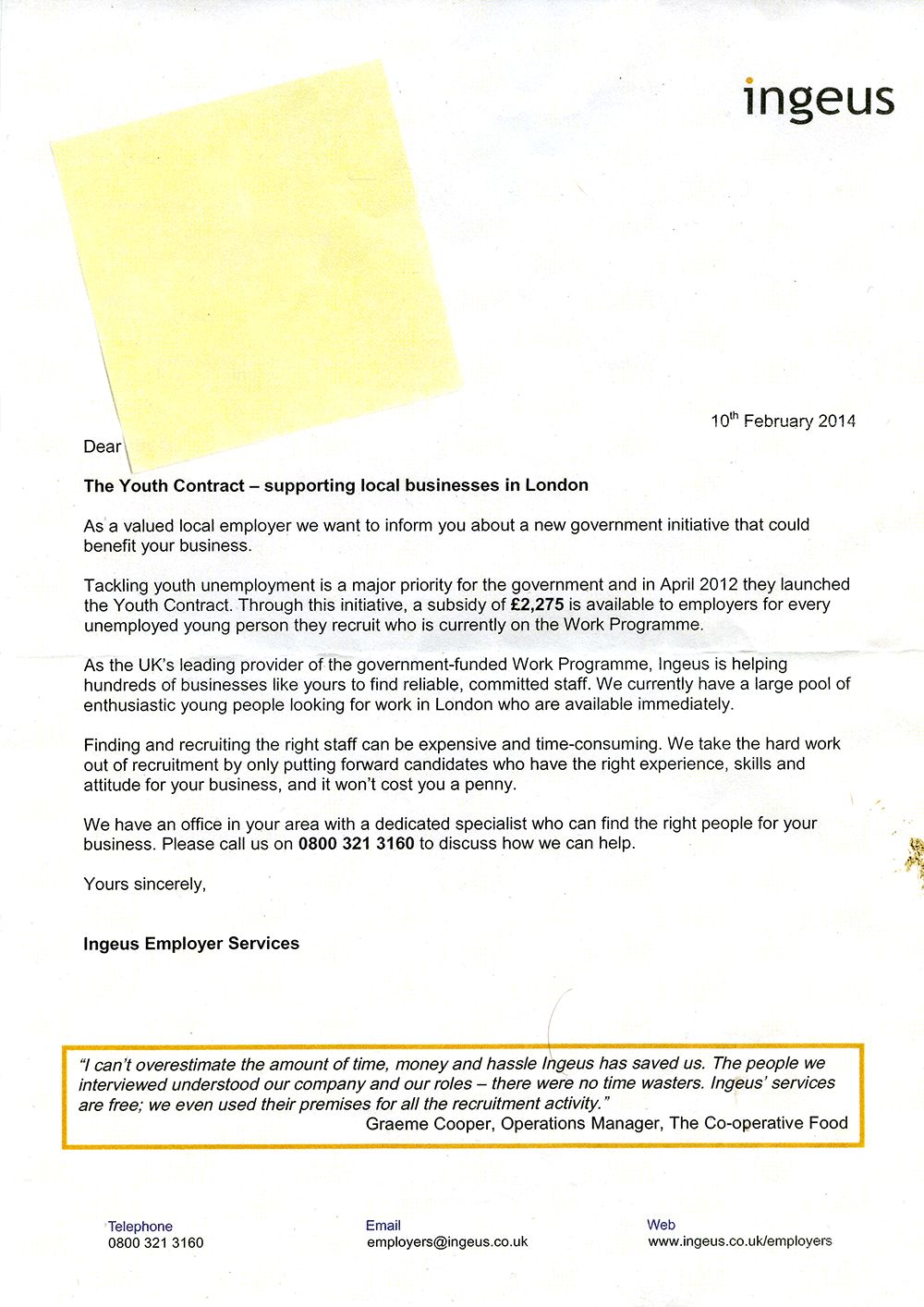
Here we go then – a letter sent by work programme provider Ingeus to someone I know who owns a (very) small business. The letter just turned up in that person’s post. Looks like Ingeus touting for action – trying to get anyone it can find to “employ” young people from the government’s rubbish Youth Contract programme. I suppose this is what companies do when a “concept” is tanking – they spam away in the hope that somebody somewhere will bite. And in the hope that the press coverge will improve, I guess.

The usual Youth Contract carrot is dangled: the letter makes clear, in nice bold numbers, that £2,275 is available to employers “for every unemployed young person they recruit who is currently on the work programme.” It appears that the company has some sort of catalogue of “enthusiastic young people” from which employers can choose. Wow. Pick your own. “It won’t cost you a penny,” the letter continues. Because, you know – why should employers pay money to recruit if they can get someone to actually pay them to do it? Why shouldn’t we keep forking out for useless work programmes? Why should young people expect real, meaningful well-paid jobs?

Somebody shut these tossers down and do something sensible. Please.

Ingeus letter

Kate Middleton gets a palace. Mothers without money get the home you see here

Time for a rant.

The young woman in this video is Fatima Fonesca, aged 23. She is sitting with her one-year-old daughter in their single room in the Focus E15 temporary accommodation hostel at Stratford. I went into the hostel to film the two last week. Have overlaid some scenes from the hostel room into the video. Think I’ll add more video soon.

This is the kind of living arrangement that gets on my nerves. It’s not just the cramped room that Fatima must live in – the bed and the cot shoved together, the tiny kitchen, the piled-up clothes, or even the tough security you have to go through to get into the hostel and the room in the first place (I had to hand over my passport for photo ID to get in, which made me nervous). It is the fact that women like Fatima must live like this while other people royally take the piss. I have specific royals in mind here, actually. The pictures of Fatima with her baby made me think (and not in a bighearted way) of that recent, pointless-but-much-fawned-over photo of the appalling Kate Middleton and her Prince Forgettable hanging out of a window with their baby. The Duke and Duchess – whose main achievements in life involve simply being born and later producing offspring (things that your average bunny, garden toad or housecat can do without even trying) – have just splurged £1m of taxpayers’ money on renovations to their already-luxurious palace. The fact that they have a palace at all makes me want to punch in a door. It’s 2014 and we still have grasping royals living in palaces and tooling about the world on endless holidays like they need a letup. Continue reading

Video from today’s #workfare protest at the YMCA…

To the YMCA HQ at Farringdon – and Boycott Workfare’s protest today about the Y’s unchristian championing of workfare. No sign anywhere of YMCA management, alas. There was hurried mention by staff of a management away day – an all-day away day, by extraordinary coincidence. I had my doubts about that, I must say. The place was eerily quiet and nobody staffside was eager to talk, or to poke around in the CEO’s diary for meeting dates. You got the feeling the whole management team was hiding nearby in a cupboard. The few staff members who were there were keen for protestors to leave…

I can only presume the shame of the thing got the better of those on senior grades. As Boycott Workfare says:

“The YMCA wants to have its cake and eat it. Their president, Bishop John Sentamu, has spoken against workfare. Yet, the organisation still takes part in some of the harshest schemes.  They’re also involved in delivering traineeships – workfare by another name.

We say volunteering should remain just that, and that people shouldn’t be “made to volunteer” under threat of sanction.

The fight against workfare is more important than ever, with 74,000 people being sanctioned every month. Sanctions are one of the main reasons people are turning to food banks to feed themselves, and you can now be sanctioned for up to three years. This is forcing people to make the choice between heating their homes or eating.”

Indeed. Not a lot of God going on at the Y.

More on the Boycott Workfare week of action here – the week runs until April 6.

Visiting the #disabilityCONfident conference…

Here’s a short video from the gatecrash of the very flash, co-branded Barclays-DWP Disability Confident conference at the London Hilton this week. Always a joy to drop in on the Hilton, albeit down the arse-end of the gravy train. They charged us £4 for a coffee. FOUR POUNDS. My word. Oh to be rich. Such a shame they didn’t ask us to stay for the networking lunch. I would have made time.

The Disability Confident campaign is… “the government working with employers to remove barriers, increase understanding and ensure that disabled people have the opportunities to fulfil their potential and realise their aspirations.” Lovely. There’s a heap of money in all this, although not for a lot of disabled people, I’m guessing. “Disabled people spend £80 billion a year,” reads the DWP’s bumpf, “so having an employee base that reflects your customers will help you to meet customer needs and achieve sustainable growth.” Super. I can almost hear Barclays saying “you had us at £80 billion.” Employers can also get more than £2000 for each person they take for six months – this is called “Work Choice”, don’t you know. The people I was with said they couldn’t help thinking there’d be more choice for disabled people if they got money directly to make their own decisions about places to work and the support they need to get there, but hey. They weren’t invited to the Barclays thing.

Government attacks on disabled people’s funding – including the funding that they have so successfully used to get to work until now – get less of an airing in the Disability Confident publicity, so Disabled People Against Cuts turned up to Tuesday’s festivities to ask the pertinent questions. Andy from Disabled People Against Cuts interrupted keynote speaker Simon Weston to contribute a few key points. He asked, for instance, how disabled people could expect to be supported into work while the government eliminates all-important funds like the Independent Living Fund – the money that pays for the 24-hour care support which means severely disabled people can continue in their work and studying, etc. I’m interested to know how many employers will come good with the substantial funding that people in those situations deserve and require.

I look forward to Barclays and the DWP holding another event to which all Independent Living Fund recipients are invited – and all people who’ve been excluded from it since the fund closed to new applicants in 2010. Same goes for deaf people who must deal with new caps on spending for support hours via the Access to Work scheme (you can read more about that here and here). Same also goes for people whose choices in anything get smaller and smaller as councils slaughter care services. Hard to get to work when your support funding is obliterated and when your training-to-employment centre is closed. Pity we didn’t catch up with Mike Penning at Tuesday’s conference. Could have told him right then and there to book the inclusive conference that Andy calls for in the video.