Update Monday 15 April 2013:
Had a call from Sean and Maggie this morning. They’d just had a call from Wellingborough homes, their housing association. The HA officer asked them why they hadn’t paid the outstanding bedroom tax amount (for them, the tax is £11.21 a week). Apparently, that HA is trying to get people to pay up front to “prevent them from getting into arrears.” I’ve spoken with Wellingborough HA to ask about this and also asked them to tell me exactly getting into arrears at that HA will mean for people. Will it mean eviction? I’ll post their response when/if someone calls me back (they said they’d get back to me by the end of today, but haven’t yet).
Update Friday 19 April:
Have spoken to Wellingborough Homes about this. They did make calls to people on Monday morning to remind them about the bedroom tax. They say they’ve identified about 700 people who are liable for the bedroom tax and that people will have to pay it, as there are simply not enough flats for people to downsize to (they said that they were building more and increasing the borough’s stock of flats to “address this issue” to an extent. In the meantime, though, people have to pay. They do take legal action to recover outstanding rent and that can mean eviction, but WH said its aim was to try get people to work with advisors at their local free financial advice service before that point was reached. That means people sitting down with a money advisor, looking at their weekly costs and so on and trying to find points where household savings might be made. WH said eviction on arrears is ultimately a matter for the courts: the HA was putting its energies into preventing things going that far.
Time will tell how that pans out. The tax is not removed from the equation, though, which is the bottom line. It is added to the equation. Anyway – that was the HA’s response on procedure. What we need, though, is a political response, so I’ve asked to talk to board members. We need to know whether the board considered reclassification, or if it would write off bedroom tax arrears if people simply can’t pay and not evict if it comes to it. You can see from this heavy-handed proceedings letter (sent by a different HA to a tenant in another part of the country) the sort of court costs that people start facing even when they’re in arrears for a very modest amount of money. It seems unlikely that people can afford those costs when they’re already in rent arrears.
What a mess this is already. We’re just two weeks into this appalling tax and people are already getting calls about parting with money that they don’t have and/or opening their lives to money advisors to try and find items that they might cut from their personal budgets. The conversations I’ve had with officers here and there suggest that some of them are stressed by this and housing benefit changes generally: they’re sort of doing a quasi-bailiff job already. None of that matters, of course, to people who are getting calls first thing on a Monday from people who tell them that they’ll have to pay up and that it’s better to pay up sooner rather than later if you don’t want to risk your home. Sean and Maggie told me that they’ll try and pay the tax, but they’re not going to find it too easy, as you’ll understand when you read their story below.
MPs, councils and housing associations need to answer to this. They’re enabling this shambles and you can see already how it’s unfolding on the ground.
————
How this story began:
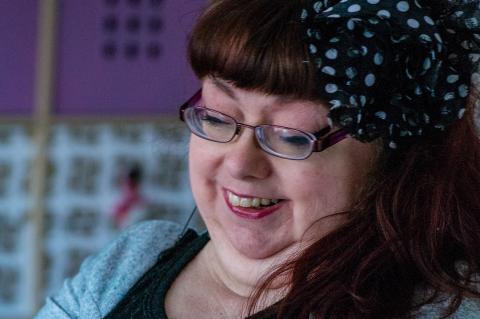
This post is a discussion and transcript of an interview with Sean and Maggie, a couple in Northamptonshire. I’ve known Sean and Maggie for some months now and have visited them at their house. They live in a small, two-bedroom housing association flat in a block and have been there for 11 years. They’ve been a couple since 1997. They met in a residential, independent-living home.
Sean has Asperger’s syndrome and Maggie has schizophrenia. Unfortunately, the political class does not give a stuff about either. Sean and Maggie are being attacked on all fronts. They say that local support services have gone, or are wildly oversubscribed and too stretched to help them. Atos calls Sean in to face-to-face assessments for employment support allowance that he can barely cope with, they’re liable for the bedroom tax, because they have a small second room in their flat, they’ve been issued with a new council tax demand, because their council tax benefit will be cut from April, and they’re worried about further cuts when the personal independence payment replaces disability living allowance.
It is not unusual for Sean to send me emails which say: “I can’t cope with any more. Why don’t they give us a lethal injection to end our fucking misery?” I imagine the answer to that question is “government here prefers slower methods.”
And that is what we have: “scrounger” rhetoric and vicious targeting dressed up as the miracle cure. We all know how this will end for those exposed to it. It can’t be long before government begins to insinuate that mental health illnesses like schizophrenia are best addressed by throwing people out of housing and off benefits – that all someone with Asperger’s or schizophrenia needs to do is pull themselves together, find a job and get out for a bit of fresh air. Sorted. The scrounger subtext pretty much writes itself from there: “why waste money on drug therapies, psychiatry and decent, stable housing when all people with serious mental health and cognitive problems need is a kick in the pants?” That’s certainly the reading Sean and Maggie take from the tax and assessment demands that pour in these days with their post. They did not, just by the way, cause the financial crisis. They’re paying for it, which is different.
In December last year, I accompanied Sean to his Atos face-to-face assessment for ESA. He found the whole assessment process worrying and threatening and he wasn’t able to get much help through it. We spoke at length in the months leading up to the assessment. He was obviously frightened and unable to settle. He sent me a lot of emails and we spoke on the phone many times. He wanted Atos to record his assessment, which Atos did in the end, but it took several months of cancellations and reschedulings to arrange that.
At that time, too, he’d been disturbed by the Newtown shootings in Connecticut (he is British, but grew up in America, in the area where the shootings took place) and he had tried to find someone to talk to about it. “I did try to get help from the healthcare around here in regards to the shootings,” he emailed to say, “but they responded that “everyone is upset” and unless I said I was suicidal, they would do nothing.” He did say that the Samaritans were helpful and talked with him.
After his Atos assessment in December, Sean was placed into the ESA support group, which gave him some breathing space – although not for long. And that’s the point. There isn’t much breathing space for people in Sean and Maggie’s situation now and soon there won’t be any at all. Every day, the government hurls in another grenade – another letter, another call to assessment, another demand for money that people haven’t got (no matter how the government screams that they must find it) and another threat to another service or benefit. I know, and Sean and Maggie know, and we all know, that those letters and demands will keep coming until everything has gone.
There is nowhere for Sean and Maggie to go: no Labour party to appeal to, no “name” politician to advocate with any sort of passion on their behalf and/or behalf of the notion of universal social security, no political commitment to the notion of the right to housing or incomes for people who aren’t born to money. It’s all very well for MPs to speak ad infinitum about “acknowledging” mental health problems, but that means nothing if they refuse to salute the universal social security that’d make improvements possible. The financial sector sails on with its bailout money, tax breaks, brass neck and bonuses while people in Sean and Maggie’s position are pursued and pursued and will be trampled in that rush: their tiny ESA incomes, their housing, the council tax breaks all hoovered by the Beast. There’s no work for them and no suggestion that work, or any source of income, will be found. They’ll be hounded and screamed at as scroungers until nobody cares how they end. They’re already targeted by kids and neighbours for looking and acting “differently.”
Last week, Sean got in touch to say that he and Maggie had “received the notice of the bedroom tax and they are giving us 30 days to appeal the spare room. I do very much plan to appeal. Our room is not “spare.” It is my study/hobby room and for storage. No one sleeps there. They want to withhold £14 a week and I just hope there is a form letter, or if someone could write a very [sic] letter, so we have something to stand against this unjust charge. We also had a council tax notice demanding £77.88 when before it was covered with benefit. We need legal advice and a really strong fightback with appeals and legal challenge. They would have us on the street or in our grave at this rate. It is ruining our relationship and our very existence with this irrational inhuman attack on our lives.” Sean says he’s also concerned about the phasing out of disability living allowance and the phasing in of the personal independence payment.
So.
I hope Fred Goodwin is happy. And warm and well-housed. Because he and the financial sector are, of course, the real victims in all of this. Or something.
Anyway.
An afternoon discussing it all at Sean and Maggie’s house:
Sean: I had [behavioural] problems from about the age of six. My symptoms were social issues – not playing well with others. I was very protective of my things. If someone snatched something away from me, I would react violently.
We emigrated to America when I was a child. I grew up in a small New England town which was very conservative. If you weren’t like they were, you were seen as very much an outsider. I already had a strong English accent and I got picked on for that. I had a terrible stutter (what you call a stammer over here) and it took years of speech therapy to help correct that, but under stress it returns.
They said I was lazy and stupid, because you know – with the Asperger’s, I have dyslexia and dyspraxia and several other issues which just makes reading, writing and maths difficult as the letters move and dance around on the page and make it hard to focus. I could not get the letters small case “d” and “b” right and I still have difficulties to even spell my name. “Ae” I got mixed as well.
It was terrible for my education and life and they just said I was just stupid and lazy. My dad said the same – that I was stupid and lazy. When I was about 42, I was finally diagnosed with Asperger’s. It was the condition that affects everything – your social life, your relationships, I’ve never had that many friends. I try to get along with people, but they have a hard time to understand me.
Maggie: It is incredibly isolating. I’d never tell the other people who live in these flats around here (about my schizophrenia), because I don’t know how they are going to react. They would probably run a mile.
Sean: When I went to meet you from the train station (they both met me today at the station when I arrived), that was the first time I’d been out for a month.
Maggie: People abuse us.
Sean: We’ve had trouble with kids coming around here throwing rocks at the windows. It was endless calls to the police to end it…. as far as cuts, around five years ago, it was the Labour government that cut the groups for local mental health users, both support and social. It was nothing to write home about, just bingo, bottle drives and a fish and chip supper once a month, but it was something. That’s now just a distant memory.
Maggie: I was born in Northampton and I’ve been in Wellingborough since 1980. I was diagnosed with schizophrenia in 1997. It’s hard to tell the difference between what’s real or in my head with paranoid schizophrenia. Seeing things that aren’t really there. Hearing voices in your head and things like that. Suspicious of what people are thinking. Not knowing what’s real and what’s not. I first had my breakdown when I was 21. I’m now on daily medication. I was sectioned in 1997.
I go out shopping, but I don’t really like it. It is hard, going out. If you have schizophrenia, you see the world differently. You are very suspicious of people. So, it’s hard when I go out, but I force myself, because I think if I don’t go out, I’ll feel isolated and I won’t be able to cope with anything and deal with everyday life.
Sean: This country is dead. It’s taken over by greedy, selfish and inhuman [people]. They removed us both from the local community mental health service, because they didn’t have enough doctors, so they cut half the patient list. Mental health services have been decimated.
Maggie: We’re actually supposed to have a nurse and a social worker. They don’t even have enough doctors, let alone social workers.
Sean: There’s a waiting list there and we’d have to go through it all over again. We are getting no support. I never get physical, but it is verbal, calling each other…
Maggie: You’re more verbal than physical.
Sean: We’d like to be able to have a psychiatrist. But they said if things go wrong, just call the police. I’m not going to call the police on Maggie, because they called the police on her the first time round when she was sectioned.
Maggie: They treated me like a criminal (when I had my first breakdown). They put me in a cell and I freaked out quite a lot. They were sitting down with me and trying to calm me down and things like that. Then they took me to a hospital in Kettering. They were giving me all these injections, to sedate me. There was a doctor in there and he was asking me all this stuff and the sort of thoughts I had.
It’s hard to remember that far back. I was saying things about the government and he was trying to get me to say if it was real, or if it wasn’t and I couldn’t tell. I was really delusional and paranoid. The medication helps. That’s about all they do. It just sort of bloats you. They just give you the medication and send you on your way. If you go a while without a crisis they assume you are okay.
Bedroom tax
Late last year, Sean and Maggie had a call from their housing association to ask if they’d be able to pay it.
Sean: We said “we’ll have to. We don’t have a choice. We don’t want to move out of here…” I’m not moving out of here. The [spare] bedroom is about as a long as this hallway It’s a walk in closet.
Maggie: It’s like the one I was in before this one.
Sean: That was shit. You couldn’t open the door with the bed it in and you couldn’t make the bed without sliding and pulling the bed towards the door. It was like being a fucking hamster or something…. They will have to come in with the police and drag me out, or they remove me in a body bag. They’re ruining the lives of hundreds of thousands of people, many much worse off than we are.
Just think back how this mess started -it was the greedy, incompetent banks that made this mess. They still get massive wages and bonuses and we get the shite end of the stick.