Article from me on disability hate crime and the entitlement of lefties and everyone else to criticise media campaigns on benefit “fraud” if we feel like it.
People on the frontline of austerity Britain. Part one: the Northwest
2
This year, I’m talking to people in different parts of the country about the ways that welfare changes, NHS reform and council cuts and charges (particularly in social care) are affecting lives.
Most of the people I’ve spoken to use a range of services and are affected by changes across the board – ESA and DLA assessments, council social care cuts and charges and NHS reform. Apparently, only 12% of the government’s cuts have been implemented. People are on edge waiting for the rest.
Extracts from these articles are appearing the Guardian here and in the Society Guardian.
This first report is from the Northwest.
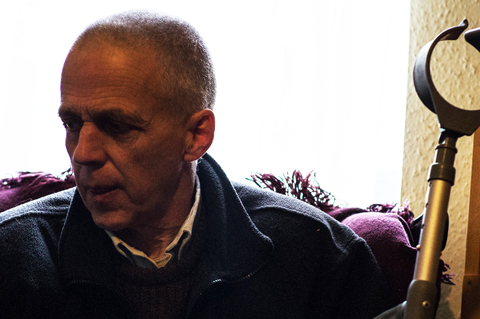
“A lot of people have got to be in this position…forced to finish work in one way or another and unable to get any money…it’s a threatening prospect.” Richard Atkinson, Cheshire (photograph: Charles Shearer)
I start to understand that care cuts and costs might be leading people to take risks with themselves when I go to Lisa Henshaw’s* house and find her front door unlocked. I knock, hear her call out, and I try the door, which is open.
“Wow,” I think, brilliantly. “That’s not very secure.” I wander down the hall to find her. Then I get it.
Henshaw, 48, has rheumatoid arthritis (she was diagnosed when she was two). She has limited use of her hands and does not walk easily. Mostly, she must use her electric wheelchair to move. This morning, she woke up feverish and “very, very shivery.” That’s how I find her – a small figure lying on her bed next to a red plastic container that her carer left out in case Henshaw needed to be sick.
She’s alone, because “I’ve run out of carer hours,” she says, grimly. Direct payments from her local council fund about five carer hours a day (starting with a couple of hours in the morning, to help her to bathe and dress) and her carer had to leave at ten for another job.
She didn’t want to ask another carer to come, because “I have to preserve my [care] hours… for an emergency.” The front door was unlocked, because Henshaw was waiting for medicine to be delivered and was worried about missing it. So – I end up waiting for the drug and signing for it and making Henshaw her mid-morning hot drink.
Then, I leave her to her problems.
She has plenty of them – “it isn’t always gloomy like this,” she says, “…but I never had to worry like this before.” Henshaw faces an ESA work capability assessment (which will cost her – she’ll have to pay a carer to fill in her forms for her) and a Disability Living Allowance assessment. She was given a lifetime DLA award as a child, but will be reassessed as the personal independence payment replaces DLA.
There’s also the ongoing issue of Henshaw’s living arrangements. Henshaw wants to keep living in her own home, but will need extra care for that as she ages.
She isn’t too sure that funds will be available, though, and worries that her local council will put her in a carehome. It’s easy to see why she wants to stay. She’s made her housing trust bungalow a magical place. Each room is a riot of retro – flowered walls, bright surfaces, lustrous curtains and winking lamps. You want to follow the lights and explore it.
Henshaw just wants to stay in it. Her concern is that her council will look at her requests for more carer hours, decide that it can’t afford them, say that she’s at risk alone and move her to a carehome. So, she needs to fight for extra care hours without drawing her council’s attention to the fact that she needs extra care hours. There isn’t an answer to this, but that hardly helps. Henshaw torments herself trying to find one.
The irony is that there might not be a carehome, either. Council officers told Henshaw recently that they didn’t have suitable spaces. So, in Henshaw’s mind now is an end-scene where she is stuck in her beautiful home without enough help. Doors are shutting wherever she looks. The Independent Living Fund has closed (people with disabilities were once able to apply to the ILF for extra money for care). In some parts of the country, councils are, incredibly, capping spending on high-cost care. On her bad days, Henshaw imagines how those chapters of the story might play. Continue reading
Hate crime, hate reporting and the hardest hit
Post updated 4 June to include details of figures of benefit fraud totals to make the point about benefit fraud levels being very low very clear. In the original post, I just had a link to them.
No doubt the Sun and others are delighted with the “patriotic” response to their campaigns to flush out benefit “fiddlers,” but I saw the flip side to that grimy coin at Newcastle’s Hardest Hit conference for people with disabilities on Friday.
This government and its vicious press have a great deal to answer for, and I hope they’re forced to at some point, preferably in court. Speaker after speaker at the conference talked about their experiences of a general hardening of attitudes towards people with disabilities and anyone who is assumed to be collecting benefits.
A number of people said that they’d been on the receiving end of hate crimes and threatening behaviour and had involved the police where they could. The problem has apparently become so widespread that whole parts of the conference programme were set aside to talk about ways to respond to it.
The facts about benefit fraud, as we well know, are neither here nor there where this government is concerned. The truth is that levels of benefit fraud remain very low, particularly as far as disability benefits go, although today’s political leadership is unlikely to let those facts get in the way of a good victimising.
“Look at these figures for [fraud around] disability benefits and see how low the figures are,” Richard Exell wrote when the DWP released a recent report on fraud and error in the benefits system (text added 4 June: the figures, which were released in February this year, showed 0.8% of benefit spending was overpaid due to fraud, amounting to £1.2 billion, and that the proportion was the same as in 2009/10. The number for Incapacity Benefit was 0.3% and for Disability Living Allowance 0.5%).
“Remember them next time the BBC is running one of its 30 minute hate programmes, pushing the idea that every disabled person on benefits is a fraudster,” Exell said.
I remembered them on Friday, all right. In the video from the conference below, people who had experienced hate crimes and abuse talk about those experiences (not everyone wanted to appear on camera, because they were concerned about drawing more attention to themselves, so I’ve posted transcripts from interview recordings below the video). Gateshead MP Ian Mearns talks about his expectations for worsening hate-crime statistics as local cuts to police funds and numbers start to affect the ability of the police to respond.
People were definitely making connections between damming political and press rhetoric about benefit “scroungers” and growing hostility towards people with disabilities.
“[Another area where] enough is enough is around the demonisation of disabled people in terms of the DWP’s campaign to vilify disabled people,” the RNIB’s Steve Winyard said. “What we’ve had is the steady drip-drip of disability benefit fraud stories from the DWP press office. Of course – these are usually about non-disabled people claiming disability benefits, but that gets lost. The damage is done and disabled people are associated with benefit cheating. A recent survey by Inclusion London found that the general public believe that disability fraud is running at between 50% and 70%.”
Disability activist and filmmaker Karen Sheader, who works with people with learning disabilities, said she hadn’t been targeted, “but the people who I work with have. People with learning disabilities seem to be more targeted by kids… it had got better – it really had. It wasn’t perfect – there was more acceptance, but it’s slipping back now. Campaigns like the Sun are running, directly against benefit scroungers – I think it is just hateful really.”
Indeed.
Needing the NHS: to Totnes
This is the latest in the transcripts from recorded interviews I’m publishing as I talk to people who are dealing firsthand with fallout from public sector cuts and the recession around the country. I’m publishing these transcripts between longer articles and testimonies that are appearing at False Economy and elsewhere.
This is a transcript from a discussion with Trina Furre, a member of a patient advisory and support group for people with arthritis in South Devon. Trina has had rheumatoid arthritis since she was 19. In this transcript, she talks about her concerns for the NHS and fears about having to pay for healthcare and also about her support group’s battle to keep a hydrotherapy pool at Torbay hospital open.
On relying on drug therapy:
“I got rheumatoid arthritis when I was 19 – so all the way through, I’ve been under the care of rheumatology departments. I’ve been put on a very expensive new drug (called Humira) which costs about £10,000 a year per patient. It’s been pretty life-changing for me, but you know… one of the things that I’ve done with my support group is put up a forum for people with arthritis and [there are] threads that are talking about the new biological drugs [for treatment of arthritis].
“[Because the forums are worldwide], a lot of people [in other countries] are saying -“Will your insurance company cover the cost of this? Which drugs will they pay for and which drugs won’t they pay for?” There’s a whole tier of stuff that [people outside the UK] have to think about. They have to try and convince their insurance companies that it’s worth funding that particluar drug – whereas here in the UK, if you qualify medically, you get the drug pretty much. There’s a bit of postcode lottery in that it is easier to get in some areas than others – but it is just so different than living in fear that [your] insurance company is going to stop the funding…
“It’s one of the new types of biologic drugs that are now used quite extensively for people with arthritis. The down side of it is that it is a new family of drugs that is very expensive to produce and they are very expensive per patient.
“A lot people don’t know…the thing that really worries a lot of people with chronic illnesses is that if this thing with [needing to buy private health] insurance comes in, there would be no insurance that I could get. Nobody [no insurance company] would touch me with a barge pole. Nobody in their right mind would give me health insurance. It only works if you’re completely healthy and very young. I don’t know what the provisions would be if you’re already ill… Most people don’t have private health insurance and it always used to be frowned upon if you went private. It wasn’t approved of in certain circles, so the whole notion of people having to buy health insurance will be a really hard one to sell.
The realities of drug and alcohol problems
More transcripts from a series of recordings I’ve made in the last fortnight with people in Weymouth who were employed (in the armed forces in some cases), or had businesses and then went through periods of homelessness after losing their incomes. A number of these people have drug and alcohol problems.
They’re exactly the people who will be targeted as Iain Duncan Smith pushes through his plans to permit Jobcentre Plus staff to dock benefits for people who refuse drug and alcohol treatment. The irony is that most have had their benefits cut at one point or another anyway – because they failed Atos work capability assessments, or missed jobcentre appointments, or didn’t realise they had to fill in forms to reapply for benefits, or didn’t get forms because they didn’t have fixed addresses, or had their housing benefits stopped through administrative errors and so on. That’s how they ended up on the streets in the first place.
Anyway – way to go, Iain. You’ll really claw back the deficit when you kick these people into touch. If anyone caused the recession, it was surely people in these sorts of situations, as opposed to an out-of-control financial sector, etc. You’re a genius.
Criminal behaviour
Update Monday June 11 2012 – there’s a list of cuts to youth services at the end of this post. These are very interesting in light of Eric Pickles’ comments about “troubled” families yesterday and today. Some councils (Norfolk, for example) have cut their ENTIRE youth service budgets. Truancy officers, youth clubs, mobile units which youth workers use to travel round to meet and talk with kids in the places they hang out – they’ve been threatened and cut all over.
Perhaps needless to day, those sorts of cuts have caused considerable (and under-reported) upset in local communities, where people are extremely concerned (particularly in the wake of last year’s riots) about possible fallout from high youth unemployment and unrest. Neither Pickles’ “initiative” nor Theresa May’s “crimbos” can disguise the fact that millions have been slashed from youth budgets, experienced youth workers’ jobs have been threatened, or cut and the kind of services which may have helped at-risk kids lost. This is quietly going on all around the country.
Thought I’d rush out a little something on cuts to youth services budgets, in the interests of crapping on Theresa May’s ridiculous criminal behaviour orders idea from the height that it deserves.
May is sonorous on punishment, but extremely quiet on the monumental cuts to council youth budgets and services that have excited (much under-reported) protests, petitions and community concern about potential youth problems and violence (particularly after last August’s riots) in recent times. Councils have tended to file those petitions and that concern in the Tough Shit pile, but we’re going to have a quick poke through it all the same.
“There is no doubt that sometimes difficult behaviour, particularly by teenagers, remains an issue of great concern in many neighbourhoods,” Enver Solomon, the Children’s Society policy direction and standing committee for youth justice chair, told the Guardian this morning, “but youth engagement programmes, community mediation and interventions that address the whole family rather than just the child are far more effective than rushing to rely on court orders.”
Enver is right. Unfortunately, we’re fast entering an era where your local council will be funding those services out of petty cash. If you’re lucky.
This post is a short outline some of those cuts to youth services. Am a bit rushed for time today, but will add to the list at the end over the next few days.
Last month, I attended a full and fraught Derbyshire county council meeting where several hundred locals turned up with a petition to save youth services that had been signed by themselves and more than 16,000 others. Local people were and are very concerned about a council proposal to cut youth service budgets by about £800,000 this year and to outsource parts of whatever is left to the voluntary and independent sectors.
People doubted that the same services could be delivered by those sectors, particularly on nearly £1m less. About 157 youth workers are likely to lose their jobs. Threatened services, as you’ll see from the video below, include a mobile service where youth workers travel around the county to talk to youngsters who might be hanging about and getting into trouble. The council confidently asserted that all sorts of voluntary and independent groups would and had come forward to fill the gaps that the cuts would open up. Unfortunately, the council was not prepared to release a list of those organisations.
Anyway – local youth campaigner Greg Roberts had collected more than 16,000 signatures for a petition to save budgets and directly-provided youth services. As you’ll see in the video below, the council spent most of the afternoon fumbling through its constitution looking for the clause that would excuse it from debating and voting on the petition. You’ll also see that this went down none too well with local people. They didn’t seem to think that the council’s plans for youth services boded well for social harmony at all.
Finding housing
This is the latest in the transcripts from interviews I’m publishing as I talk to staff and service users who are dealing firsthand with fallout from public sector cuts and the recession.
This is a transcript from a discussion with a housing association officer in the southwest. The housing association assists people who are at risk of becoming homeless – because they have lost jobs, or benefits, or their rent has increased and so on. The officer talks about the fast-escalating need for social housing and the trouble that the association is having keeping pace with that need.
“Initially, the main criteria for our service is that somebody could become homeless because of their problems, but we [look at a range of issues]. We fill in a generic form with people that covers everything – from employment, to education to social [needs]. [The main thing for us is] we need to be working with them to saving their tenancy. The tenancy is the most important thing – keeping a roof over your head.
“The majority [of people come to us] now because of cuts in benefits – because of the cuts in housing benefit, because of the cuts in ESA and it’s just all a big dominos effect…
“Demand is going up massively. We’ve always been busy and even in the last year, we’ve had a significant change from people with just general housing problems to the majority of people [needing help] because of the reduction in benefits.
“Sometimes, they are looking at homelessness. Unfortunately, because of the accommodation that’s on offer, a lot of the time people are being put into accommodation that isn’t suitable for them – whether that is because they have physical disabilities, or mental health issues. That is going to have a knockon effect, because their mental health will get worse, or their physical disabilities will get worse and they will have to be moved somewhere that is maybe more supported.
“In the long term, you wonder where the government is going with all of this… the government seems to think that there are a lot more bludgers than there are. It’s the people who were already struggling who are now getting to the end of their tether and not quite knowing where to turn. They’re having to turn to foodbanks on a regular basis – rather than just every now and again when something crops up with their benefits [in the past, people used foodbanks in emergencies, when their benefits were unexpectedly delayed]. It’s now a regular event, because that’s the only way that they can feed their children.
“The reallocation of housing benefits for the under 35s – [that has had a] huge, huge massive impact. The people that were already in a one-bedroom flat are now being told that they are no longer going to have benefits to fund that. Then you’ve also got people with mental health issues who can’t go into shared accommodation, but unless they’re on mid-rate DLA, or they’ve been in supported accommodation in the past, that’s all that they’re being offered. In their circumstances, it’s wrong. Continue reading
No country for mental health
As I continue to meet with people who are dealing with fallout from public sector cuts and recession around the country, I’m posting transcripts from interviews here (between longer articles and testimonies that are appearing at False Economy and elsewhere).
This is a transcript of an interview with a Weymouth woman who is a recovering alcoholic and was homeless. She works as a homelessness officer now. Her role is voluntary and she is still on benefits. In these excerpts from a recorded interview, she talks about mental illness, alcoholism, the abuse that people with mental health problems encounter and life in social groups and families which rely on benefits. I don’t expect that this transcript will generate much sympathy, although it should. Cameron can yell “scrounger” as loudly as he likes, but these are still real lives:
“I’ve been through just about every trauma in my life… I’ve been an alcoholic and raped and abused in all shapes and forms. I didn’t think I could go any lower. Human nature says there ain’t nothing lower…
“I was doing well. I had a home and I had a fiancé. I had a business. Life was good, relatively. Then I got scammed by some advertising companies, so my business started to suffer and I changed my priorities to concentrate on my partner who was also very disabled….not having the brain cells at the time to understand that if I concentrated on the business, I might have a bit more money to concentrate on him. Then, my housing benefit got mucked up. They stop and start the benefits on a whim – they do that.
“Then on the ninth of May, I found myself out on the street and I’m like – hang on. I don’t quite understand where this has gone. My landlord decided that he wanted me out. He didn’t care if they (the housing benefit office) would pay [the rent] or if they’d backpay when they sorted it all out – [he just said] “I want you out. I want my rent.” I owed something like £1200 in rent, which was only about three or four months rent. He wasn’t having it. He would have got it all back – but this is what social landlords are frightened of, you know [not getting their rent] , and then about 8 o’clock on the 9th of May in the evening, I suddenly found myself unexplainably out on the streets. My partner said – “Nah, that’s it,” [and he’s] gone. [So] what do I do? So after several suicide attempts, I just spent until December as a homeless person. It’s not good…
“I just spent my days wandering about. I remember one evening being sat on a bench in town and I had dark jeans on and I had white socks, because that’s all I had. When I was put on the streets, I had a couple of changes of clothes and underwear and that is all I had, plus the clothes I stood up in… I had dark jeans on and white socks and some lads come out of the nearby pub and just started cussing me. “Oh – love the socks. They’re real stylish” [she starts to cry here] and I’m thinking – “why are you doing this? You don’t know me. I’ve been sat here quietly trying not to bawl my eyes out….and just getting abused.”
“I was as guilty as a young puppy. I would see a scruffy… I hate the word “tramp”. It’s an old fashioned word, but I’d see these dirty, homeless guys, drinking or whatever they were doing and I thought there was nothing that could make me go there. I think that was my first mistake, because the minute you say that you’re not going to end up there, you can be pretty sure you’re on the slide down….I think the Lord allowed me to be on the streets for as long as I was, because I had to learn how to be humble.
“[I don’t think people understand the lack of confidence]…now, [people without housing] come to me and say “We’re not getting our benefits. We need to phone the council to see if we can get on their [housing] list” and I say “okay, phone them up -you just pick the phone up and make a phone call.” [They will say] “Can you do it for me?” and that’s when I found out that [for a lot of people] it’s not just a case of picking up the phone and making a phone call.
“I do believe that if you want to learn about life, then spend an unknown indefinite time on the streets. All these stupid, idiotic studies that politicians do – you know, “I spent a week on job seekers’ allowance.” Anyone can tolerate a week if you know that it will end, but being out there and never knowing whether that this is your last day… Continue reading
Poole foodbank: our biggest client group now is people on low incomes
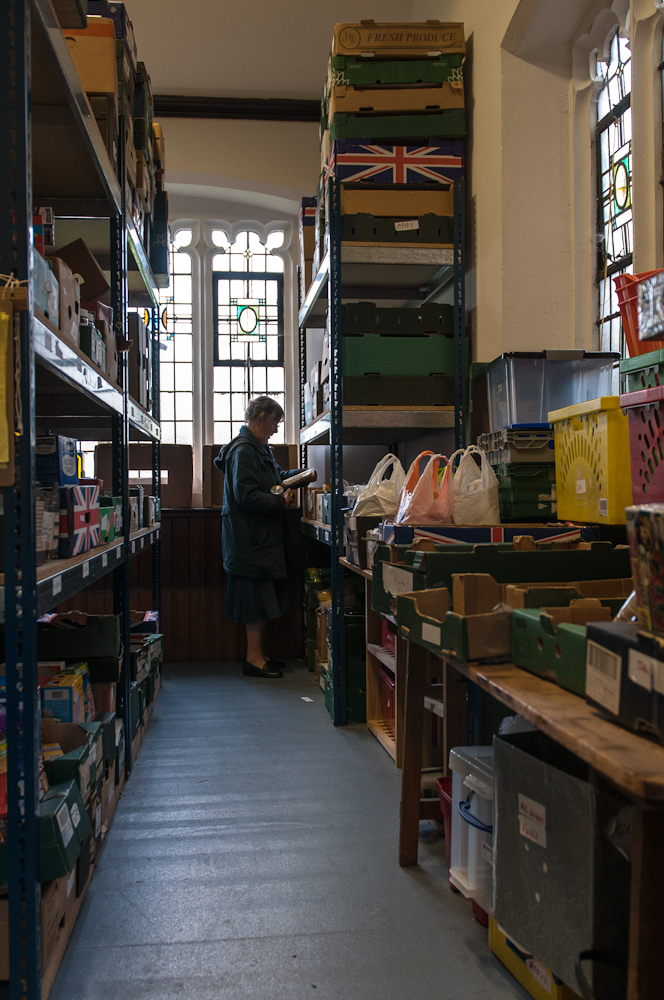
Stores at Poole Food Bank (by @skinnyvoice)
As I continue talking to people who are dealing with fallout from public sector cuts and recession around the country, I’m going to post transcripts and points of note from interviews (between longer articles and testimonies that are appearing at False Economy and elsewhere).
Today, I spent the morning at the Poole foodbank on Longfleet. Staff and volunteers spoke about two significant trends: one, that demand for food parcels has trebled in two years and two, that their biggest client group is now people on low incomes – so, that’s people who are working, but can’t make ends meet because of rising rent, mortgage and living costs and low wages.
Poole foodbank manager Lorraine Russell said that: “Before, the primary reason (for needing food parcels) was benefit cuts or delays, but now that’s been overtaken by people on low incomes. We used to get very few low-income people, but now that has taken over.”
So much, then, for the government’s “scroungers” rhetoric.
This is a transcript of the interview with Lorraine Russell. She talks about the growing need for food parcels and the way client groups have changed as the recession as deepened:
“[This foodbank] started about six years ago, through work some people were doing with rough sleepers. There were a few people who were involved in helping with rough sleepers and a lot of food was donated at about harvest time – a huge amount of food. They thought – there has got to be a better way of managing this supply of food and from that, and from discussions with other folk, the foodbank was founded.
“I’ve been here for about four years and in that time the numbers [of people who need food parcels] have increased dramatically. Certainly, in the last month it has tripled from what we gave out [at the same time] two years ago.
“2763 people were fed last year and these weren’t all new people. Some were ongoing. The idea of a food bank is that people are given a voucher from our partners – health visitors, social workers, the CAB and health professionals. They get a red voucher if they really can’t afford [to buy] food themselves and so they bring it here and we give them a food parcel for the right number of people – single, couple, or families. The idea is that they come three or four times, over which period their presenting problem – whether it is benefit cuts, or [benefit payment] delays, or debt, or whatever it is can be sorted out, but it’s not happened like that.
“If you’re out of the benefits system, it takes an awful long time to get back in. If your circumstances change, then that alters everything. The person will be given a red voucher. The person who signs it off will tick the right box [which describes the client’s circumstances] – [it could be] benefit cuts delays, debt, or the person may be an asylum-seeker, [or a victim of] domestic violence, or [experiencing] homelessness, or sickness. And the one that we’re increasing seeing more of is people on low incomes. We usually try to signpost people to the CAB then, because they’re got their finger on the pulse, so they can help people [further]. We are a short-term emergency gap for people who can’t afford to buy food.
“Numbers are growing and we are seeing a lot of people on a fairly regular basis. Certainly, in the last six months, six to nine months, things have got worse financially and people have to pay more for their rent, or their mortgage has gone up, so they have to keep a roof over their heads and there’s not enough money for a lot of people to actually buy food for their family. Continue reading
Massive cuts to youth services and Tory contempt for opponents
My latest video interviews with people dealing with public sector cuts. This time – how Derbyshire Tories tried to shelve a 16,000+ petition signed by local people who are opposed £800,000 in cuts to youth services budgets and services.