A massive turnout for the hands-around-Lewisham-hospital march and protest today. Biggest protest I’ve seen for a while.
As followers of the Save Lewisham Hospital’s A&E campaign will know, a hand-picked (by Andrew Lansley) ‘special administrator’ (as ever) recently produced a report which recommended that Lewisham Hospital close its A&E Department, impose staff cuts and sell off 60% of hospital buildings to developers.
“Lewisham’s children’s wards, critical care unit and emergency surgery may close to pay massive debts at neighbouring hospitals. A&E would be replaced with an urgent care centre. Maternity services could be lost too.” There’s an excellent report on Andy Worthington’s blog which backgrounds the proposals and response in detail.
Thousands of people turned out to protest today at these developments – probably more than 10,000, I thought, and on a cold and rainy day, too. I’ve uploaded the videos below to give you an idea of the turnout. The fight for Lewisham hospital services goes on, with another meeting this week, so I’ll add some more links soon (Update 25 November: added now – see end of post). In the meantime, check out the videos for numbers.
As I like to say: you know a government is in serious shit when thousands of people show up to protest on a cold wet day. Interesting times.
Videos
I took the first video below from the top of the slide in Ladywell park at around 3pm. It shows very clearly that there was a huge number of people in the park right – and it’s worth remembering, too, that a lot of people were still in a very big queue outside the park to get in. The video is shaky in parts, but I wanted to leave it unbroken to show the numbers.
This one has some sequences from inside Ladywell park and a few from the walk there:
There will be another public meeting to continue the campaign in the Catford Broadway Theatre at 7pm this Wednesday, November 28.
“Today approximately 520 Barnet Council staff have been told in a series of briefings that Capita is to be their new employer.
From figures released in the presentations today, approximately 57% of staff will face redundancy as local jobs are exported to Belfast, Blackburn, Bromley, Carlisle, Darwen, Sheffield, Banstead, Swindon, Southampton.
For the last four years, UNISON has warned of the danger of jobs being exported out of Barnet. Leading councillors and senior officers have either played down this risk, or discounted it as irrelevant.
John Burgess, branch secretary said: “It is a dark day in the history of Barnet council. Staff and residents will remember this date as the day the council carried on marching over the cliff ignoring the stark warnings of residents and other key stakeholders. The implications for our members are awful.
I thought the morale of the workforce had already hit rock bottom. I believe this news will drag it down deeper and it will have an impact on other council staff. I also fear for the impact on future quality of services to Barnet residents. I really hope councillors will think again about the implications of what they are proposing and the risks of ignoring a growing dissenting community voice emerging from a resilient committed community campaign. But, it isn’t over yet, there is an alternative way to delivering public services and our campaign is still very alive and focused. Watch this space.”
***** Ends *****
Background
Barnet Council is implementing a policy known as the One Barnet Programme, sometimes referred to as the ‘Commissioning Council’. This mass privatisation policy is designed for the Council to divest itself of responsibility to deliver services to its residents.
“As reported in the year two review, mental function champions have been introduced at a regional level, rather than in each assessment centre as was originally recommended. Given scarce resources, the review supported this approach… Some representative groups claim that awareness of the champions is low, and that those who are aware of them believe they have little or no impact on the quality of mental function assessments. The review asked Atos to report on the effectiveness of their mental health champions. They said that their healthcare professionals found the champions to be ‘a great resource’ and that they were of ’great use to put any uncertainties into perspective’.”
Well.
A couple of weeks ago, on November 5, Mark Hoban said this about mental health champions:
That line caused some excitement among some of the people I know who have mental health illnesses and are employment and support allowance claimants, and among people I’m in contact with who support people with mental health problems through Atos work capability assessments.
Indeed, a number of these people were so taken with Hoban’s remarks that they sent them to me and asked if I could find out if there was indeed a mental health champion in every single assessment centre in the country.
So, I wrote to the DWP to ask them what Hoban meant when he said that a mental health champion had been introduced into every single assessment centre in the country.
It turned out that he did not mean there was a champion in each assessment centre. He meant that regional champions had been appointed and that they operated a sort of phone advice line.
The DWP told me:
“There is not a champion in each Atos assessment centre. Instead, there are regional champions, with all healthcare professionals having access to a telephone advice line where they can access advice from a champion.”
The department went on to say that:
“A full complement of 60 mental function champions has been in place since the end of July 2011, following a recommendation by Professor Harrington.
“The role of mental function champions is not to interact directly with claimants. Instead, their main functions are to provide advice and support to Atos HCPs (either face to face or via the helpline), spread best practise [sic], and build links with appropriate stakeholders in their area.”
The department also said that:
“All Atos healthcare professionals receive specific and additional training in assessing mental health conditions.
“We are currently working with a number of specialist disability representative groups to improve the initial questionnaire that is sent to claimants.
“We are also working closely with a range of disability organisations to develop an ‘evidence-based review’ of the descriptors used in the WCA in order to make the WCA fairer and more accurate. This is in response to changes proposed by organisations representing both mental health and fluctuating conditions, following Professor Harrington’s second report.”
Needless to say, the mental health support professionals who’d brought Hoban’s “we have introduced a mental health champion in every single assessment centre throughout the country,” statement to my attention were disappointed to hear that what he meant was that there were a few people in each region (the numbers are here) and a phone number for Atos HCPs to ring. (Hoban did mention the phone line in an October statement. but his November remarks got people excited. “We have introduced a mental health champion in every single assessment centre throughout the country,” led people to conclude – not unreasonably – that a mental health champion had been introduced in every assessment centre throughout the country.
I went back to the department for more – to ask if the department could say what training the champions went through, if the champions are already trained health professionals (for example, doctors, nurses, psychiatrists, psychologists and so on) and how many there are in each region (as I say, those numbers are already in the public domain, but I’m always keen to see if everyone’s match).
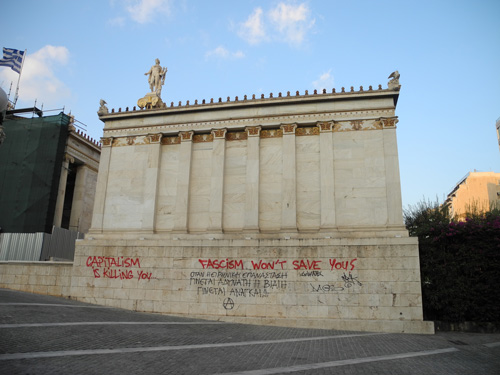
This is an interview with Nikos (aged 18 and taking his high school exams), George (aged 19 and a university student) and Artemis (a high school teacher). They all live in the neighbourhood of Kallithea. They are part of the Initiative Against Fascists and Fascist Violence – an anti-fascist group where all decisions come out of general Assemblies as direct democracy. They take direct action on the street. A recording of the interview will be added soon.
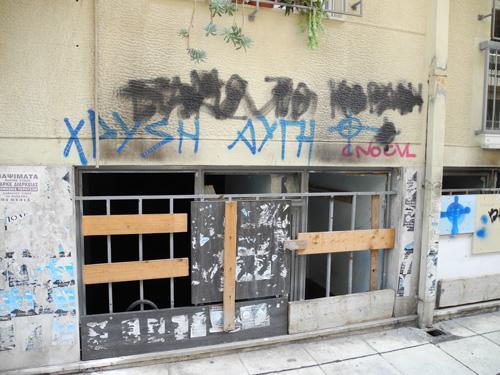
Video: graffiti on a torched mosque and abusive graffiti on the school in Kallithea where teachers have been running antifascist campaigns. George showed us the frence on the school where the graffiti was painted:
In this interview, Nikos, George and Artemis talk about the rise of Golden Dawn, the anti-fascist tactics they use to fight them and how confrontations have escalated since the austerity crisis.
Nikos, George and Artemis: “What we are doing – there is a strong link with workers movements and the anti-fascist approach. We are adopting a holistic approach. Fascists at the moment fight the working class and those who are left leaning. There is a strong presence of the Egyptian community [here in Kallithea] and there were racist attacks against them for the last year. All these attacks taking place are being backed up by the police or along with police officers. Last year in May, there was a racist attack in Kiprou Square. Police officers were actually there on the spot – looking, but doing nothing. We could talk about numerous incidents like this but we want to focus on the area.
From December 2011 until May 2012, there were numerous incidents and at the end of April last year, there were approximately five immigrants detained in the police department of Kallithea because the police wanted to check their documents. So, when they walked free, two of them were told in the police department – you can go, but bear in mind a few blocks later, you will get attacked. [The police said this] in an intimidating and sarcastic way.
But they weren’t trying to warn them – they were threatening them. Those immigrants were actually attacked. There was a bunch of people on three motorbikes, wearing helmets. They asked where the immigrants were from. One immigrant said ‘Egypt’ and they started to hit them with crowbars [and son on]. These were legal immigrants. The guy who said that in the police department was allegedly a plain-clothes police officer. We were told about this from the immigrants themselves.
The day after this incident, many immigrants assembled in Kiprou Square in solidarity with the immigrants that were beaten up. Our anti-fascist initiative was informed of this demonstration; we knew that it was happening.
There was a bunch of 20 guys, dressed in black. When the crowd dispersed, they attacked an immigrant and stabbed him. He was rushed to hospital and we went with him. This was two incidents of violence in a row. It’s very important to underline that this took place following the elections, when Golden Dawn got into Parliament with 7% of the vote.
This gave them a big boost in confidence and their presence became much more visible. Before this they were working on the periphery, but following the elections, they went completely out of control. We [the anti-fascist movement] responded promptly and the fascists actions were minimised.
[This anti-fascist movement] started being active at the end of February 2011. So, it was an initiative of teachers, members of the local branch of union of high school teachers, along with other grassroots movements, high school students, other teachers, the unemployed. We all gathered together to start being active. This was triggered by an incident when around ten 15-year-old students attacked an immigrant passing by with steel bars. They were students from this school.
For the previous incident, there is no concrete reason but generally speaking, Golden Dawn has done a lot of work here in central Kallithea to try and influence in schools. There is strong evidence that this attack was racist, because at point in time, there was intimidating graffiti outside this school, threatening teachers who support anti-fascist movements. (see video at the top of this post for images of the graffiiti).
Golden Dawn appeal to younger students aged between 13-15 years old the most in this area, because they are in a pre-adolescent phase. They don’t yet have a coherent ideological framework. They are easier to manipulate and it’s easier for Golden Dawn to have an impact.
What halts fascist action is a large anti-fascist presence in the neighbourhood. While fascist action was escalating [earlier], it stopped completely. A massive anti-fascist presence in the neighbourhood by us and other anti-fascists managed to stop them completely and we reclaimed the space where fascists used to congregate, and people couldn’t go before.
It was important how we put these anti-fascist actions in a political framework. Golden Dawn voters voted for them not mainly because of race and immigrants, but mainly, and this is so important, it was because they are anti-government and anti-austerity.
In fact, it was a means of taking revenge and punishing those who were responsible for the crisis. Those fighting fascism within the official government will not have a positive impact because it’s the same system that keeps Golden Dawn in power.
Fighting fascism is strongly related to fighting the system. By placing the anti-fascist argument in an anti-capitalist framework, we will have more success, as capitalism is the backbone of the initiative here. This is what we write on our press releases – Golden Dawn is part of the system, they work with the elites and not against the elites interests.
There is a strong link between trying to find a way to highlight the negatives of, for example, tomorrow’s National Parade and the materials that we give out. Tomorrow [Sunday 28 October] is supposed to be about national coherence and unity, saying No [Ohi Day]. The leader at the time was a fascist who said ‘no’ to Italy, so in reality, it has nothing to do with unity. It was the people who actually said ‘no’ and fought against the Nazis. Not all of the people were against fascism though. The majority of society was; the working class, the middle class, youths, they all fought. While this was happening, the elite took a lot of money and fled to Egypt and there was also a section of society who were happy to collude with the Nazis. Golden Dawn are now saying that the real patriots were the ones who did collaborate with the Nazis. Continue reading →
Photo: Burned-out mosque daubed with Golden Dawn insignia, Attiki. By Abi Ramanan, October 2012
These are more transcripts from the recorded interviews that Abi Ramanan and I made in Athens several weeks ago. We interviewed people there about the economic crisis, service cuts and the rise of fascism. We’re publishing transcripts from the recorded interviews we made on this site.
In t his interview, Amalia Vasilakaki, a language teacher who teaches free Greek language classes for immigrants in Athens, talks about the problems her students, who are all immigrants, are dealing with in Greece as they are targeted by fascists and the Golden Dawn. There’s a transcript and recorded interview with three of her students here.
“The language school operates everyday, I deliver Greek language courses to immigrants. Following austerity and the financial crisis, and the rise of racism in the last year, most of the students have left. They have left Greece.
There is a video which one student of mine videoed. Most of the students in this video are already outside Greece – they have already left. Four have emigrated to Canada [among those in the video], one married a Spanish girl and he was working in Spain, and then moved to Algeria and he is now working for a Spanish multinational. He has Spanish citizenship.
To cut a long story short, those remaining in Greece are those who are trapped. They cannot leave. They are undocumented, they don’t have money, they don’t have the contacts.
Apart from my former student who married the Spanish girl and became an EU citizen, the rest, who went to Canada, have done it in an illegal way.
They deposited [money] and used fake Bulgarian passports. So, as far as I’m concerned, I think the major issue at this point of time, is the immigration ring. These people are earning lots of money – they are bribing the police and other people. They have links with the mafia. The police are collaborating with foreigners to promote these immigration rings.
We have been operating for around 15 years delivering Greek language classes to immigrants because we believe that we should show our solidarity with them and this is all we can do.
We are like “cheeky” students who learn from each other, we exchange knowledge about our cultures but we are not an NGO [non-government organisation].
We are contributing to this from our own budget for materials, like photocopies etc. My other job is teaching Spanish and Greek.”
Alexandros is a dentist and also teachers Greek at the language school. In this interview, he speaks about his students and the rise of fascism in Greece.
“I teach Greek here. I also speak German and English, and I want to start teaching German. I used to come here for many years before and I have been teaching here for seven years, and I can tell you that most people don’t come here to stay. They are in transit.
There are big problems with Golden Dawn in Greece. We are now the only Parliament in Europe with such a far-right presence and people are very afraid, especially dark skinned people. [Fascism is] rising fast and I am very concerned regarding this.
“What can be done? This is a hard question. Massive demonstrations of all the parties and people against Golden Dawn is necessary. I am very sad to see this happening, especially for elderly people who lived through the German occupation in Greece, like my father.
In my opinion, 50 or 60 percent of the police support Golden Dawn. When reforms happened in the army following the military junta, the same did not
happen with the police.
Austerity, the IMF, the Government, the Troika, the strong nations of the EU – they are all bullshitting the public. It is new loans for old interest.
Let me ask you something – in Greece, the Troika make us implement these cuts, but in the UK your own government does it – why?
Big, bad privatisation plans and failed private-public projects have caused near-meltdowns at Cornwall and Somerset councils in recent times – but that hasn’t stopped Tory Barnet council from storming towards oblivion with a plan called One Barnet – a deeply unpopular proposal to outsource swathes of council services which has brought the council to its knees before it has even begun. With just a few weeks left before the first major One Barnet contract is decided, this post looks at the controversy and a bit of Barnet council’s outsourcing history.
Photo: a protestor at a march and rally for Fremantle careworkers, 2007 (By @skinnyvoice)
I first became aware of the problems faced by people who were on the rough end of Barnet council’s privatisation deals in 2007.
The careworkers were a group of low-paid staff (mostly women) who were in the middle of a bitter industrial dispute with the Fremantle Trust (a partner of Catalyst Housing) – the so-called not-for-profit organisation to which Barnet council had outsourced care for elderly people.
Earlier that year, the Trust had slaughtered the careworkers’ salaries and terms of employment. Their wages and working conditions had (supposedly) been protected when the council privatised care and TUPE-transferred staff to their new, outsourced employer – “they said it was all going to be super duper and we were going to be fine,” careworker Carmel Reynolds told me in 2007 – but in December 2006, the Trust made its move.
Staff were presented with a harsh new employment contract and told that anyone who refused to sign it by April 2007 would be sacked. With the new contract, the Trust cut careworkers’ annual leave allowances and reduced their sick leave to a statutory minimum. Worst of all was the abolishing of the weekend enhancement payments that many careworkers relied on to make up a reasonable wage. Barnet Unison estimated that after those cuts, some careworkers lost 30% of their pay.
When they complained, staff were told by management that they could make up their lost pay by working extra shifts. ‘I said [to management] – how do you expect us to be able to cope [with these cuts]? What [management] said is that you have to do extra hours to make up your pay. But what about the quality of our daily life?” said careworker Lango Gamanga in 2007.
The truly appalling part of all this, though – the part should not be forgotten in light of Barnet’s current outsourcing quest – was the discovery, late in 2007, that the cuts to the careworkers’ salaries and conditions had very likely been for nothing.
In a 6 December 2007 cabinet resources committee report, the council admitted that the “high profile” change (by which, presumably, it meant the much-publicised industrial dispute over the new contract) had not helped Catalyst blunt financial losses and that those losses presented “an ongoing and increasing budget risk to the council.” Catalyst lodged a claim for further funds from the council – and was ultimately awarded £8m in arbitration. So. The moral of this tale is that outsourcing often goes arse-over for everyone involved, except those selling it. Don’t take my word for it – here’s a list of outsourcing catastrophes for you to weep over. The point in this post is that the Fremantle-Catalyst endeavour was a Barnet council debacle to beat the band.
One Barnet
Unfortunately, that experience has not deterred the council from pursuing new and even bigger potential outsourcing disasters.
As we speak, the council nears a decision on the now-infamous (even before it is launched – not a good sign) One Barnet project – an amazingly unpopular plan to pay private companies the best part of £1bn to provide a mass of council services. There’s £275m up for grabs for development and regulatory services and a whopping £750m for a new, if ill-defined, support and customer services “organisation” from which services like council estates, finance, human resources, IT and revenues and benefits will, allegedly, spring. In the face of monumental opposition from residents, five legendary local bloggers, an extremely motivated and informed union branch secretary and council staff and union members, the council will, on December 6, decide which (very lucky) private company will win the £750m contract. The second contract will be awarded in January.
And One Barnet could be a very big turd indeed. Estimates are that 70% of the council’s services could be tied up in ten-year contracts with the private sector if One Barnet gets the green light. Unison expects hundreds of job losses as a result of outsourcing and “efficiency savings” – the sort of numbers that can only have a negative impact on services.
Pointed questions have also been asked about Barnet’s ability to keep a grip on all or even some of its relationships and contracts with private companies. I’ve already talked about the Fremantle-Catalyst wreck. Last year, there was another scandal, when Barnet bloggers revealed that the council had spent more more than £1m to hire a private security firm company called MetPro. The council engaged the firm without putting the contract out to tender, or running basic security and financial checks. I had the pleasure of that firm myself at a very feisty (ie full of pissed-off locals being denied the right to attend the meeting by overzealous private security guards) 2011 Barnet council budget cuts meeting. Security guards confiscated our laptops and cameras, bullied people who wanted to sit in on the public council meeting and overrode police decisions to let members of the public into chambers.
Residents in Barnet have made this brilliant short animation to explain the risks associated with Barnet council’s plans to go ahead with its massive, and massively unpopular, one-billion pound outsourcing deal.
As many people will know, Barnet residents, bloggers and unions have been fighting the council’s plans to mass privatise council services (a plan called One Barnet). Already, they’ve won a fight to keep the council’s waste and recycling services in house.
Meeting tonight – a “Question Time” in Barnet on the One Barnet outsourcing programme
Tonight (Thursday 8 November at 7pm at the Greek Cypriot Centre, Britannia Road, London N12 9RU) Barnet residents will hold a ‘Question Time’ debate about the proposed One Barnet programme. On the panel will be Barnet resident and chair, Barbara Jacobson, Barnet Conservative Council Leader, Richard Cornelius, Labour Leader, Alison Moore, Lib Dem Leader Jack Cohen and Andy Mudd from the Association for Public Service Excellence.
Many people will know that it’s all hit the fan in a very big way over that mass-outsourcing deal. Council CE Nick Walkley recently resigned – only a couple of months before the mass-privatisation decision was due to be made. Everyone else is fighting – so this evening’s meeting could be a belter.
Top job done there by residents, bloggers and union members who have simply refused to accept that the private sector is entitled to their money and services. Hope they win.
As the general strike continues in Greece, we publishing more transcripts from interviews we recorded last week with people who are dealing directly with cuts and austerity in Athens. Earlier interviews are posted in sequence below this one.
This post is a transcript from a recorded interview with Olga Kosmopoulou, a doctor who specialises in infectious diseases , including HIV medicine. She works at the General Hospital of Nikaia.
In this interview, she talks about the problems her patients are facing, the political and economic situation in Greece and how this relates to health care and possible solutions for the future.
Speaking about her patients
“I would like to speak on behalf of my HIV patients.
Most of them live in this area, which is one of the poorest in Greece. Not everyone has free access to medicines and free access to healthcare. They have a lot of problems, which have increased over the last three years.
Problem number one: most of them are already stigmatised. It’s not easy for them to find a job. All these patients used to live on a benefit which was cut down. So, I know when I see some of them, they are going to face hunger during the winter. Some of them are going to be homeless during the winter.
Some of my patients are IV drug users. During the last three years, we have had an epidemic of HIV disease in IV drug users. Many are homeless and almost none are insured. We don’t have many social workers and many people who come here cannot be insured at all. They come here and say ‘please keep me in the hospital because I need a roof over my head, and food’, but I cannot do it for everybody.
The state has destroyed rehabilitation programmes. They say that we are doing better, but in fact, the places where people can find methadone are full. They don’t have enough doctors, not enough nurses, not enough psychiatrists and not enough support in general. They don’t even give syringes. On the other hand, the poverty among families made most of these people practice prostitution, which led to a very sudden rise in HIV.
All Greeks have seen their income diminish, but among them, the most frail patients with chronic diseases are desperate right now. They have to pay just to get into the hospital. They have to pay for a prescription. They have to pay part of the cost of their medicine. Sometimes, they don’t find the medicine they used to take, or they are forced to take another medicine by another company.
If people are diagnosed with HIV, they do have access to drug treatment. But, there is a frightening situation, because every time I ask for tablets, I have to refer the patient and the drug companies answer ‘”e approve the scheme, but we warn you that it is your responsibility to advise the patient to get insured.” But, the patient is not able to get insured. There is no insurance for most Greek people at the moment. There are well over 1 million people unemployed… and they are uninsured.
There are no preventative measures, like condoms. Of course not. It’s a joke. Non-governmental organisations may provide syringes and support. This is not correct. The state should organise this.
I don’t think anyone has time to find out which neighbourhoods are being particularly affected. To show you the size of the problem in Greek society, in this corner [points to corner of the room] last year, every month we collected food. We provided this food to schools in a poor area ,as the teachers were asking for food for children and their families. Last year, this corner was always full with food, and now, starting from September onwards, I haven’t been able to collect anything because they have cut down the salaries of the people.
The insecurity they feel makes them reluctant to help others. Although there is solidarity in Greek society, it’s going to have an end and this is the proof. Middle class people and poorer people are not able to help each anymore in the same way they used to. The food is running out. Philanthropy cannot be the solution.
The other disease that is increasing is suicides. We never had a high rate of suicide in Greece, because the weather is so good and family bonds are so close, so people felt secure. Now, we have a high rate of suicide, a high rate of psychiatric diseases, a high rate of depression. There are too many people taking tablets. On the other hand, psychiatric patients with severe illnesses have had their benefits cut down and they don’t have money, not even for cigarettes. The places where they used to stay are closed. So many of them are homeless. It’s really cold over winter, starting in November, through to early March. You can die on the street.
I see about 10 people everyday on the ward, sometimes 20 a day, sometimes 30 a day. When I work in casualty, we see more – about 300 a day at the general medical hospital.
In outpatient clinics, people come to get examined. Sometimes, I substitute for social workers… everything.
On treating everybody
This is a special place because in my way, I am a political person. I see immigrants. I treat people [who do not have] papers. I see everybody without asking for the fee of €5. Me and my colleagues have been downstairs several times to stop patients paying.
On Golden Dawn
I hope I will never meet them. They don’t dare to get into the hospitals yet. But they have declared that they are going to come to the hospitals and take the immigrants – they mean every foreigner – and get them out of the hospitals. But, of course, outside the hospital, there are a lot of Pakistani people living in this area. They have been beaten several times by Golden Dawn. They are legal immigrants.
On solutions and the future
There is no future inside the European Union. The EU doesn’t express the will of the people of Europe. It expresses the will of bankers. I don’t think there is any future inside this European Union. I think the problem is for the whole of Europe, not just Greece. Greece is just a kind of experiment. It was very easy to say ‘oh you’re Greek, you’re lazy,’ which is not true. That makes other people take in what was happening to us without saying anything.
We have two solutions. We can either accept it and go into the darkest years of history, or we do not accept this. I am very, very afraid, because I would not like to live in such times. I am very afraid that people will need their own revolution to get power again. If they don’t, they are going to live in very, very dark years. People in Greece have to take power in their hands.
They don’t have this power by voting. The politicians threatened us [during the last elections, with] -‘if you don’t vote for us, we are going to have to leave the Euro’, which is funny. If you don’t have any money, you don’t really care whether its drachma or euro or anything. I firmly believe that without revolutionary methods…I don’t mean violence – but people in Greece, and other countries like Greece, have to understand that its very important to go radical.
Affected personally
This is like a thunderstorm. We have seen our lives change to such a degree that sometimes, I don’t have money for the mortgage anymore. This means that I would be without a house. My brother and sister and their children would also be without a house [they live together now]. It is not only me – this is a whole family.
An [example of an everyday danger/worry is] – I think – “do I have enough gasoline to go to the hospital?” because public transport doesn’t help. I need two hours for that. To make time for my patients, I need to use my car. We are a middle class family – in wintertime, we decided that we wouldn’t use any heat in the house, except for the bedrooms and the place where the kids study. And we are doing well compared to others. Most people in Athens will not have enough heat during the winter. My salary has been cut by 40% and now they are going cut it by another 20%, from a salary that was about 50% or 60% that of a medical specialist to begin with.
This transcript is from a recording made last week with three young men – all recent immigrants – in Greece. Two were from Togo and one from Nigeria. There’s an audio from that interview here:
We spoke to the three men at a centre and cafe where free Greek language lessons are held for immigrants. All three had paid agents for transport and help getting into Greece (through Turkey) and all had been promised that they’d be able to study and work in Athens. None had been able to get a job and none had been able to get papers to stay or to study.
All three had been either abused or physically attacked by the police – one of the men, Koffi, 25, pointed to a large lump and cut above his eye where, a few days earlier, he’d been hit by a bottle that the police had thrown at him. Two of the young men were planning to leave Greece as soon as they had the money together.
So. They will return to Togo and Nigeria without their money and with an utter loathing of Europe – something Angela Merkel and cronies might want to keep in mind. There was a certain nationalism forming in the minds of these young men: a nationalism based in part on a feeling that home was considerably more civilised and sophisticated than Europe and in part on a fury at Europe’s vile treatment of them. Could be interesting for Europe, if this generation of young, rejected immigrants decides on revenge when it comes of age.
Saheed Aylula, aged 22. Home country: Nigeria. Has been living in Greece for three years.
“The reason why I came to this country is for education. I’ve been here for three years.
In my country, I studied accounting. I believed that when I came here would continue with my education and pay for myself with a part time job. Unfortunately, I found out that was impossible for me. I’ve been to many place to look for a job – to look at something I can do to finance myself, so that I can continue my education. They give us a form to fill in and say that we will call you when we need people.
I tried many, many cafes, so that maybe they can employ me, but unfortunately, none of them can give me a job.
So, I started to sell something.
[I have been] selling photographs and posters. Sometimes, that sells and sometimes I can’t [sic]. [Then] one of my friends told me that there is a school where I can learn Greek here for free, so I came to here and [I’m] learning Greek. Before, I cannot speak any Greek. And the people you want to sell something to – you want to talk with them before they buy something from you. Unfortunately, I would say [to them] – would you speak English? and they would say No, only Greek. So, it was very difficult for me to communicate with them and that’s why I’m learning Greek.
To be frank, I cannot stay here.
If I had known how this place has been, I wouldn’t have come. This country is a … I think I need to go back to my country, because there’s no room for [me to develop here]. You can’t get any benefit from here. There’s no job. There’s no future. So, I’m planning to go back to my country.
In Nigeria, we have corruption, but I think Nigeria is better than here. If I don’t have papers to move forward, there is no way I can proceed to another country [in Europe]. [Anyway] – I’m seeing that all of Europe is having an economic crisis. Even moving to another European country… I don’t know what I can do there. I can’t believe that I will face a problem like this there.
I came alone. My family is still in Nigeria, but one of my brothers is in Canada. So, the others of my family are in Nigeria.
We are facing many problems here. First of all – they don’t like foreigners. Just take a look. If I’m on the bus, I can not get people to sit down with me. If there is two seats there, I cannot get people to sit next to me. You can go to any restaurant or any cafe here and you cannot see blacks working there. They don’t like the foreigners. They don’t like the blacks. That’s what I said – you can go to many restaurants, many cafes and many shops and you cannot see blacks working there. I didn’t expect it to be like that. That’s why I’m going back to my country. I can settle down and enjoy my family. I cannot see a future here.
The police? – countless times the police have been racist to me. A friend of mine, three or four months ago now – the guy was macheted. They [the perpetrators] were wearing black. They macheted the guy around nine or 10pm. So, that’s the reason why I don’t feel like walking around at night.
The police – [they’ll say] – ah, excuse me, can I see your passport? And they [do this]… [makes a gesture to demonstrate someone flicking someone else in the face]. That was,…the fury. We cannot wait for two minutes before they are stopping you. Many people in the bus stop – they will say if you don’t have a passport, you cannot stay here. So, that’s why I’m saying maybe I would not be able to live in another country. Maybe it’s better for me to go back to my country.
It’s worse now than it was [three years ago] when I came here.
Of course I am scared here. I live in Pagrati. I live with my friend. My friend is from Nigeria as well. He is finding it difficult as well. He is not working. I haven’t worked for a single day since I got here. I’m selling things – that’s how I buy food. It’s not enough. I regret coming to Europe.
For me….they don’t believe that foreigners or immigrants have…brains or can share anything. They don’t believe that immigrants are intelligent.
When you’re selling the photographs, the police will stop you – the municipal police. They move you around. They can arrest you.
I’ve spoken to my parents. They also call me and they say come back. My father is a businessman and my mother is working on a farm. They have got good jobs. They are not so rich and they are not so poor. They are in the middle.”
Koffi, aged 25. Home country: Togo. Has been in Greece for three months.
“I came here for education. I was studying economics. I wanted to learn Greek and English. I wanted to finish my schooling. That’s why I came here.
The police attack us every day. It’s been very difficult. We don’t have time [the chance] to work to get money. We don’t have time [the chance] to get out to learn the language. The police stop us every day. They attack you.
They know us… they know if you don’t have the papers. They hunt you like you are a thief or something. [They] bring us to the station to ask if you have the papers. Why? They have you go to the police station before they even ask you to see your papers. They don’t like to see the black [sic]. Why? Why don’t want to see the black? In other countries, they like black people. In Africa, we treat white people like us.
We collect bottles to sell to recycling. Sometimes, you get just two euros in a day to survive. [People collect bottles, then put them in recycling machines for a few euros].
[I live with] 15 people together in Victoria.
I thought Europe would be a good area – a place that it would be easy for me to go to school, to learn something good. I’m not able to study here, because we don’t have a chance to meet people to learn.
[I don’t want to go home]. I want to fight and to let them know that the immigrants can contribute.
I want to learn Greek. I want to go to school here. It is very hard for people who don’t go to school.
I would go back home, but in life – everybody wants to be the best, to have a good life. I’m here to learn, to know something, to get knowledge – but [given] the conditions, it is not possible.”
Eden, aged 27. Home country: Togo. Has been in Greece for ten months.
“I wanted to continue my studies. I study history.
It’s a little bit difficult. They don’t tell you the real situation with the country that you’re going to face. So they [agents] help you get here and when you get here, you find the reality. It’s crazy.
Me – I was thinking that when I got here, I would have a time [when I got] a paper to be registered in a university, but when I got here, I realise that I had to go get a pink card. It’s called a pink card – it’s a refuge card. It’s not an easy deal to get one. There’s a fight here every time to get one.
For me, I left my country – normally, the person [someone looking to emigrate to Greece from Africa] will pay to get there. To pay, you take a plane to Turkey and then you come here by boat or something like that. It cost €3000 – paid that to an agent to get here. They say it’s going to be great – you can go to school, you can get a job…
It’s really hard being here. You have to face it. Because the police – the big problem is the police. They are harassing [us]. If you are in the danger zones – some parts are really dangerous.
I’m not going to stay I’m waiting for the end of the year to go back to my country. I have finished my studying in Togo – I have learned African history and done design also. So – I wanted, after learning Greek, to complete my design skills.
But there are no human rights here. You don’t see them here.
The police are very racist.
Koffi says: There is no human rights. The way the police behave with people – they don’t treat you like you’re human. There’s nobody to help. At home – it’s your country, you’re more relaxed. You don’t have any problem in that country.
Eden: It’s just like a lot of grief. I’m looking forward to going home. I hear that the pink card does not allow you to go to the university [anyway]. I don’t consider myself as a refugee.
Koffi says – This place that you go to get the pink card – this is the place that I have this problem (points to the injury on his head). The police threw a gas bottle. I don’t have this pink card. It’s where we queue for the pink cards.
“Dead-eyed, austerity continues to march Europe deeper into poverty, shock, fascism and other forms of oblivion. Reporting that and the wider experience is a crucial part of the response of those of us who refuse to accept that most people exist to serve out as austerity’s fodder. To put it another way – everyone everywhere needs to know when and where poverty and fascism are taking people out across Europe and anyone who is in a position to report that should be doing so. So, we went to Athens last week.
Right away, race was an issue. Abi: “I spoke to Greeks in London who told of anarchist friends being beaten up alongside immigrants. Before we left, I’d heard that the American government issued a statement warning dark-skinned Americans in Athens to be careful when leaving their hotels at night. I assumed that as a dark-skinned British person, that probably applied to me as well.
Many of the Greek people we met wondered why the UK government was pursuing cuts with such passion off its own bat. A dentist we spoke to said: “In Greece the Troika is forcing us to implement these cuts. In the UK, your own government is doing it. Why?” Certainly, the evils being inflicted on people in the UK in the name of bank bailouts and corporate welfare – the Atos assessments, care cuts, bedroom taxes, council tax benefit cuts, housing benefit caps, rocketing rents, workfare, falling wages, the relying on foodbanks and all the rest – often came to mind while we were in Athens. The rise and rise of Golden Dawn may not be replicated here, but the heaping of cuts and blame on people who can least afford to shoulder those things sure as hell is.”
 That was when I started to spend
  As the general strike continues in Greece