Join the Focus E15 campaign this Saturday: March Against Evictions!

From the Focus E15 Mothers’ campaign:

“It’s the second birthday of the Focus E15 campaign for decent housing.

Join campaigners this weekend as they march against evictions:

12pm Saturday 19 September 2015 at Stratford Park, West Ham Lane, London E15 4PT

Bring whistles, horns, sound systems, drums and pots and pans! We will not be cleansed and not be silenced!

The Focus E15 campaign was born in September 2013 when a group of young single mothers were served eviction notices after Newham council cut its funding to the Focus E15 hostel for young homeless people.

To make matters worse, Newham council had recently decided to prioritise access to social housing for people in work – a decision that effectively discriminates against single mothers and their children, who are being especially hit hard by the government’s public spending cuts and welfare reforms. When they approached the council for help, the mothers were advised that, due to cuts to housing benefit and the lack of affordable housing in London, they would have to look for private rented accommodation and were likely to be moved as far away as Manchester, Hastings and Birmingham if they wanted rehousing.

This attempt by Newham council to displace the mothers from London, removing them and their children from their families and local support networks, is just one example of a city-wide process of social cleansing, with low income people being forced to the fringes of London and beyond by soaring rents, benefit cuts and a shortage of social housing. This prompted the mothers to form the Focus E15 campaign, demanding access to decent ‘social housing not social cleansing’. Continue reading

Transcripts from the jobcentre: inside a Work Activities meeting for a man with learning difficulties

This article is about a work activities-type meeting between a jobcentre disability employment adviser and a JSA claimant who has learning difficulties and some literacy problems. The article includes excerpts from a transcript of a recording made at this meeting earlier this year. There are longer edits from the transcript at the end of this post for people who want more detail.

I’m posting this to give people an idea of the way that some of these interviews operate. I also want to show you something of the combative relationships between people who must use public services and people who provide services on the front line these days. I have a lot of these recordings. I’m pretty sure I’ll look back on them as evidence that Iain Duncan Smith decided, perversely, to take people in need and frontline officers, and set them onto each other in jobcentre buildings and housing offices. I suppose that really would be somebody’s idea of entertainment today.

The JSA claimant (or “customer”, as this jobcentre likes to call people) in the transcripts below is a 52-year-old man I call Eddie* in these articles. Eddie worked for many years as a kitchen and catering assistant. He says that he was made redundant by his last employer about six years ago and hasn’t found work since.

As I say, Eddie has learning and literacy difficulties (he finds writing a challenge in particular). He has health problems: he’s diabetic and seems sometimes to struggle to manage his diabetes. He also becomes stressed easily and finds change difficult to deal with. He often says that he wants change – “I should be in a job by now. I want to live in a quieter place, in a proper flat” – and he hands out CVs around town, but he hasn’t found work yet. I’m guessing that his age and health problems work against him, especially in manual assistant jobs. He also loathes the bureaucracies that he must rely on for change: the council and the jobcentre. He resents all officers, good and bad. When I ask Eddie for his views on officers, he usually says that they are all useless, should be sacked, or sent to jail. We never get much further than that.

Anyway – the meeting.

It isn’t the easiest interview that I’ve attended. As soon as we arrive, Eddie tells the jobcentre adviser that he isn’t well. He says that his blood sugar is high and that he must see his GP. The adviser clearly doesn’t believe him – or, at least, decides that there’s no real emergency. Eddie cut last week’s appointment with the same adviser short for a similar reason. “You had lunch?” the adviser asks “You have to stick to really regular times to eat, otherwise you’re going to get issues.” I’m no medic, but I do wonder if writing the diabetes problems off so fast is such a great idea. Eddie’s face is sweaty, he has tiny red sores across his cheeks and he does seem tired and irritable. Continue reading

So again…what exactly is the planned end for people in poverty and serious debt?

I wonder about this a lot these days.

I’ve posted the letters below to show again the deluge of mail, DWP demands for money, and bailiff and eviction threats received by people who have absolutely no money at all.

I want to give people an idea of the relentlessness with which debt is pursued and the way debt stacks up for people who have no chance of paying any of it. I’ve wondered before about the sort of endgames that the political class has in mind for people in these situations. Will we see lots of people in debtors’ jail? Permanent homelessness? A lifetime chained to unpayable fines? Deportation? Who can really say. I think something might have to give at some point. I certainly see a few people in this kind of shit.

The young woman I’m writing about in this post (and wrote about here) is facing eviction for rent arrears caused by a rent shortfall that she was never able to pay, bailiff threats for outstanding fines and mounting court costs that she can’t meet, and benefit deductions for a loan and supposed overpayment of a couple of hundred quid a year ago.

The debts grow and grow, while the money she has to repay those debts stays the same (she gets about £73 a week in jobseekers’ allowance, which she also must live off). This equation is clearly never going to add, but her debtors keep going for it anyway. This young woman has been homeless in the past. She’s had a very difficult domestic situation to deal with this year. The main point here, though, is that there’s no way out of these sorts of problems if people don’t have money to throw at them. It doesn’t matter why they don’t have that money, or whose fault it all is, or whatever the hell people want to say at this stage. If people don’t have the money, they don’t. And – that’s it.

Nonetheless, debts are chased incessantly. It’s as though debtors expect people who are in this kind of trouble to suddenly come into thousands of pounds. Or something. I don’t really know where those on the collection end really expect things to end up. One of the letters below is a bailiff demand for a travel fine and extra costs. A couple of weeks ago, the bailiffs turned up first thing in the morning at this woman’s flat to collect. Meanwhile, the DWP piles on the pressure with a barrage of letters about benefit deductions and fund repayments. These letters are almost impossible to follow most of the time. I like to think that I have a reasonable grasp of these things, but I just DO NOT understand some of the figures that the DWP arrives at with these calculations. Different totals are set for deductions – from month to month it seems at times. The deductions are taken from benefits at source. Sometimes, this woman has been left with about £40 a week to live on.

Here’s one of a number of recent eviction threats this person has received. For several complicated reasons, this young woman has a housing benefit rent shortfall of about £40 a week and rent arrears of more than £1600 because of that. The Housing Trust has since sent another note to apply for this woman’s eviction:

Housing_letter

We’ve met with the trust and the council and will have a shot at sorting things out by applying for a discretionary housing payment. The young woman has been told not to get her hopes up on that score, though. So – yeah. Helpful.

Here is a bailiff’s letter demanding more than £700 for the travel fine (as I say, the bailiffs have since visited again in person):
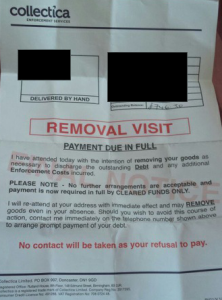
Bailiff_letter

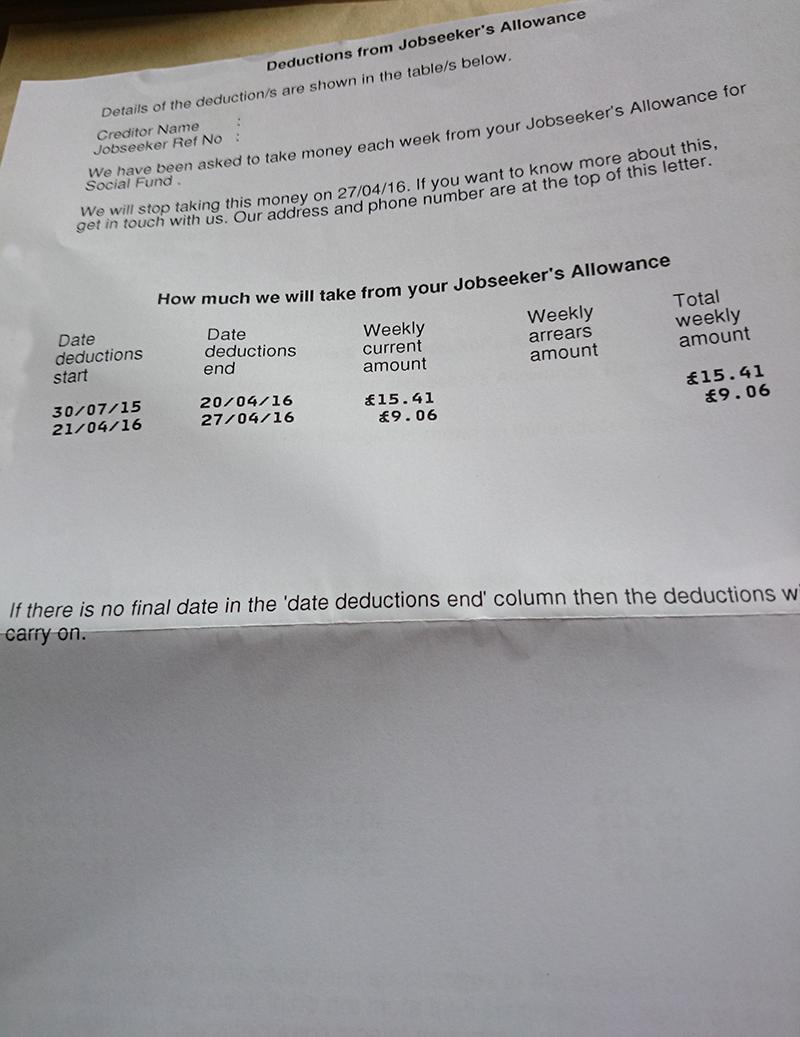
Meanwhile, the DWP continues to deduct loan and overpayment money from this woman’s jobseekers’ allowance at source. No matter that she has the rent and arrears problems, and is facing eviction and homelessness. None of that appears to be factored in. Letter after letter arrives, advising her of these seemingly random amounts for deduction:

First_deduction_letter

Here’s another one:

Second_letter

Plenty more where those came from, too.

A few weeks ago, I rang the DWP to explain the situation and to try and get some of the deduction rates reduced. The DWP agreed to cut one repayment amount by three pounds and the other by about six pounds. That frees up around a tenner. I suppose we should all be grateful for that.

I’m not sure what is meant to happen next. The DWP can spew out letters as often as it likes. Government can bleat on about scroungers and Taking Responsibility For Yourself as loudly as it wants. None of that changes the fact that people crash. It really doesn’t. I think we’d all know by now if it did.

  • Thanks to the CAB adviser who got in touch last time I wrote about this. Advice was appreciated.

Support Gabriel Pepper: protest for former ILF recipient facing a massive cut to care support

Update 2 September: Mirror story now out on this care cut: This disabled man has lost HALF his care after Tories axed the Independent Living Fund.

——————————————————————————–

Original post 1 September 2015:

Disabled campaigners and supporters will hold a protest today at Waltham Forest Town Hall in support of former Independent Living Fund recipient Gabriel Pepper, who is facing a substantial cut to his care package now that the ILF is closed. The ILF used to pay for some of Gabriel’s care. Now, Gabriel must rely entirely on Waltham Forest council to pay for his care package – a package that will be cut by about 48%.

So much for government claims that councils could and would meet disabled people’s care needs when the Independent Living Fund closed. “All disabled people, including those transferring from the ILF, will continue to be protected by a safety net that guarantees disabled people get the support they need,” Cameron’s last government waffled in 2014 when then-Minister for Disabled People Mike Penning announced again that the ILF would close. (I say “again” because the courts had recently thrown out a previous government decision to close the ILF. Undeterred, that government returned in March 2014 to say again that it would close the fund).

Obviously, Penning was talking rot. We all knew that, but still.

The protest about the cut to Gabriel’s care package will take place from:

12pm to 2pm
Waltham Forest Town Hall
701 Forest Rd
Walthamstow
E17 4J

All support appreciated.

Here’s Gabriel discussing his disability and the reasons why he needed the ILF to pay for extra carer hours:

Update: 5pm.

Tweets from Penny Pepper at the protest today:


If government is so obsessed with “helping” disabled people, why did it close the Independent Living Fund?

So.

A lot of disabled people used the Independent Living Fund to pay for the extra support that they needed to get to work and college, and so on. You’d think a government that was so obsessed with getting disabled people to work would have kept a crucial fund that allowed a lot of disabled people to – err, work. Nonetheless, the government closed the ILF earlier this year.

Makes you wonder what the government agenda for disabled people really is.

It can be really hard to get welfare rights advice

At about 9am yesterday morning, I turned up at the Newham Citizens’ Advice Bureau to queue for a 10am-1pm Gateway drop-in session. The plan was to meet this young woman there and to hopefully get some direction from the CAB on her benefit deduction and rent arrears problems, and maybe a longer appointment later.

The problem was that even at 9am, the queue was already closed. I know I should have made my way there earlier. The woman at the desk told me that the CAB could only see eight people at the 10am-1pm drop-in yesterday and that those eight had already been chosen (appointments are allotted on a first come first serve basis). Some days, the CAB sees 12 people, but  yesterday, it was only eight. That was the end of that. The woman was pleasant and as helpful as she could be about things, but said that our only option was to come back at the same time next week (and make sure to queue earlier), or to try the Freemasons Road drop-in today (and queue early there, too).

Anyway. I realise that people already know it can be hard to get advice because of the demand, or because law centres have closed and so on. People talk about that a lot. They tell me they’re sent from one CAB to another. Jobcentre advisers at the Kilburn jobcentre were actually telling people to go to the local unemployed workers’ group for advice at one point, because that group was very good at sorting people’s problems out. It’s always worth pointing out how quickly the window can close otherwise, and that the demand means people in dire straits must be turned away without advice.

It’s possible that trouble accessing advice and support services excludes people from other support options, too. Here’s an example: last week, a helpful reader of this site sent me information about several funds that the young woman with rent arrears might apply to for help with her debts (that advice was much appreciated). It seems that applications to one of those funds can only be made by professional support workers, or the CAB, though. You see where I am going with this: you might struggle to get into the CAB, but you can’t access some of the help on offer unless you get into the CAB.

Jobcentres will sometimes try to use that sort of concept in a perverse way to actively deny people their rights: they’ll insist that JSA claimants can only be accompanied to appointments by “official” advisers, or supporters from recognised organisations (this is incorrect, as it happens. People can take a family member, or friend). One of the East London jobcentres recently tried that on with me and someone I was accompanying: staff there tried to take the line that only recognised support workers were really allowed. The security guards at that jobcentre were wrong to say that, but they absolutely wouldn’t let me in.

Anyway.  I suppose the point I’m making is that I spend a lot of time with people who are facing eviction and/or dealing with debt problems, jobcentre problems, sanction problems – the works. They really need advice from people who are expert in a range of fields: housing, benefit entitlements, debt relief and debt management, and legal aid rights and entitlements. People come to my site from time to time to say that they have tried the CAB and to ask if I can recommend anyone else who can help. Mostly, I have absolutely no idea what to suggest.

What exactly are jobcentres for?

Photo from the jobcentre by http://photos.snapsthoughts.com/blog

20150811jobcentreI wonder some days.

Here are a few more stories:

Leafleting at the Kilburn jobcentre yesterday with the Kilburn Unemployed Workers’ Group, I spoke for a while with an older woman. She said that she was 62. She was very confused about benefits and her entitlements. She said that she’d received a call the day before from the DWP. The person who’d called had either told her that she wasn’t eligible for employment and support allowance, or that an existing employment and support allowance claim would end. She was agitated and not entirely clear about the call, or the instructions. “They told me I had to ask them about JSA,” she said.

She had brought paperwork from her doctor. I think she had an idea that she could take the paperwork into the jobcentre and that someone there would look at the doctor’s letters and help her sort her benefits out. Nothing of the kind happened, of course. I don’t see too many jobcentres providing an on-the-spot service, even for people who are older and clearly struggling. At best, people are given DWP contact centre numbers to call and told to go outside and call them on their own phones (some of them cost to call. I made a whole lot of 0345 calls to the DWP yesterday. Wonder how that bill will turn out).

I went into the jobcentre with this woman and we were stopped straightaway by security. The security guard we spoke to wasn’t as antisocial as some, but he was adamant that this woman couldn’t see an adviser until she rang the DWP and sorted out an appointment. There was no other option. It didn’t matter that she was in her 60s and obviously concerned. Requests to see someone were just met with a blanket No. The woman had scrawled a number on her doctor’s letter when the DWP had called the day before. The security guard told her to go home and call the number from a landline. That was the end of that. Continue reading

DWP takes up to 4 weeks to decide whether to reduce loan repayments for people in hardship? Wtf.

Any input on this appreciated. Haven’t dealt with social fund repayments before.

Feel free to contact me here if you don’t want to leave a comment.

I spent about an hour on the phone to various parts of the DWP today (more on that exercise soon). I was trying to a) work out why money was being deducted from this young woman’s JSA and b) if the rates of these various deductions could be lowered, seeing as this woman is in an impossible place financially. She has a weekly rent shortfall of a considerable sum each a week, rent arrears because of the shortfall (her Housing Trust said that it might accept a reduced repayment rate on arrears, but that she still has to find the shortfall, of course) and social fund repayments of about £15 a week – a seemingly random amount that was announced by DWP letter about a fortnight ago. These deductions and repayments mean that she will have almost nothing left out of her JSA when all payments are made. That clearly won’t work no matter who thinks it should, so we rang the DWP to try and get the social fund repayment rate lowered. The thinking here was that maybe some of that money could go towards the arrears and help prevent an eviction. The whole thing is a total mess and the paperwork is unreal. No wonder people ignore calls and letters when this shit starts happening. There’s no way to fix it if people can’t pay any of it off, so they ignore it for as long as they can. I’d say that this was the point where people needed the most help sorting things out in a way they could manage, but what would I know. No doubt this is the point where loan sharks come in. I can picture a scenario where people go to loan sharks because the DWP is deducting money from benefits for its own loans – money that people can’t afford to lose each week. Or something. Bloody hell. How does this even work.

Anyway, the woman at the DWP said it would take between two to four weeks to decide whether or not to reduce the repayment terms – with the emphasis on the four weeks end of the scale. That’s an impossible length of time to wait for a decision in this sort of scenario. Two weeks is bad enough. If people are struggling to repay a loan right now and inching ever closer to homelessness because of rent arrears, they’re sure as hell going to be closer to the edge in four weeks’ time. If only outstanding contributions from tax dodgers were pursued with such enthusiasm. That’s the sort of money that would make a difference.