Newham council to me: you are foul mouthed and aggressive. #Result. A #FocusE15 update

To Stratford again! where career mayor Robin Wales continues one of London’s leading Pillock of the Year campaigns…here he is at the recent Newham Mayor’s show running from the Focus E15 mothers and their kids when the mothers asked him again about social housing in the borough.

Video from the Focus E15 mothers:

“This [event] is a family day!” Wales barked at the mothers as they walked around the event with their – err, families. I wonder if I should even bother outlining the ironies in that one. I guess we can take it that when Wales says “families,” he means “families who are not campaigning for social housing for families.” For nearly a year now, the Focus E15 mums have been fighting for secure social housing for everyone who needs it, which is most people. The women want decent, secure social housing for all – places where people can settle for the long term and raise their families. It is actually hard to think of a more family-orientated campaign. (For more on the financing of Newham’s family days and other short-term crowd-pleasers, read Mike Law’s excellent blog on that council’s likely borrowing legacy here). Wales is under investigation now – a complaint was made about his behaviour towards the mothers at the mayor’s show.

So. Perhaps the real problem here is that Wales, Newham council and the political class generally find assertive, persistent women difficult. I thought about that again this week when I found a letter that Newham council sent to the NUJ about me earlier this year. I’d forgotten about this letter, so thought I’d share it with you before I throw on my pile of Fuck Off Kate correspondence from councils. All good.

Earlier this year, I asked the NUJ to complain to Newham council when security guards stopped me from attending a public council meeting. I’d completely forgotten that the council had sent a response, but remembered this week and hauled it out. In the letter, the council said I’d be denied entry to the council meeting because I was foul mouthed and aggressive to security guards. OUTRAGEOUS. Conveniently, I have a recording of the interchange between me and the security guards that evening. You can hear me challenging the guards – as well I might, seeing as they were denying me entry to a public meeting and pushing my press pass aside – and that I actually sound quite sweet, because I am. I am in person, anyway. Generally. I like to swear all the time on social media, not least because that’s an excellent way to let off steam after exposure to a twat like Wales. Anyway – I thought about all of this when I saw Wales racing away from the Focus E15 in the video above. Not for the first time, I wondered about Newham’s two-fingered salutes to assertive women. I’ve posted more videos of those salutes at the end of this article. The Focus E15 fight is a feminist fight, all right. These female campaigners have been dismissed categorically – by Newham, by Labour, by the political class and the press. They’ve kept going, though, and generated a great deal of interest and support. It is not easy to keep things going, but they have. Continue reading

“I didn’t want my first #JSA meeting to be in a group session with a G4S guard.”

I’d be keen to hear back from anyone who has experience of this:

I spent a couple of hours today talking with someone who is a new JSA claimant in North London. This man started his JSA claim a couple of weeks ago. It’s the first claim he’s made. He filled in an application form online and then was sent a text by the DWP some days later which called him to a meeting at a London jobcentre in the first week of August.

He assumed that the meeting would be one-to-one with a jobcentre advisor – a meeting where an advisor goes through the application in detail with the claimant and jobsearch requirements are set – but instead found that the meeting was a group session with about ten other new claimants and one G4S security guard who sat in the room the whole time. This man was shocked to find that this first meeting wasn’t private. He found the experience confusing and worrying, and wasn’t sure what he agreed to in it.

He said that he was certainly concerned about asking questions and sharing personal details and financial information in front of a group of strangers. He wasn’t the only one. He said that “a couple of the people there looked very nervous and anxious at the prospect of a group meeting,” and that people were worried about confidentiality.

He also said that the two jobcentre staff who ran the meeting “said that the new claimant meetings were now ‘unfortunately’ group meetings rather than individual meetings.” He has another meeting coming up soon and thinks the new meeting is a one-to-one, so he wasn’t sure if the group session was a direct replacement for a new claimant one-to-one. He was hoping that his claim would be finalised at the upcoming meeting. He was concerned about papers that he signed at the group session though. He was worried that he may have agreed to a claimant commitment without properly talking about it, or having time to think things through. He wasn’t sure if that had happened and hoped to find out at the upcoming one-to-one. He didn’t want to make a fuss and not sign papers at the group session. He also didn’t want to ask many questions or reveal his financial situation in a room full of strangers.

I’ve put a transcript of our discussion below. I’ve found some evidence of these new claimant group meetings online and a woman I know told me today that she’d accompanied someone to another London jobcentre where new claimant group meetings were held. The woman she was with was excused from that group meeting, because she didn’t speak English well. She was given a one-to-one session with an advisor instead that day.

The man I spoke to today said:

“Beyond the complete lack of confidentiality and privacy in a group meeting, it proved highly impractical and inefficient to address questions of ten different claimants. New claimants obviously have very different and unique cases. I can’t imagine how anyone would want to talk about sensitive or difficult issues in that environment.”

People were also told to put their identifying documents and bank statements into a box for photocopying and had their names read out for all to hear when the documents were returned.

I’ve asked the DWP for more on this and I’d be interested to hear from anyone who knows about these meetings. You can contact me here. People I’ve spoken to about this have real concerns about confidentiality and also about the appropriateness of a group environment for people who need to discuss sensitive personal information. I’m also interested to know why these meetings are held at all and why a G4S security guard gets to sit in listening to people’s personal stories. Continue reading

Court case to #SaveILF to go ahead

Great news from Disabled People Against Cuts who say:

“Permission has now been granted and the second  ILF Court Case will go ahead.

The papers went to a judge this week and he has granted both permission and expedition (which means speeding up the usual timetable for the court case).

The hearing should be “as soon as possible”, which could mean anything at the moment, as the judges are on holiday and the court has a very bad backlog, but we would hope we will get a trial date for some time in September/October as planned.

On behalf of all ILF recipients we’d like to say a continuing thank you to those involved in taking the case. We know from experience just how gruelling and stressful taking legal challenges can be and we offer our solidarity with you all.”

The Independent Living Fund is the fund used by severely disabled people to pay for the extra personal assistants and carer hours they need to live independent lives. The government tried to close the ILF last year, but that decision was overturned by the courts. Needless to say, the government is trying to close the fund again.

More soon.

In this video, #SaveILF protestors chain themselves to Westminster Abbey gates at a 28 June protest to draw attention to the government’s plans to shut the ILF:

In this video, ILF receipient Penny Pepper explains how the ILF made it possible for her to leave home as an adult and set up her own independent life:

The government will not get away with this.

London evicts. Women and children first, thanks

One development (if you can call it that) I’ve really noticed in London this year is the increase in calls and contacts from people who are facing eviction, or trying to stop an eviction right then and there, or worried that they are being pushed out of their their estates and homes by planners and developers. I decided to start to collect the stories of some of the people affected. The first two are below in this post. They’ll form part of a longer piece I’m writing on these evictions.

A few thoughts on this –

The more I talk to people, the more obvious it becomes that the real problem is the terrible lack of decent, secure, well-maintained, well-managed social housing people can easily afford. Long-term lets are especially crucial. The expensive, wildly insecure private rental sector is a challenge for most of us who rent. It can be particularly challenging and unforgiving if you have support needs. If people had secure social housing with long-term lets, a lot of the problems they’re reporting now simply would never come to pass – problems like being forced to move because a landlord wants the house or flat back, the stress of uncertain short-term tenancies, having to live in single, tiny, dirty rooms that private sector landlords pass off as flats to collect housing benefit and all the rest. I’ve spoken with people who have serious mental health problems and who simply can’t handle the idea of moving home, or to an unfamiliar environment. They are offered other places in the private sector, but that’s neither here nor there. They don’t want to move. They can’t move. But they’ve been evicted – forcibly – because the landlord wants them out.

Unfortunately, social housing waiting lists in some boroughs run into the tens of thousands – about 24,000 in Newham, 28,000 in Camden and 20,000 in Lambeth, to give a few examples. The truth is that people’s chances of securing a place that way are non-existent. (There’s another point, too – with a bigger social housing stock and better security in it, people in social housing wouldn’t be facing eviction in the growing numbers they are now, either).

Without those places, it’s up to tenants to get by in a hostile environment. Doesn’t matter that many people struggle. You beat the odds yourself, or you go down. Ours is the great era of individual responsibility, after all. Iain Duncan Smith – a man who is himself housed in his rich wife’s mansion – is very big on this Do It For Yourself concept. Individual liability at any cost is one of Universal Credit’s many rotten planks. When UC comes in for all, if it does, the housing element will be paid to claimants, who then must pay rent from it. Anyone who fails to achieve that will be dismissed as feckless. Anyone who argues for direct payment to landlords will be written off as a Nanny State relic (*waves*). No matter that the odds in that game are already stacked against plenty of people. Cuts to council tax benefit and housing benefit mean that many already pay bigger council tax bills and bigger rent demands. Using rent money to cover council tax arrears because your council threatens you with a liability order to deduct tax straight from your benefits, say, would not be irresponsible. But we’ll end up there, anyway. We live in an age where individuals must sink or swim – which usually means a lot of well-off people blathering on about responsibility while they watch other people sink.

“They told us that we have to organise the money,” one very young housing benefit tenant said to me a week or so ago when she reported back from a Jobcentre Plus meeting about Universal Credit. “They said that we shouldn’t be having fun with our money.” Continue reading

How Iain Duncan Smith lives – compared with people who must live his policies

Posting this because I can.

Here’s Iain Duncan Smith’s weekend place, which was occupied last year by UK Uncut and Disabled People Against Cuts in a protest against the bedroom tax. It’s a very nice pile indeed. It comes with a tennis court, the sort of lake that Mr Darcy might emerge from in clinging pants, happy lambs and a very large house. Very. If you must lie around somewhere thinking of ways to piss the rest of the exchequer away on Universal Credit, then this is the place to do it:

Compare this if you will with the tiny one-room Kilburn flat which I visited on I visited on Monday.

No lakes or tennis courts here, alas. This flat is occupied by a 51-year-old man who is out of work at the moment and must sign on at the local jobcentre. He has been sent on the work programme. He has mild learning difficulties. He has not found a job through the jobentre, even though he has a good work history.

He was very depressed about the flat and it was easy to see why. The room was so small that it was difficult for the four of us who were there to fit into all at once. There was a bed, a broken fridge, a small fridge in the middle of the room that this man had bought to keep his diabetes medication in, and a broken oven. There was a second, smaller oven with two hotplates sitting on top of the broken oven.

There were no windows as such in this room – just a door area that led to a path. The man had complained to his landlord about the mice and cockroaches that live under the broken oven, but nothing had been done.

I’d say We’re All In It Together, except that is getting old. Even as irony it’s getting pretty old.

How people with learning difficulties are expected to live…#jsa #sanctions

Wednesday 30 July: updated with more photos at the end

Yesterday, I went to the home of a Kilburn man who is 51, has mild learning difficulties and currently signs on. He has worked all his life in hotels and in kitchenwork, but found it harder to get and keep work during the recession. He’s been out of work for four years now and is depressed about it. He doesn’t read or write very well and thinks that is the reason he’s finding it difficult to get another job. More on that soon.

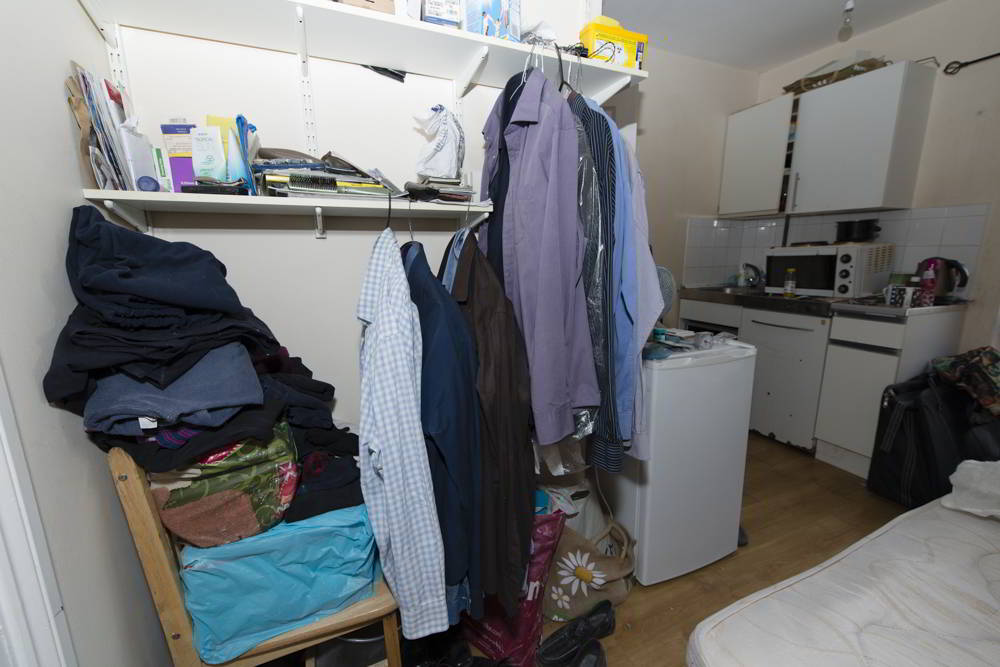
For now, he wanted to show me his flat. It’s the tiny, single room in Kilburn you see here – so small that it was difficult for the four of us who were there to fit into all at once. His rent is paid in housing benefit – which means that his landlord gets housing benefit for renting this tiny little room out as a flat.

There was a bed, a broken fridge, another fridge in the middle of the room that this man had bought to keep his diabetes medication in, because it must be kept cool, and a broken oven. He’d got a second smaller oven with two hotplates to sit on top of the broken oven so that he’d at least have hotplates that worked. You can see that in the video. This man has complained to his landlord about the mice and cockroaches that live under the broken oven, but nothing has been done.

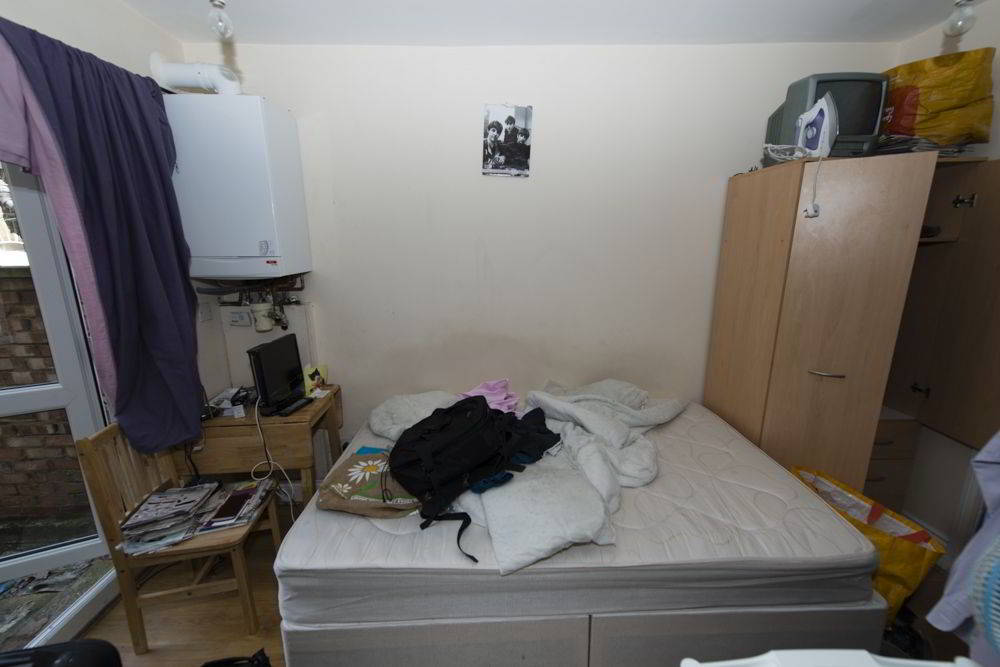
There are no windows as such in this “flat” – just a door area that leads to a shared path down the side of the house. In the heat, the room has been nearly uninhabitable. To cap things off, he says he has to do a jobsearch of about seven to ten jobs a week and has been threatened with sanctions if he doesn’t. He has been sent on the work programme. He wants another job. I’ll add to this story and have a lot more video to post, but – have this to think on for now. Here we are in 2014. Austerity’s over, you know. For some.

Photos added:

Room view. Bed, kitchen and clothing all in one tiny area.

The whole room

Bed area:

Bed area

Don’t like homeless people in your area? Don’t like kids? Spike them!

Update Saturday 26 July:

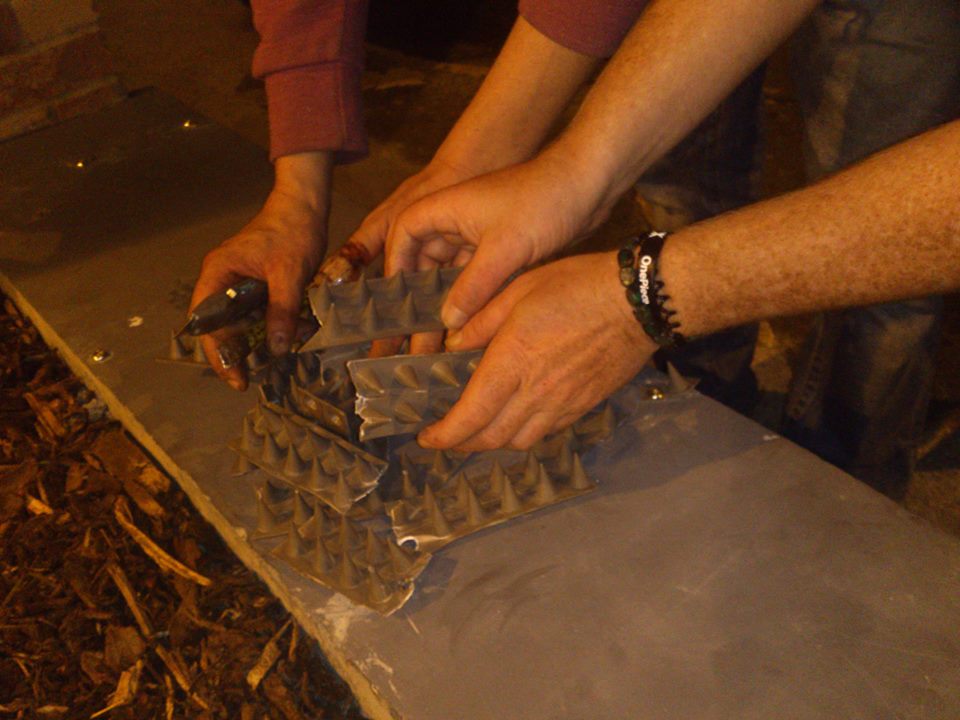
The spikes have been totally removed. Here’s a video of the spikes being cut out:

And a good photo courtesy of People’s Republic of Southwark:

Spiteful and dangerous spikes

Some photos of the spikes being removed here – here’s one from that facebook set:

Spikes being removed

People won’t put up with this sort of elitist crap – ie giving some people free access to neighbourhoods, but not others. Doesn’t matter if it’s your poor doors or spikes or whatever. This “some neighbourhoods are only for the well-off” bollocks will not stand.

So give it up.

————————————————————————————————————————

Update Thursday 24 July:

Have returned to the site to find that a helpful someone has started to remove the spikes. People really don’t like these spikes. Nor should they. They’re awful. They’re aimed at rough sleepers and kids. Don’t care how gentrified your area is. You don’t need these.

Anyway – they’ve been reduced from this:

Spikes

To this:

Spikes removed

Also, as you can read here, one of the people I returned to the site with talked to some of the people working right next door to the spikes site and found out from those people that skateboarders are not a problem in the area. The same person also rang the company that placed the spikes and was told never to call or email again. How rude. “We didn’t need to talk to anyone,” that person was told. “It’s private property.” That’s a refrain you hear a lot these days. As it happens, private companies must learn that they do need to talk to people. The concerns raised about these anti-homeless, anti-young-people spikes need to be answered. There are no safety or warning signs about these spikes. I had another look today.

———————————————————————————————————————

Original post:

Ahhhh – the inner London gentrification era. I just love it…

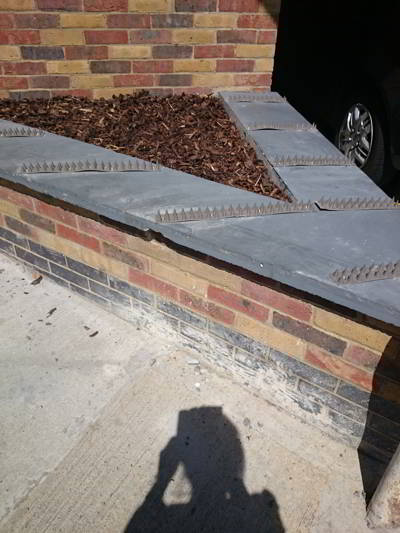
Yesterday morning, I went to Abbey Street in Southwark, because the People’s Republic of Southwark blog had received a report of more anti-homelessness spikes outside flats at the corner of Druid and Abbey.

So off I went to take a look and to take photos….of the very large and harsh plastic spikes you see below. The spikes were clearly unpleasant and meant to hurt, and it was a little hard to imagine exactly who they were aimed at, so when I got home, I rang the company that manages the building (their badge was on the building) and asked them who the spikes were for.

The answer to that was – err, youngsters. The woman I spoke to said that the spikes had been put down to stop skateboarders, because building management had received complaints about them. Am guessing that the spikes would put rough sleepers and street drinkers off sitting and lying in that space, too. Can’t help thinking that went through a number of minds – not least because it seemed doubtful that skaters could jump to the point that the spikes were at, or that they’d leap across the divide in huge numbers, like a herd of gazelle, or whatever it was the building management company had in mind. The street doesn’t look like a skateboarding place. It’s just a street with an uneven pavement and a garage with cars in it after the so-called jump. Weird place to want to jump and smash up against a car on landing. But yes – kids on skateboards was the line. It seems that these large, exposed spikes are thought to be acceptable ammunition in a battle against young people who get on other people’s nerves.

So – we’ve had spikes for homeless people in Southwark and now we have spikes for skating kids in Southwark – and whoever else might sit or lie in that space. Am starting to wonder if spikes are the weapon of choice against people who are believed to mess up increasingly gentrified inner London neighbourhoods. Hum. I don’t believe that I care for that.

And just in case you were thinking of turning up here to moan that people like me just don’t understand how hard it is to live cheek-by-jowl with the south-east London rabble and boo hoo and blah blah – well, I do live in south-east London, thanks, and I also live right across from a skate-and-basketball park which is full of kids day and night and I really don’t give a shit about any of that, because I don’t own the world. There are homeless people and street drinkers and they sit in the park as well – unspiked to date. This is an urban space we have here and everyone has the right to it. Kids play out and do their thing and that is how it goes. I did the same when I was a kid. It’s never occurred to me that the kids in our local park should not be there. Neither has it ever occurred to me to have them impaled on spikes. It is interesting to know that a building management company thinks that’s a starter.

I’d also say that if you really can’t stand skating kids in your space, there are plenty of skate deterrents around that are less likely to have some 12-year-old’s eye out than the latest effort in Southwark. There’s no justification for the spikes in the pictures below. I don’t care how popular they are, or how often they’re used, or whatever. But what would I know, I guess. If you don’t like them – spike them. That’s the era we’re in.

Two rows of spikes

Spikes for skaters

Spikes

Spikes

Clips from today in London: very big turnout for the #GazaUnderAttack protest

As above from today. What a crowd. Forget whatever the mainstream tells you. Or doesn’t tell you. There were a hell of a lot of people out in London today protesting against the Gaza attacks. Should be big news everywhere. It won’t be, but it should.

Here are a few clips to give you an idea of scale and the sense of urgency around the whole event.

Keep an eye on the Reel News site as they’re going to post a full video report.

Empty words and a terror of protestors: thanks for nothing, Penning #SaveILF

Here we are, then – a little video I filmed on the quiet of the now-departed (post-reshuffle) Minister of State for Disabled People Mike Penning talking total bollocks at the June Independent Living Fund adjournment debate. I had to film this one on a little camera that I rested on my knee under the desk. Things were fraught at the House of Commons that day. There was an official in the room who told me off for stepping over a little rope instead of walking around it. After that, he kept looking at me like he was measuring me for a coffin. I got the distinct feeling that the very fact campaigners and journalists turned up for the ILF debate that day was getting on people’s nerves. I arrived 15 minutes early for the debate and wasn’t allowed to wait outside the room. Officials told me to go away and come back. It really was that kind of day.

Anyway – thought I’d post this video for the record. Mike Penning’s failure to support independent living for disabled people ought to haunt him forever. It will if he has any sort of conscience. This issue will not go away.

As many people know, the Independent Living Fund is a vital pot of money used by severely disabled people to pay for the added carer hours they need to live their independent adult lives. Earlier this year, Penning announced that the fund would close by the end of June next year and that people would have to rely on councils for social care. No matter that last year, the court of appeal overturned an earlier government attempt to close the ILF. Penning and Iain Duncan Smith have insisted that this attack on disabled people continue.

That ILF closure will be disastrous for ILF recipients – and for the idea that disabled people should be able to live, like everyone else. This is a crucial point – and it’s the reason why the fight for the ILF is both escalating and winning people round. There’s something fundamental to the notion that everyone is equal in this battle. As I’ve said before – saving the ILF is not just about saving a pot of money. It’s about saving the idea that disabled people deserve to live and to get out there and live. Penning argued, of course (he did it again at the adjournment debate) that councils will be able to pick up the tab for care costs for this group of people. That is garbage and everyone knows it. Councils can’t meet social care costs as it is. As readers of this site will know, I’m already talking with severely disabled people who have real problems finding adequate care. ILF recipients will join these people in their problems if their fund closes. The fund should be kept and opened up to all who need it.

Penning did tell one truth at the adjournment debate, right at the start of his speech:

“Can I guarantee that no one in receipt of ILF money today will be adversely affected by the changes that we are going to make? No, I cannot, and no minister of any colour or persuasion could.”

People know this and are responding accordingly. About ten days after he gave this speech, ILF recipients occupied the grounds of Westminster Abbey to draw attention to the threat the ILF closure poses.

Which brings me to – protests about social security cuts:

During that adjournment debate, the MP Mary Glindon observed that a group of ILF recipients had recently turned up to the DWP offices at Caxton House to protest at the ILF closure and to hand in a letter which outlined their concerns. The doors at Caxton House were shut in their faces. I know this, because I was there. I took this film on that day. “Those people simply wanted to hand a letter in to the Minister’s office, but no one was available, and I had to take the letter in by the back door,” Glindon told Penning.

Said Penning: “I am sure that it [the event] was peaceful, well-mannered and nice, but that is not always the case. If the hon. Lady looks at the side of the building she will see that paint has been thrown over it and there have been really nasty incidents outside.” (There’s a clip at the end of the Penning video above where he says that).

Interesting. I sent an FOI to the DWP to ask about the paint throwing and the “nasty incidents”. The response showed things were really not as dramatic as all that. They certainly weren’t as dramatic as Penning would lead you to believe…The paint throwing was apparently noticed in February this year. The DWP didn’t know when it was thrown, or who threw it. So that was all a bit hopeless. You can see the sad little dribble of paint they photographed in the picture they sent me here:

Paint on Caxton House

As far as Penning’s “nasty incidents” went, the DWP reported three events in its FOI response to me.

The first was a 2012 “invasion” (their word) of the DWP’s Caxton House reception area by protesters, which the DWP said prevented “normal access.” I was at that protest myself. My overriding memory of it was that the thing was seriously overpoliced and ended in scuffles in which a disabled protestor was injured. The police did a hell of a lot of pushing and shoving that day. You can see that in the video I took here:

Remember: people at that protest were demonstrating against horrendous social security cuts and the Atos regime. They had and have every right to make a vociferous protest against those things. Protesting against that sort of government extremism is not extreme. It is an entirely rational response.

Next, the DWP FOI response mentioned the May 2014 protest at Caxton House, too (I was at that one as well and filmed it here. There was no violence. There was a group of disabled people in wheelchairs trying to deliver their letter about the ILF as discussed above and asking people who came and went from the building if anyone had ever set eyes on Mike Penning. People were starting to wonder if he actually existed at that point.

The DWP also cites a 9 June 2014 protest where staff had to walk past protesters to return after a fire evacuation – you can watch that here. Protestors had a loudhailer and banners, and they chalked names onto the pavement. The FOI response says that police were not called.

People have the right to protest. They certainly have the right to protest about this government’s out-of-control social security cuts. And of course people wanted a response from Penning on the ILF. They wanted him to abandon his plans to close the fund. But Penning made it clear that the closure would go ahead – that came through loud and clear at the ILF adjournment debate. That left and leaves people with no option except to go back to court, which they are doing, and organise protests where they get in the establishment’s face. The ILF closure plan must be thrown out.

Until it is, people are perfectly entitled to demand that it is thrown out. Such protest is entirely justified. As far as I’m concerned, it’s the establishment that has done the escalating to date. I’ve been to plenty of these protests and was at the recent Save the ILF occupation of Westminster Abbey grounds – a peaceful but ridiculously over-policed event where a small group of disabled campaigners and supporters tried to set up a camp to draw attention to the government threat to the ILF. Look at the number of coppers that turned out for that one. Look at the vile policy protestors are campaigning against. It’s very clear to me who started all of this.

I find it very interesting that the mere act of protesting these days – that is, standing outside a building with banners, loudhailers and leaflets – is written off as nasty or extreme and used as a justification to stick to a massively unpopular decision, and to ignore the people whose lives are being destroyed by that decision. Without ILF money to pay for personal assistants, ILF recipients face lives at home with grossly inadequate levels of care, or stuck in carehomes. Nobody deserves that. Nobody voted for that. It is this government that is extreme. Even Nick Clegg is getting that. So, you know – expect a goddamn response. It amazes me that people on the receiving end of the coalition’s appalling attacks on social security have kept their cool for as long as they have. The government keeps escalating. Who knows what the future holds.
Video: life with a serious mental health condition. Join the WCA vigil this Tuesday

In this video, Roy Bard explains his lifelong problems with critical depression. He also takes us on a short tour of his home and explains how difficult he can find it to look after himself and his flat when things are going badly. This is how a serious mental health condition can affect day to day living:

One of Roy’s friends was a bit shocked when he saw this video, so he came to London to help Roy clean the flat up.

When we made the video, Roy was on incapacity benefit. He was waiting for the forms that would tell him to apply for employment and support allowance and to prepare for an Atos work capability assessment. He has since received those forms and returned them. He is now waiting to hear about the Atos face-to-face assessment. He could be waiting a while on this, too, given that there are hundreds and thousands of people in the ESA assessment queue. You’ll hear Roy say in the video that he finds all the waiting torturous. Struggling with serious depression is difficult enough. It is made considerably more difficult if you have to wait for a useless private contractor to get around to deciding if you’re entitled to financial support.

Which brings us to this week’s court action on the work capability for claimants with mental health conditions:

In 2012, the Public Law Project and two people with mental health conditions brought a judicial review of the work capability assessment – and the courts found in their favour. As Disabled People Against Cuts reports here, the judges decided that the WCA did indeed place mental health claimants at a substantial disadvantage and that the DWP should make reasonable adjustments for claimants because of that.

Says DPAC:

“Often mental health claimants struggle to provide further medical evidence to support their claim for ESA. They may not be able to accurately self report how their mental health conditions affect them, either when completing forms or at face to face assessments. Many claimants are wrongly found fit for work and subjected to the stress of appealing the decision.

“The claimants who brought the case, DM and MM, asked the court to rule that the DWP should be responsible for obtaining further medical evidence at every stage of the process to improve the chances of a more accurate decision being reached about whether a person is able to work, or to start preparing for work, and to avoid the need for a face to face assessment in cases where this would be especially distressing for the claimant.”

Needless to say, the DWP appealed that judgement – “we believe we have made – and continue to make – significant improvements to the work capability assessment process for people with mental health conditions,” the DWP told me when I asked the department why it had decided to appeal a decision which would have made life so much easier for so many claimants. Continue reading