Was back at Stockport jobcentre on Friday with Stockport United Against Austerity. We spent a couple of hours talking with people who were signing on for jobseekers’ allowance, employment and support allowance and Universal Credit.
A lot of people were keen to talk on Friday – about benefit problems, that is. People didn’t talk much about the local elections which had taken place the day before (elections which left the Lib Dems and Labour tied at 26-26 on Stockport council, I believe, and already fighting like rampant weasels. Can’t wait to see how that pans out).
Anyway. While the political class disappears down the Brexit hole that it won’t or can’t stop digging, people in need are left to get on however they can.
That generally means trying to make sense of the haywire public sector systems that millennium politics has created (if “created” is the word), trashed and abandoned. Pity that there’s so little sense to be made. I keep meeting people who can’t get answers. They certainly can’t get the answers that they need.
Here are two examples from Friday.
The first story came from Dave*, 57.
We see Dave regularly at the jobcentre. He’s a friendly bloke and always keen to talk. He’s been looking for work for a while.
On Friday, Dave said he was in the running for a permanent job as a carer. There was probation to do and then he should be underway.
This news of a job would be reason to celebrate in a world which made sense.
Unfortunately, we’re not in such a world.
Dave was worried. He was pleased about the job and eager to start – but he’d been told that taking the job and working certain hours would stop his jobseekers’ allowance and trigger a Universal Credit claim.
The mere mention of Universal Credit is enough to crush any excitement about a job offer.
As Dave understood it (and he wasn’t sure that he understood it at all), a move to Universal Credit would mean that he’d have to:
– move his housing benefit claim to Universal Credit and wait 5 weeks and more for his rent payments to start (he’d still be several weeks’ short in rent if he did get an extra fortnight’s housing benefit). Nobody in the real world believes that migration to Universal Credit will go well
– trust the DWP to accurately record Dave’s varying weekly zero-hours-contract wages as a carer and pay him whatever Universal Credit money he was owed each month on time. This is a skill which the DWP famously does not have. I’ve interviewed part-time workers and self-employed people at Stockport jobcentre who were tearing their hair out because the DWP had literally never paid them the right amount of Universal Credit, or on time.
Back to homelessness in East London – where Newham council tells Maya and Rakib, a homeless couple with two very young children, that a flat with smashed and broken storage sheds and no floor coverings, or stove, or furniture is perfectly adequate for (the likes of) them.
The couple is homeless. That means they have no rights and no voice. They must live wherever authorities tell them to live. They must be grateful. They must understand that they’re at the bottom of the pile – and that’s how everyone else sees things.
Truly, homeless people are disenfranchised.
Says Maya:
“The council officer said they often rent flats out as shells and that was okay.”
This is important. It shows where the official mindset is at.
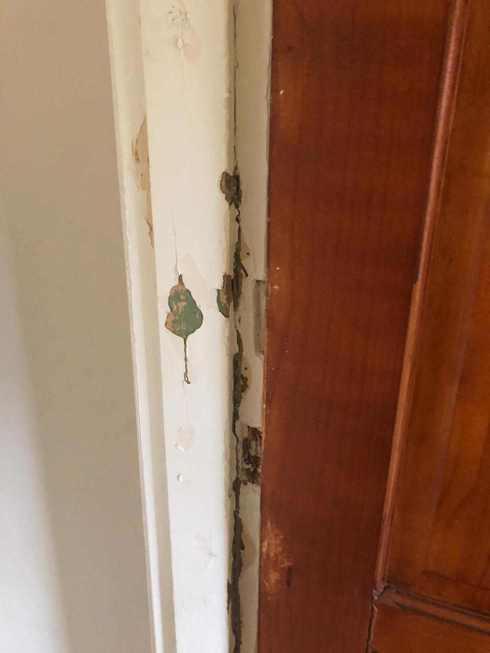
Windowsills in the flat
We’ve reached a point (we’ve been at it for a long while) where officers and politicians genuinely believe that it IS okay to shove homeless families into shells and hovels – and that homeless people who are offered a shell, or a hovel, don’t know they’re born.
I think that a lot of officials genuinely believe this. After years of austerity, this institutional contempt is rife.
“At least you’re inside,” the argument goes. In the bureaucratic mind, sleeping on an uncovered floor under a roof is better than sleeping on a park bench – because that’s the choice. That’s where the line is now. We’re all meant to accept it. Homeless people no right to expect the basics, let alone a healthy environment, or anything so romantic as comfort.
Homeless people who hope for the basics are felt to have a scandalous sense of entitlement.
I wrote about 67-year-old Paul in Oldham, who was told by officers at First Choice Homes that the filthy, tiny and rotting static caravan that he lived in counted as adequate housing and he’d make himself intentionally homeless if he left it. I attended a meeting with him where an officer actually said that.
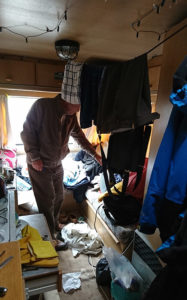
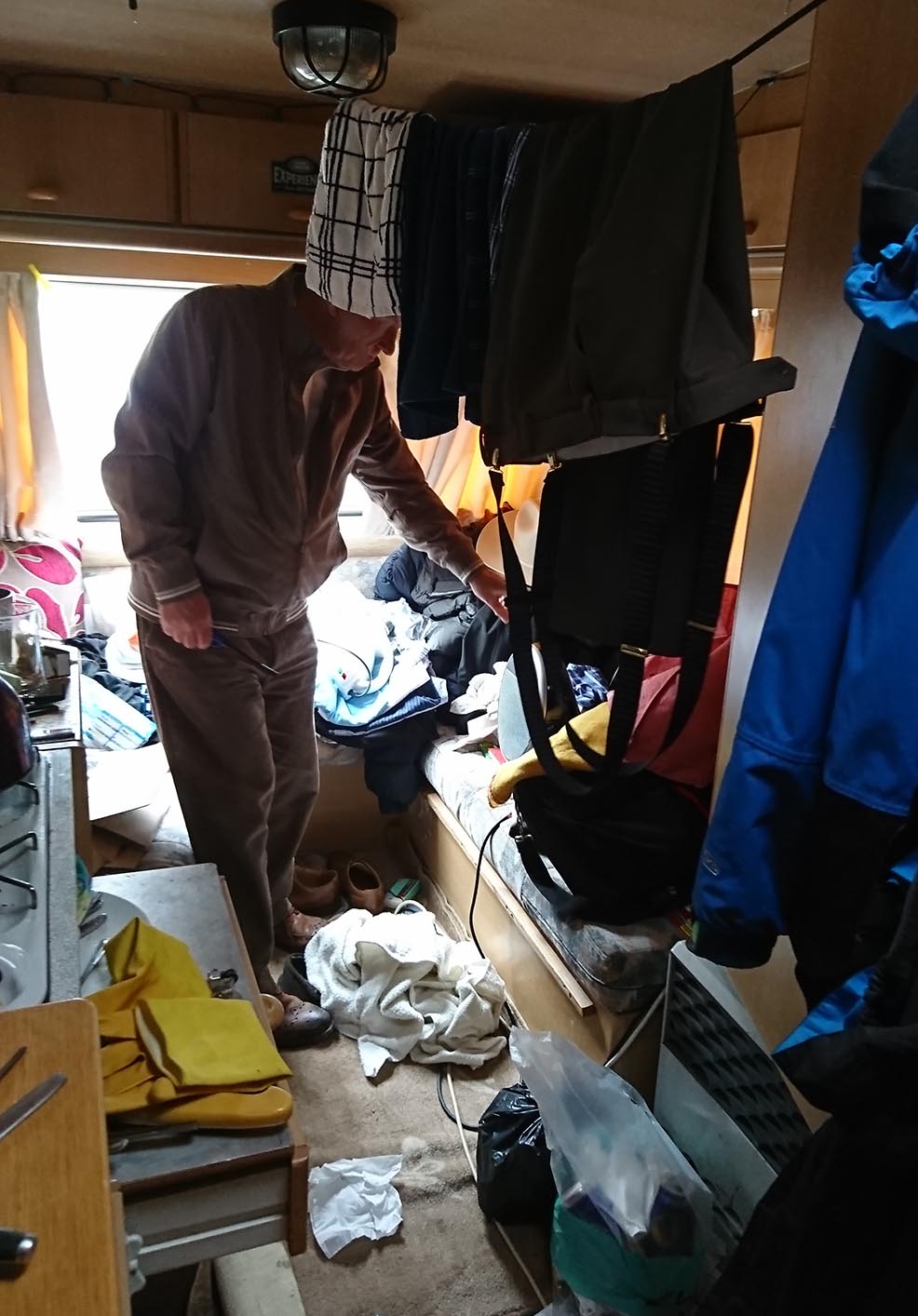
Paul in his caravan
I wrote about Marsha who was shown a place in Woolwich with stained mattresses, a broken, filthy oven and broken doorframes. She was told to accept the place, or else.
Oven at the flat Marsha was shown
Homeless people must accept all of this, or risk a council discharging its duty to them – that is, refusing to help them any further.
Their “choices” come down to – “do you want to live inside, or outside?” and “live in this hovel, or else.” Continue reading →
Posted below are excerpts from a transcript of an interview with homeless Newham woman Marsha, 30.
I post this as an example of homelessness as so many women I interview these days experience it.
Marsha talks about common problems that homeless women with children are always up against now: the lifetime of housing insecurity, the debilitating anxiety and depression, and the public authorities that invade a homeless woman’s privacy and keep her in her place by never letting her forget that they could take her child.
Marsha talks about being trapped forever – in rotten housing and low-paid work.
Few people on the ground believe that this will change soon.
The political and media classes are completely consumed by Brexit.
There’s no time or space for people who rely on the public services that our imploding politics can’t provide.
That is disgusting. I can’t tell you how upsetting it is for everyone involved.
——-
Housing
For 18 months, Marsha has lived with her 6-year-old daughter in a single room in a Newham homelessness hostel.
The two share a bed in that room:
Marsha and her daughter in their one-room temporary homelessness hostel accommodation
Before they were placed in this hostel, Marsha and her daughter lived in temporary shared accommodation in a Newham hostel called Belgrave Court.
The two had one room. They shared a kitchen and bathroom with other hostel residents.
Marsha has lived in a lot of places like this. She grew up in shared accommodation.
Marsha’s mother migrated to England from Jamaica. She worked long hours as a cleaner. She brought Marsha to England when Marsha was 12. The two lived in shared housing.
They often had to move. Stability is a privilege that not everyone enjoys.
Marsha says:
“…when you’re renting a room… you’re sharing with all different people and there’s always issues, so we’ve always had to just kept to kept on moving, so as a teenager coming up into my adult years, I had to move…”
Marsha says that she was abused when she was younger.
She hates talking about these issues (“I don’t want all my business out there”), although council and jobcentre officers insist that she talks – again and again and again:
“The medical assessment officer, he asked if I had any issues. My issues growing up is not something I’m comfortable talking about, so I just said to him, “bottom line, I suffer from depression. I don’t need to go into the things that make me depressed, because it is uncomfortable to relive certain moments…”
Relentless interrogation by authorities
Marsha is forced to relive her past and present problems, though. Homeless women must repeatedly justify their need for housing and income help to strangers by explaining their backgrounds and experiences again and again. They must tell their stories from the start to each new officer who interviews them – council homelessness officers, MASH (multi-agency safeguarding hub) officers, jobcentre advisers and social workers.
They must tell officers everything: mental health histories, family histories, relationship histories and abuse histories. There’s no letup. There’s no privacy. There is no autonomy. Officers want details when they are deciding if a homeless woman is in need.
They want graphic details, even. Does the woman have panic attacks? How often does she have them? How serious are they? How bad is her depression? Is she medicated? Was she abused? Who was her abuser? What did her abuser do? How has her experience affected her kids?
Officers want to rate a woman’s story. They want her to prove that her problems are genuinely serious, whatever that means.
Marsha says that her medical history of depression and panic attacks (she’s been hospitalised in the past) has sometimes been dismissed in the past, because officers say that panic attacks are run-of-the-mill these days:
“They said to me panic attacks is a common thing, [that] lots of people go through it. [They said] “just find coping mechanisms and you will be all right.”
Officers say that even when Marsha is clearly unwell:
“…the sort of depression that I had at the time – I was always washing my hands. I was always doing stuff. I couldn’t take light. Even now, I can barely stand light. That’s why I put stuff over the window.”
Marsha still drapes sheets and blankets over windows to keep the light out. I visited her at about midday on a Saturday and her hostel room was in shade.
Sheets and blankets draped over the hostel window
Officers know these things, but ask about them repeatedly all the same.
Councils keep detailed files about homeless people, but don’t refer to them, apparently.
Marsha says:
“I said to him [the officer], “I’ve got my housing file in my drawer. It’s this thick. I have been complaining since I moved into this property that I have panic attacks at least two to three times a week.”
At a recent meeting with social services, Marsha had to remind the social worker of her name, because the officer wasn’t sure who Marsha was – even though she had called Marsha to the meeting.
The social worker hadn’t looked at Marsha’s file. She just brought Marsha in to question her.
Regular readers will know that I recently published a story about the letter on this page – a letter that threatened a Newham hostel resident with homelessness if she didn’t attend a meeting.
Lukia, the woman who received the letter, has serious mental health issues.
She’s recently been in the care of a mental health unit.
The note said that Lukia would be thrown off the council homelessness list and evicted from her hostel room if she didn’t attend a meeting that day.
Needless to say, Lukia found this note upsetting in the extreme.
When I first posted the letter, some readers here and on facebook felt that it couldn’t be genuine – that staff couldn’t have issued such a rough note on an unheaded piece of paper in such unprofessional way.
I understood that. Nobody wants to think that council and hostel staff professionalism have collapsed to such a point.
Except that professionalism has collapsed – at councils, at the DWP – all over.
In the two recent videos below, Newham mayor Rokhsana Fiaz apologises for that letter. She says that there’s been an investigation into the note and that the person responsible has been sacked.
I’ve heard the same thing on the grapevine, so we’ll go with it for now.
Thing is – what next? – for Newham, for councils generally, for the whole of the public sector?
The political and media classes couldn’t care less that the public sector is actually anarchic a lot of the time. Brexit is their one interest and fatal obsession. You’d be better off asking Santa for housing than putting in a request with that lot.
Politicians like Fiaz do a good line in apologising (google “Rokhsana Fiaz apology” for a look), but that doesn’t change the fact that they’re still overseeing a housing catastrophe. The national housing disaster is going nowhere even faster than Brexit. Sadly, unlike Brexit, it isn’t live-blogged by mainstream press outlets in real time.
The best you can hope for now with local politicians is a kneejerk response that goes in your favour.
I know for a fact how things “work” behind the scenes at certain council offices at the moment, because I’m in contact with officers here and there. Campaigners and welfare advisers bring individual housing cases to the attention of a mayor or a council leader. That mayor or leader rushes down to the housing options team in that council and tells staff to find housing for that individual pronto.
Staff do as they’re told and money is somehow found to meet a local rent (this part always intrigues me), but staff seethe. Some leave. There’s no system as such – just reflex reactions from sensitive politicians. The thing really is lawless – like Brexit, if you will. Sign of the times, I suppose.
If you’re campaigning with people who are homeless, that sensitivity is your main way in. Problem is – not everyone who is homeless knows that, or is in a position to pressure a council.
I’ve posted below an extract from a PIP assessment recording I made.
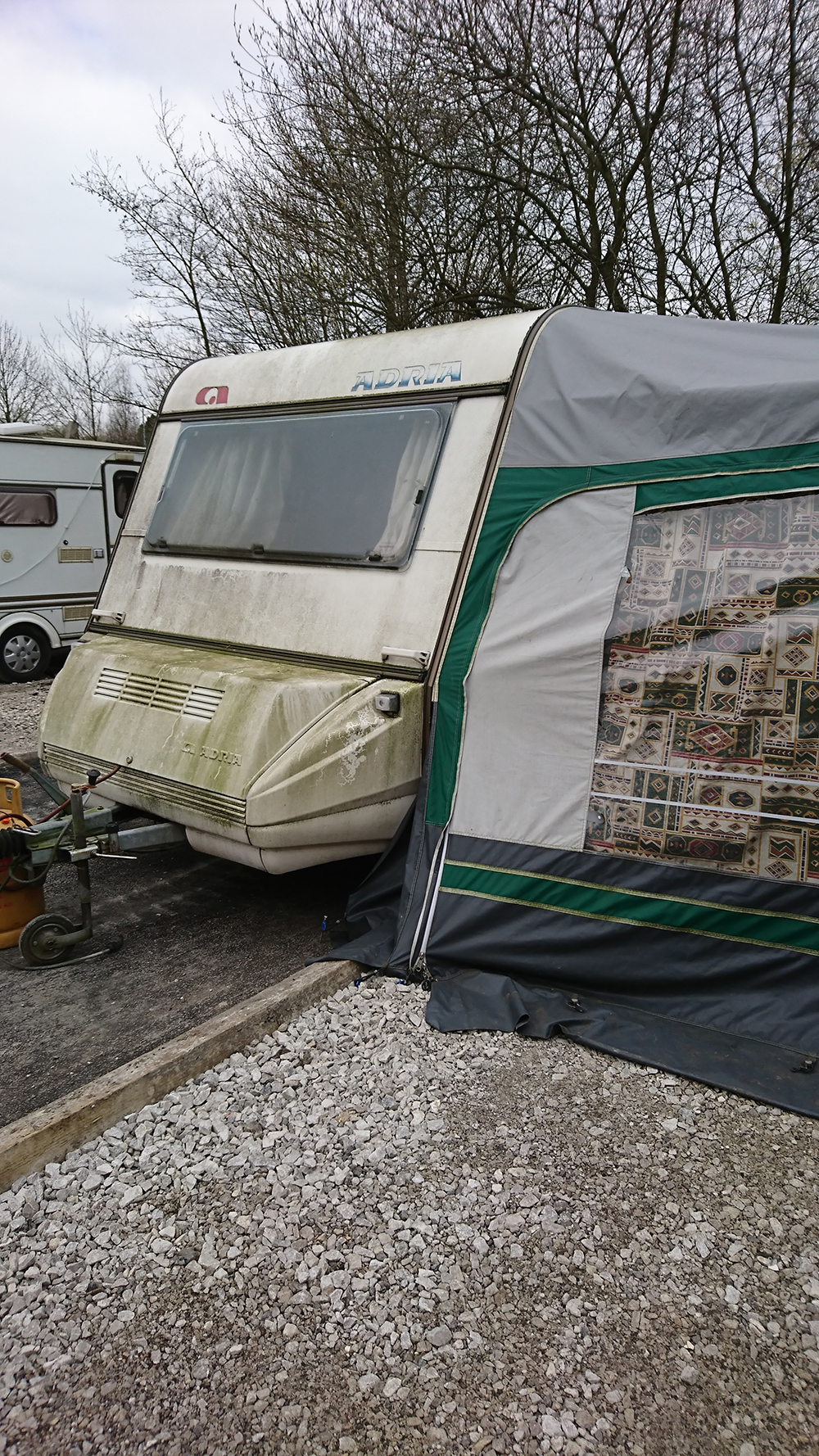
Paul’s caravan – exterior
It shows that some Personal Independence Payment assessors have no idea what extreme poverty in our so-called modern era looks like.
It shows that some PIP assessors don’t know – or don’t believe – that such poverty and need exists.
That is a problem. These assessors make judgments on sick and disabled people’s eligibility for much-needed benefits.
They’re at a dangerous remove, because they carry out these assessments behind a desk.
They judge people’s needs by reading through a computer checklist in a room in an assessment centre.
As poverty worsens, that remove tells more and more.
I attended this PIP assessment a bit over a year ago in Rochdale with Paul, who was in his 60s.
Paul had a serious heart condition, chronic kidney disease and mobility difficulties. He’d had a pulmonary embolism.
He was also homeless. He lived in a tiny old caravan on a concrete site in Oldham.
Paul in his caravan
The problem? The PIP assessor had NO idea what such homelessness meant. I was struck by this. You can’t judge people’s needs if you can’t fathom their lives. You certainly can’t judge people’s needs if the assessment system you’re using doesn’t account for poverty.
Two things:
– the assessor expressed straight-out disbelief about Paul’s accommodation (“a caravan?” you’ll hear him ask with surprise in the audio below)
– the assessor showed a startling lack of imagination about the limits of such a caravan. He asked if there was a shower in the caravan.
He kept asking Paul what disability adaptions and aids he had in the caravan. You can see from the photos that the answers were No and None. Paul barely had four walls.
So.
I find this too often with so-called professionals who assess people in poverty for much-needed sickness and disability benefits.
Bottom line is that assessors think that people in poverty have more than people actually do. They give every indication of thinking that people are better supported than people are. There’s a sense that the default position is that people are coping.
There was certainly a sense here that people who were sick or disabled and homeless simply couldn’t fall below a certain line.
Stove in the caravan
The fact that Paul didn’t have adaptations because he was literally living in a tin can without even a bucket for a toilet in it wasn’t on the radar.
Made you wonder if PIP assessors asked the same questions of homeless people who lived in tents.
The PIP assessor even asked if social services had been around to see Paul’s caravan could be adapted.
I think the assessor wanted to see an occupational therapy report – he wanted proof that Paul needed help and should get PIP because of that.
Assessors are obsessed with formal reports and pieces of paper – the certificates and reports that cost money, require ID and are harder and harder to get for people who are pushed to the fringes.
Paul’s caravan was as basic as caravans get. It was old, tiny, broken down and cramped. The caravan was so small that Paul couldn’t stretch out on the interior ledge that served as a bed. You couldn’t lean on the walls, let alone fit a handrail to them.
The caravan had no toilet or shower. There was a toilet and shower block on the Oldham site where the caravan was parked. Paul had to use that.
I realise that questions about adaptions and aids are usually asked at PIP assessments, but I wondered what the assessor was seeing in his mind: Paul living in a nice two-deck Winnebago in which you might fit a wet shower and a stairlift?
Here’s the conversation:
Assessor: The home that you’re living in – what would you describe it as?
Paul: I’m homeless…
Assessor: Homeless. Right. You do not live in a house at all?
Paul: I actually live in a caravan.
Assessor: Caravan. Caravan…? Caravan. Now, in the home do you use any aids or adaptations that are there for you…? What are they?
Paul: If I lived in a house, then I would be needing preferably a bungalow so there are no stairs…if I lived in a bungalow, I need a walk-in shower and preferably a seat to sit on…
Assessor: Yeah, but in answer to the question that I asked. Do you have any aids at the moment…
Paul: I have elbow crutches…
Assessor: Elbow crutches. Anything else?
Paul: No
Assessor: Have you been assessed by social services… or anyone that has been around to your caravan to see if there’s anything that they could do for you…
Paul: No
Assessor: When you wash, is there a shower in this caravan?
Paul: No…There’s a shower on site, there is a shower block…
Assessor: All right. There’s a shower you use in the shower block.”
—–
Etc
—-
The post below is an excerpt from a series of covert PIP and ESA recordings I’ve made in austerity.
The transcribing of these recordings will form part of an interview and assessment collection made possible thanks to a Barry Amiel & Norman Melburn Trust grant.
To twitter, then! – where Universal Credit director general Neil Couling (or the hapless minion who runs Neil’s twitter account) tells me that Universal Credit works brilliantly for people whose incomes vary.
People who are self-employed often earn different amounts from month to month. They must report their earnings each month. The DWP is meant to adjust their Universal Credit entitlements accordingly and pay people the Universal Credit that they’re owed.
Neil seems to think that this actually happens.
I’d asked twitter what should happen to a Universal Credit claim if people made money one month, but not much in the next two (I was trying to understand if Universal Credit claims stopped if people earned over certain amounts):
#UniversalCredit: if you have a variable income and, say, earn in one month enough not to be entitled to any money – you have to make a new UC claim if in the following two months you don’t earn enough?
It’s in effect a rapid reclaim process. Treated as continuous, simply reconfirming details (assuming nothing else has changed). Light touch, simple and quick
“Light touch, simple and quick” – like a 2 in 1 shampoo! Sounded absolutely fantastic.
Pity it’s tripe.
I say it is tripe, because I keep meeting self-employed people outside the jobcentre who tell me that trying to claim Universal Credit while on a variable income is a nightmare – a nightmare that they’ve given up trying to wake from.
They say that the DWP can’t calculate their entitlements correctly and/or never pay their Universal Credit entitlements on time. In fact, this was the reason that I asked twitter about Universal Credit and variable incomes in the first place. I was trying to work out wtf was meant to happen, so that I could compare that with the shambles that was actually happening.
In February, for example, I posted a discussion with a woman outside Stockport jobcentre who said that trying to claim her family’s Universal Credit entitlements each month was “a nightmare.”
She said that her self-employed husband declared his earnings to the DWP each month as instructed. The DWP had not once managed to calculate the amount of Universal Credit that the family was owed and pay the money on time.
She was not happy about this. At all:
“They [the DWP] never pay us on time… Me husband works for himself, so his earnings are up and down at the moment, so we have to declare them every month…even when he’s declared his earnings, they suspend our account, we still haven’t got paid a week later and then we still have to ring up [the DWP]…
“He declares them [his earnings] on the 16th of every month, because the payday is the 23rd. He declares them, which reopens our account, but then a week later, we should get paid – on the 23rd – but every month when it gets to the 23rd, we’re never paid, so I have to wait 40 minutes by ringing them up and getting through to them… and I’ve got a three year old and a two year old as well as the baby and it’s a nightmare.”
The note says that if she doesn’t attend a meeting that day, she’ll be thrown off the council homelessness list and evicted from her hostel room.
In an email last week, councillors said they and the mayor were horrified by the note and would investigate.
Apparently, the mayor repeated that concern at a council meeting last night.
That was all very well, but I want to know the outcome of that investigation. It’s been over a week.
How many people have received such letters?
Why is it that councils (and other so-called service providers such as the DWP, just btw) allow such contempt for people who are most in need to flourish?
Update 28 Feb: the council says that it is investigating this situation – to find out how someone living in one of its homelessness hostels came to receive such a letter.
————————–
Original post:
Seriously.
I wrote a fortnight ago about Lukia, a woman with serious mental health difficulties who lives (if “lives” is the word) in a Newham homelessness hostel.
Lukia has previously been in the care of a mental health unit.
She is battling Newham council for permanent housing.
Lukia came home last week to find this note under her door:
The note says:
“You are request [sic] to come into the office in Victoria Street today by 3pm. Failure to do so will lead to you being removed from the homelessness list and you will be asked to leave your home.”
I post this to show you again the way that people with no clout are addressed by authorities.
Every contact is a threat.
People aren’t invited to meetings with council or hostel staff. They’re told to attend, or else.
The “or else” part can be the threat of being thrown off the homelessness list and out of a hostel room, as in this case.
It can be the threat of street homelessness and child removal. Whatever form the “or else” takes, these threats are heavy-handed, dangerous and unjustified.
It’s high time that councillors and MPs addressed this. A shortage of housing does not justify a shortage of decency and care.
Lukia, as I’ve written, has a history of serious mental health difficulties and of being placed in temporary accommodation so vile and substandard that she’s been moved out of it.
She feels that permanent accommodation is her only chance at the stability that might lead to an improvement in her health.
Threats of homelessness hardly help people achieve that.
Marsha is living in a homelessness hostel in Newham – in a one-room hellhole which she shares with her six-year-old daughter.
I reported this week that Marsha had written to the council to ask when she and her daughter would be placed in longer-term housing in Newham.
The two have been living in that stifling hostel room together for over a year.
Marsha is desperate for a place in Newham. She is at college. Her daughter is in school. Marsha relies on family for childcare and mental health support. Her mental health is deteriorating, because of her housing problems.
Marsha is being bullied by the council.
Like so many homeless mothers I and others speak with, Marsha fears that children’s services will remove her daughter if she pushes her case.
Certainly, social services have Marsha in their sights. When Marsha wrote to the council about her housing last week, she was suddenly dragged to two meetings with social services. She and her daughter – who is only six – were grilled about their health and wellbeing.
Now, there’s more.
After that story appeared and I emailed the mayor, Marsha got a call from housing options yesterday.
She was told that the council had one private-rented flat in Woolwich that she had to look at and accept. She was told that if she didn’t accept the flat, she’d be out on the streets. End of story.
That’s the way homeless people are spoken to.
Oven at the flat Marsha was shown
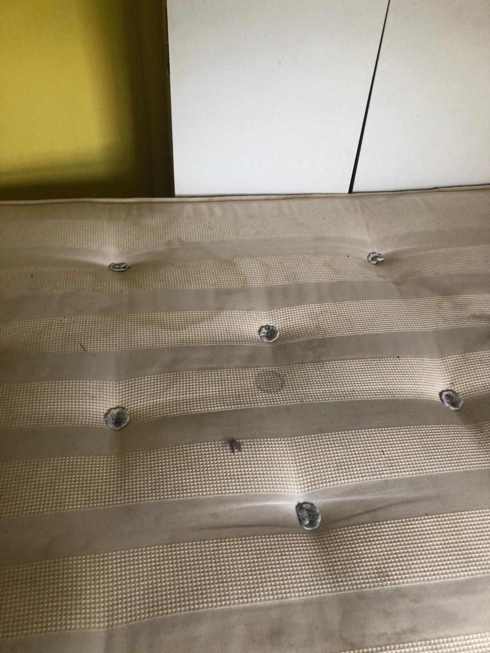
The flat was disgusting – cracked walls, filthy oven, broken locks, stained and squalid mattresses and grimy sinks and walls. I’ve posted photos through this article.
The agent who show Marsha the place said that he wouldn’t house his family members in it.
Homeless women, of course, are expected to be grateful for such places.
Mattress and bed in the flat Marsha was shown
Marsha called me in a terrible state. She has a choice: she can take her six-year-old child to live in this pigsty, or she can live on the side of the road. That’s not much of a choice in my book.
Marsha has become more and more distressed as this has gone on.
The bullying, the threats from and of social services and the upset and rotten housing that she must expose her child to are taking an obvious toll.
I’ve asked the mayor for a response to this. This is council aggression and bullying, pure and simple. The mayor better come back to me soon.
Broken walls and doors in the flat
I’ll tell you this – homeless women I’m speaking with say that they are inevitably treated like this – “do what you’re told and live in whatever hovel we send you to, and be grateful.”
It’s bad enough to know that your mental health is deteriorating because of this and because your kids are exposed to filthy living conditions and your distress.
It’s very bad to know that social services is watching you as that happens.
Readers of this site will know that I’ve recently been interviewing Marsha, a homeless 30-year-old Newham woman who lives with her six-year-old daughter in a single room in a Newham homelessness hostel.
The two have been stuck in this temporary accommodation for over a year.
Marsha and her daughter in their one-room temporary homelessness hostel accommodation
In the last article, Marsha talked about a concern that many homeless mothers raise. Mothers worry that council social services will try to remove their children because they are homeless. Doesn’t matter what the council can, or can’t, actually do. The threat hangs in the air and that is enough. I’ve written about this before.
In that recent article, Marsha said that Newham social services said they could take her daughter and place the child in care while Marsha “sorted herself out”:
“Social services is telling me – “oh, we can provide a home for your daughter, but not for you.”
“So I am scared.”
There’s been more since then.
On Tuesday morning, Marsha sent an email to her housing officer (Marsha copied me in). She asked for an update on her housing situation and whether she and her child could be moved to a better place than the awful hostel that they’re stuck in.
Marsha is in the dreadful limbo that so many women in poverty are.
She’s facing eviction from the homelessness hostel she’s in.
She’s studying at a local college to try and improve her chances of work and better-paid work.
She doesn’t want to have to move to a flat miles away in Tilbury (which is where the council wants her to go), because Marsha relies on her mother for mental health support and childcare while she studies. If Marsha loses that support, she’ll sink.
Marsha has no-one else to help with childcare while she studies. The jobcentre certainly won’t. Her adviser already threatened to sanction her Universal Credit for spending some of her time studying rather than all of her time looking for work.
So, Marsha sent that email to the council asking about her application for better housing. There’d been earlier emails, too, as well as the stories posted here.
Enter social services.
The next thing Marsha knew was that social services was all over her – and asking questions about her daughter’s health and wellbeing.
Marsha said she felt extremely threatened by this. A woman asks a council questions about her housing application – and suddenly, social services is on the phone demanding meetings and firing off all sorts of questions about the woman and her child’s welfare.
You have to wonder.
Marsha says that first, she was contacted by someone from the local multi-agency safeguarding hub – one of the hubs set up to track children who could be “vulnerable”:
“I literally had to explain myself and my housing situation all over again. He [the MASH officer] was really like getting a bit personal… asking me questions about my doctor, my daughter, my wellbeing, [the] school that she [my daughter] attends, her attendance… just a lot of personal stuff…”
So, there was that.
Then on Thursday last week, Marsha got a call from Newham children’s services, demanding that she attend an appointment with them that very afternoon:
“Another lady called from the social services…she said to me that she’s been given instructions from her manager to call me to arrange a meeting with herself.
I said, “what is it in regards to, because I just spoke to somebody else in the department within the social services and they are saying something different to me…”
“[She said] that she has to do an assessment with me and my daughter to do with my housing issues, and I have to come and see her and I should bring my daughter…
“I said to her – “I’m in college until 4.15pm. Then, I have to pick up my daughter.”
“She was like, “this is important and you have to come and see me. You kind of just have to find time, basically.”
“So I said to her, “okay, well, I’ll grab my daughter from school early and I’ll come and see you.”
“I was really uncomfortable…”
At the meeting, the social worker questioned Marsha and her daughter about Marsha and the child’s wellbeing:
“It is… the stuff they were asking me, Kate, had nothing to do with my housing situation. They were asking my daughter if she sleeps well, how does she play, who helps her with her homework… It’s not relevant.
“It’s almost like I’m being investigated… do you know what I mean… everyone knows that my issues is strictly around housing. I feel so uncomfortable.”
“I feel like the council is just trying to use tactics to force me into a situation…I feel like I’m being punished. I’m trying to get my voice heard and I’m speaking to people and I’m raising issues. I feel like it’s a tactical to make me go away – like they are thinking, “let’s get social services to call around.”
Marsha said the social worker told her that Marsha and her daughter would soon be evicted from their temporary accommodation. Marsha and her young daughter are facing street homelessness.
That was the first Marsha had heard about her impending eviction.
She said that the social worker was shocked to hear that the council’s housing team hadn’t told Marsha that eviction was nearing.
The bed Marsha shares with her daughter
——-
You see my point.
I talk to too many homeless mothers now who say they feel ever-threatened by social services.
They don’t know if councils can take their kids, but Can or Can’t is beside the point. The point is that the spectre of social services is raised at the drop of a hat. An implied threat is plenty good enough to shut homeless people up.
People worry about challenging a council offer of housing, or complaining about the dreadful state of temporary housing, or drawing attention to themselves by asking a council any questions about housing at all. I wonder how many homeless people are disenfranchised – bullied into silence – in this way.
Said Marsha:
“It’s the normal thing that I’ve been experiencing with council, with social services – bullying, threatening, saying that you have to do this now and you don’t have an option…she [the social worker] sat down yesterday and she said, “as you know there is no affordable housing, affordable properties [in Newham]… it’s just been like 18 months of ongoing like turmoil with them.”
Indeed.
I have more on this which I will publish this week.
The Newham council press office has blacklisted me and so won’t give a comment, but too bad for them. I’ll be emailing the mayor and the head of housing with this article and asking the council what the hell it is doing.