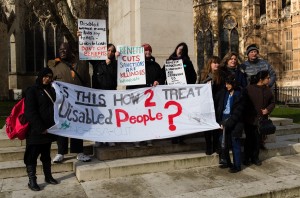
I think about this one quite a lot.
Over the past few years, I’ve had many conversations with left activists and plenty of others who hope and/or believe that austerity and adversity will bring out the best in people: that the majority of us will one day rise against social security cuts and the housing crisis, and pull together in common cause. The hope here is that austerity will end in revolt of some kind, perhaps very soon. This could happen, I guess. I doubt I’d see it coming, but then I rarely predict the big events. Turns in the narrative usually take me by surprise, especially when they’re positive. There is absolutely a chance that austerity, and the housing crisis in particular, will provoke widespread fight in addition to the fear. There is every chance that people will band together in a big way and help each other out. I already see plenty of evidence of mutual support.
The problem is that I see and hear plenty of evidence of a serious fracturing, too – a siding against, rather than with, people in the same boat. I tend think of talk along those lines as just the latest installments in a very long-running, anti-community, pro-self global narrative. Maybe I’m right. Maybe I’m wrong. I don’t know. I never find firm footing on this ground. I speak to people who are from this country and people who have come to this country from other places. Views are very different and very similar. I have quite a few conversations like the one I’ve transcribed below. I have conversations with people who are on the receiving end of government policy and who are largely sympathetic to government. I talk with people who receive benefits and say that government is right to crack down on benefit claimants. They clearly don’t believe that they’ll ever be in the firing line.
I’ve posted the transcript below as an example, so that you can get an idea of what I mean. The transcript below comes from a discussion with a person who claims unemployment benefits and has for a while. You’ll see that this person is strongly of the opinion that other benefit claimants are scroungers and that government is on the right track with benefit sanctions regimes. This is not a view that suggests unity. It is certainly not a view that suggests revolution.
“How can this be,” people say when they hear claimants taking this line. Members of the claimants’ union I was with on the day of the discussion below certainly wondered at the views being expressed. And who could blame them? I mean – how can this be? Benefit sanctions are extremely unpleasant. They’re particularly unpleasant to see. If you attend a jobcentre regularly, you see people being sanctioned. It ain’t pretty. I can tell you that for a fact. There is reason to feel a certain sympathy for people when they are sanctioned. There’s also reason to feel a certain fear. You can’t always predict who is going to be next on the sanctions list, even when you think you can. How can people imagine that they’re not in the firing line when they’re literally standing in the firing line?
I don’t know the answers to any of these questions. Perhaps you will.
Anyway. Here we are outside one of the northwest London jobcentres at the end of last year. We speak with a number of people. One woman we speak with says that she came here from Russia a long time ago (“it’s complicated”) and is nearly 40. She has lived in England for some years. She is unemployed at the moment and so receives jobseekers’ allowance. She says that she used to receive employment and support allowance, but lost that benefit earlier last year when she was found fit for work at a work capability assessment.
We talk for a long time. The woman says that that people are right to call some benefit recipients scroungers and that something in the local mindset leads people to believe that they are entitled to financial support from the state:
“I know it may sound a bit hard, because I am one of the people who come over here [to the jobcentre] to sign on [for unemployment benefit] but I’ve seen people who you would put into that [scroungers] category.”
“You see certain familiar faces. I just see that this person has no intent of looking for a job – has no intent of doing anything – and I understand why they are sanctioned. It may be not the right way, but otherwise, how will you make the person do something? How you can make somebody to actually search for a job if this person doesn’t want it?”
For herself: She says that she has told her jobcentre adviser that she can’t work for less than £22,000 a year, because she couldn’t afford to pay rent on a lower wage and would still rely on state support in the form of working tax credits. Continue reading →