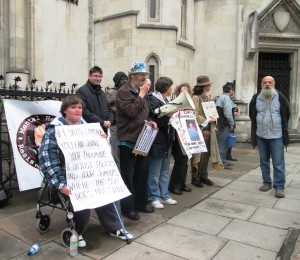
No god here: just heavy police at the Westminster Abbey #SaveILF protest

Sunday 29 June: more updates, including more footage of the protest, police standing on tents and us arguing with police about press access added at the end of the post:

———————————————————-

Saturday 28 June:

A lot more to video to come – here’s a starter.

Went with Disabled People Against Cuts to the blockade of Westminster Abbey today as severely disabled people continued ther fight to save the Independent Living Fund. The ILF is a fund that severely disabled people to pay for the extra carer hours they need to live independent lives. Iain Duncan Smith and Mike Penning, needless to say, plan to close the fund and leave these people in carehomes, or stuck at home with dangerously low levels of care. The court of appeal overturned a government ILF closure decision last year, but that’s not the sort of thing that puts Pennning off. The government announced this year that it would close the fund by 2015

Disabled people continue to fight for the ILF through the courts. Today, they attempted to take things to another level and set up a camp in the grounds of Westminster Abbey. The hope was that the church of England would see the point of this extremely serious and important protest, and help facilitate a protest camp and discussion. The lives of these disabled people will be threatened without that ILF money. It’s as simple as that.

Unfortunately, the church seemed to miss that point – perhaps in its rush to get the Met on the line. Christianity was in very short supply at the Abbey today. Police poured through the gates to stop the protest and to stamp on tents, to make sure they couldn’t be pitched. They were very heavy-handed all round and must easily have outnumbered protestors ten to one. Have a look at some of this.

Here’s a short clip of the police chasing one protestor across the grounds, then grabbing one young woman and cuffing her after shoving her against a tree. This was pretty brutal – you’ll see towards the end of the clip that they twist her arm right up behind her:


Here they are standing on a tent so that disabled people couldn’t pitch the tent in the Abbey grounds to make their protest:

Police standing on tents

This next photo shows disabled people grabbing onto each other when police rushed their line of wheelchairs. This was extraordinary – the police just raced at the line of wheelchairs:

Disabled people try and stay upright when rushed by police

another cop standing on a tent:

Police standing on tents at Westminster Abbey

In this video, you’ll see some of the severely disabled people who had their wheelchairs chained together to protest at the ILF’s closure – and then a short clip of the sort of police numbers sent in to deal with them. Unreal:

And in this video, disabled protestors getting into the grounds through a smaller gate and chaining their wheelchairs together:

More to come tomorrow. As I say – this is a vital protest. Saving the ILF is not just about saving a pot of money. It’s about saving the idea that severely disabled people deserve to live – like everybody else. Pity the church doesn’t get that. At all. Today’s display was utterly shameful. Those behind it better start praying that there isn’t a god.

————————————————————————————–

Updates 29 June 2014:

Here’s a video of a few of us arguing with police about press access for filming, and then more footage of police standing on tents and then again of their sheer numbers. I had the weirdest discussion with the clown you see at the start of this video. I wanted to walk through the police kettle to talk to disabled protestors on the other side of the police line and the railings, so I showed this copper my press pass. He said I couldn’t go through, because I was using my pass for “suspect” purposes and that if I was a journalist, I’d know what he meant. I am a journalist and I had absolutely no idea what he meant. I still have no idea. I can only assume that they didn’t want people who were inside the protest to have any sort of contact with people on the other side of the fence. He got out his little notebook and pen and told me to give him my name. I turned my pass around so he couldn’t see my name and told him to get lost. Jesus:

Another photo of disabled people being shoved into each other as police rush their line of wheelchairs:

Disabled people fall against each other as police rush their wheelchairs

More footage of protestors and of applause for their efforts when they were finally forced to leave the Abbey:

DPAC’s next action: Save the Independent Living Fund party this week on July 4. See you there.

A few words from young people who must sign on because work is insecure and low paid

Am surfacing briefly today to make the point to Ed Miliband and other Labour greats that quite a few of the young people I meet who claim jobseekers’ allowance ARE in work. The problem these young people have is that they’re in and out of work, because the work they get is very insecure and low-paid. They pay in while they’re working. They just don’t get enough ongoing work to pay in on a regular, ongoing basis. Because that’s our era, Ed. People can train all they like and as hard as they like, but that won’t count for much if the only work on offer is badly paid, or not paid at all. That’s the point to focus on, Ed. That’s the ONLY point to focus on. If Ed is really serious about sorting out youth unemployment and low pay, he might like to support a few boycott workfare protests.

The young people who I’ve spoken to outside jobcentres this year generally report that they land a few months at a job here and a few weeks at a job there, and then the work dries up and they have to sign on until another crap job comes along. Said Ravi 22: “Contract work – it’s not ideal. Once the contract is over and you haven’t got any backup, then yeah, you lose everything that you’ve worked for. You save up and when the contract ends, if you haven’t got another job, everything that you’ve saved up goes onto your bills and stuff like that and you’ve got to start again.”

These people also seem keen on meaningful, paid work and often say things like “I don’t really want to go back to dealing.” Said Gio, 19, below: “I don’t want to be on the streets drug dealing and stuff to earn the money, because I’ve been through that stage.”

Etc.

Anyway.

Here is:

Ravi, aged 22. Signs on at Kilburn jobcentre. We met in March. He’d last worked in January. He worked in sectors like retail and banking. He wanted something ongoing, but was struggling to find permanent work. He was trying to sort out a sanction the day that we spoke – he was waiting to go into the jobcentre for a meeting where he hoped things would be worked out.

Ravi said:

“I have to come here every week. One week is to just sign on and one week is to speak to an advisor – but it’s not really to speak to an advisor. It’s just to sit in front of them and they are just going to say “there’s nothing to really match your criteria here – retail – so see you next week.” It is a system set up for you to fail. If you don’t turn up for an appointment – because [for example] you have got to come in every morning and they say, well, you didn’t turn up, so you’re suspended.

“They suspended my benefit. Apparently, the reason was that my jobsearch wasn’t correct. Apparently, you can’t hand out CVs any more. They go – “95% of your jobs are online” and they [said to me] “a few of your jobsearches say that you handed out CVs and these places don’t accept CVs. Therefore, you’ve been suspended.”

“I was sanctioned, yeah. I think I still am. I’ve got to come back to talk to someone at 3.15pm and they are going to explain it. It’s a bit difficult. My adviser [that I’m talking to today] – out of all of them, he’s okay. He’s more understanding, unlike the rest of them. I think they’re fed up with their own jobs to be honest. He’s quite good. He’s really understanding. He would actually advise me, unlike the rest of them.

“I asked them – what was the reason for the sanction? I asked them like three times and they kept diverting the conversation. So I honestly didn’t know. [It came about this way]. Basically, I came in on time and it was 9.15am or something, and then one of the advisers looked through the [jobsearch] sheet and he said “come back at 11.15am to the third floor.” So I came back at 11.15am, not knowing what I was coming back for. She said “the reason why you’ve been told to come back is that your jobsearch is incorrect.” I asked her “Why? What’s wrong with it?” and she was like “some dates are missing,” and I was like “it’s all there. Maybe I’ve just made a few mistakes on it.” She actually gave me the chance to do it again in front of her, so I literally done it again in front of her. I spent like 15 or 20 minutes doing it again and I handed to to her and she said “it’s still incorrect” and I said – “I honestly do not know what you want me to do. I’ve done it again.” I don’t like arguing and things like that – some people there really argue and shout – but I’m not like that. I was like,

“Okay, fair enough.” It’s their decision, so I just left them and I’ve been told to come back today to sort it out.

“This is my first time of being sanctioned, so it was pretty confusing. This is my second time at the jobcentre since I’ve been 16. I’ve always been working, so I’m not used to the system. I’m not sure what it’s all about to be honest. So it’s changed. It’s more confusing. They were telling me that there’s like a million people from age 18 to 24 on benefits, so obviously they’re probably frustrated behind the scenes and all, but I think that the way they take it out on us is not right. I’ve seen the way that they treat people upstairs myself and I don’t say anything, but I think it’s not right.

Continue reading

Disabled and without a carer for the night? Go to #Asda! #SaveILF #jobcentre #jsa

This one goes out to every prat MP and commentator who says we must keep hacking away at social security until there is nothing left to cut. I like to think this story will remind those people about some of the crap that disabled people have to put up with as they take the brunt of cuts:

Video: I didn’t have a carer and I was so thirsty I went to Asda at 5am in my wheelchair to get a drink with a straw and help

A week or two ago, I again accompanied Angela Smith of Wembley as she travelled to her jobcentre and work programme appointments in her wheelchair. (I first went with Angela to Wembley jobcentre about a month ago). Angela has a master’s degree and worked for about 20 years in policy and disability support until she was made redundant in a couple of years ago. Angela has cerebral palsy. She must sign on once a fortnight at the jobcentre and once a fortnight with her work programme provider, which is the Reed Partnership in Harrow. She uses public transport – the bus – to get to both places.

So. When I arrived at Angela’s house before we set off to Wembley jobcentre, Angela told me that she was very tired. There was a reason for this. She’d woken up very early – at 4am – because she’d been very thirsty. There was a reason for this, too. Angela’s afternoon carer had been off sick the day before, which meant that Angela had not had anything to drink since 2pm the previous afternoon. She finds getting a drink for herself very challenging: the involuntary movements of her head and arms makes co-ordination and turning on the watertaps difficult. Her afternoon carer usually leaves her something to drink, but didn’t on this occasion, because she didn’t come to work. So Angela woke up at about 4am, thirsty. By about 5am, Angela was so thirsty that she decided to get out of bed, climb into her motorised wheelchair and travel down the road to the 24-hour Asda to buy a drink. She said that staff at Asda helped her – “they are very nice over there.” Angela showed me the receipt from that excursion – you can see the date and 5.14am time stamped on it:

Receipt from Asda 5.14am

Receipt from Asda 5.14am

You see where I’m going here. This is the sort of reality that disabled people get to enjoy while career twats like George Osborne, Chris Leslie and Andrew Rawnsley blather on about social security cuts being an unavoidable fact of modern life. They leave disabled people in a dangerous position indeed. I asked Brent council for a comment on this Asda situation and on Angela’s care and the council’s care and cover systems generally. That was about ten days ago and I haven’t heard a single thing back. I understand that the council has since had a meeting with Angela, but a response this way would be welcome, too. Angela is embroiled in an ongoing battle with the council about care services. The whole thing is a complete mess.

I’ve seen plenty of correspondence about it. Angela doesn’t like the agencies the council uses, or some of the carers that agencies send. She doesn’t like the restrictions placed on her direct payments spending (this is a point that several disabled people have raised with me recently). She has made formal complaints. The council argues in its correspondence that it makes adequate provision to cover care and that Angela could hire her own carers with direct payments. Angela’s point is that she doesn’t want cover from agencies that she doesn’t trust and that it’s hard to hire good people in an ongoing way when you only have a small amount of hours and money to offer.

The upshot of all this is that Angela’s younger brother is now her carer, more or less. He has been coming around in the morning to get her out of bed, washed, dressed and fed. He’s certainly been there most mornings when I’ve visited. It may be that sometimes, family is easier to negotiate, or work with or rely on. I’ve fed Angela breakfast on days when her brother has had to leave early. I fed Angela lunch on the day of the 4am Asda journey, because if I hadn’t, she would not have had lunch that day. Continue reading

Save the #IndependentLivingFund: get your MP to the debate on Wednesday

Callout from Disabled People Against Cuts:

“We are slowly coaxed to believe we are too expensive to keep alive and it’s kinder if we are convinced to die.” (From an article Penny Pepper and I did last year on the government’s attacks on disabled people).

The future of the Independent Living Fund – the fund that severely disabled people use to pay for extra carer hours so that they can live independently in their own homes – will be debated in the House of Commons for the first time this Wednesday 18 June from 11 to 11.30am.

Save ILF poster

As many MPs as possible need to know this is happening and will be there to stand up for the ILF and the future of independent living support for disabled people.

The fight for the ILF is far from over.

In March, the Minister for Disabled People Mike Penning announced a new decision to permanently close the ILF in June 2015. He did this despite a ruling by the Court of Appeal in November 2013 which quashed this government’s previous decision to close the fund.

Last week ILF recipients launched a fresh legal challenge which you can read about here.

Meanwhile, #SaveILF supporters have been busy contacting their local councillors and MPs collecting sign ups to the campaign statement and spreading the word with the brilliant ILF postcard campaign: www.facebook.com/ILFpostcard

One supportive MP Nic Dakin MP for Scunthorpe has managed to get a debate on the future of the Independent Living Fund for this Wednesday: 18 June 11 – 11.30am.

It is only half an hour, but it is the first time that the ILF and the fundamental question of the removal of disabled people’s right to independent living which its closure represents, has had a debate in parliament.

This is an opportunity to make sure politicians know what the ILF is and why it is so important.

We need to take urgent action to write to our MPs, urging them to attend the debate, telling them why it matters and most importantly sharing your stories and experiences that show why we need not only to keep the ILF open but to reopen it to new applicants.

You can find your MPs email address and post address here.

Here is a briefing about the ILF you can download and send them as an attachment. ILF briefing 13 June 2014 (this link opens the briefing).

If they can do it in Scotland, why not here?

See Disabled People Against Cuts for more.

ILF recipient Penny Pepper on the threat to the fund:

“There is this bizarre idea coming our way that you can eat sandwiches, lie in bed and use incontinence pads. If that happens, then that is, in effect, the end of my career. The basic idea of having a separate pot of money like the ILF did give you choice and control. Now, we’re being forced backwards into having to go on about how pathetic we are as individuals – you know, with your poor legs and your this and your that. The idea of choice is being narrowed and narrowed and narrowed. If the council ever tries to put me in a care home [because it cannot afford to fund independent living costs ] I will take it to court.”

“I need support to do most things of a physical and practical nature – from getting out of bed, using the bathroom, getting dressed and food preparation to moving from A to B, getting into my wheelchair and getting out of my wheelchair. I would not be able to work without that funding. This is what is terrifying to me.”

#HelptoWork: nowhere to be seen. More stories from the #jobcentre

And so to Hammersmith jobcentre this week as part of the ongoing leafleting sessions I’m taking part in with the Kilburn unemployed workers’ group. We went to Hammersmith to talk with people there who are on JSA and who are dealing with sanctions, to see how things were going at jobcentres outside of Kilburn.

We were also there to see if we could find anyone who was long-term unemployed and participating in the government’s rubbish Help To Work scheme – George Osborne’s “you must sign on daily at the jobcentre and/or take workfare jobs,” concept that was announced to such fanfare a few weeks ago. We’re not seeing much evidence that Help to Work is underway if I’m honest. That’s no bad thing, given that the whole idea is bollocks – it is based on the widely-discredited notion that workfare leads to work. We certainly found people who were long-term unemployed at Hammersmith as you will read below, but we didn’t find anyone who was on the Help to Work scheme. We haven’t been able to find anyone who is on Help to Work up Kilburn way either. The fact that so many organisations refuse to participate in workfare could certainly be one of the reasons for this. Long may these shambolic workfare schemes fail.

Anyway – to long-term unemployment. This first interview transcript goes out to the Labour party – especially members of that party who think the best way to beat Ukip is to quasi-endorse anti-immigration rhetoric. You’ll see what I mean when you read the article below. I hope members of the Labour party note that the man quoted in this transcript made a couple of anti-immigrant remarks, and comments about drug and alcohol users. Members of the unemployed workers’ group I was with simply responded by saying “don’t let the government and MPs turn us against each other,” and “if someone is on benefits, I don’t judge them in any way,” and the guy we were talking with seemed to take those points on board. I have no idea what he said or did after that, but the point is that he was prepared to have the conversation at the time.

So. My point to Labour worthies, like they care, is that this is a conversation worth having with people. There are alternatives to jumping on the anti-immigration bandwagon when people turn on immigrants. One very good alternative – this one certainly appeals to me – is to remind people that they should loathe a ruling elite that lines its own pockets at everyone else’s expense. Labour won’t do that, of course, because its own elite is part of the ruling elite that is implicated in the kind of larceny that makes the rest of us hate the ruling elite – but you see my point. It’s possible to have different conversations with people. There are alternatives to rolling over for fascism.

Anyway.

Here is:

Daniel, Hammersmith. Has been signing on for six years. Said he was still trying to get JSA money refunded after winning an appeal against a sanction. He was confused about the amount of money he’d been repaid after his sanction and about the amounts of money he now received.

He said:

“Some of them [in the jobcentre] are the nicest people in the world, but some of them are the biggest arseholes in the world. There are women in there who would help you literally until you are blue in the face, but there are some people who will turn their nose up at you as soon as you walk in. Just because they get wages, they think they can look down at me, innit. It’s a joke.

“They got me one of them already – a sanction. I had to appeal against it. You might be able to answer me this question. When I got sanctioned, they sanctioned me for three months, I appealed against it this year and I won my appeal, but they only paid me back with hardship pay. They didn’t give me my actual benefit money. If I won my appeal, I should get my jobcentre money, not hardship money? It was basically half the money that jobcentre would pay you. When they told me about the sanction, because I actually done it with a manager in there, they told me that I am not entitled to hardship pay and I got to go for it [see out the sanction] with no money at all. So, I appealed against it, because it wasn’t my fault. They had made a cockup with the whole system. It worked out that I only got £395 back after three months. So, they owe me money innit, but no matter what I do, I basically can’t get that money back off them. No one in there is willing to help me all. They’re telling me – you got paid didn’t you? Continue reading

Hate Europe…? Most people I talk to say they hate MPs here

To Clacton-on-Sea, where I spent a day recently setting things up for a longer project – more on that in the coming weeks.

For now – a few transcripts and a bit of a rant.

When I was in Clacton a couple of weeks ago, I went to the CAB and spent some time with officers there. I also stood outside the jobcentre for a while, to see I could find anyone who was prepared to speak about JSA, sanctions and work experiences in Clacton.

We talked about those things and then generally about the people they hold responsible for tough times. I find this part of things interesting, especially in our burgeoning We Hate Europe era. I spend most of my time talking with people who have been badly hit by public service cuts, job losses, wage cuts, insecure work, etc, and they come from a very wide range of groups. The thing is – people don’t talk to me about European politics very much, or certainly haven’t in the past few years. Not spontaneously. Not as the first thing out of their mouths. I don’t think I’ve ever heard anyone mention their MEP to me. Maybe people need prompting. Maybe that will change as politicians and the press keep belting out the anti-EU message. I do hear anti-immigration talk and that usually has to do with the housing shortage – who gets housing and why, who should be prioritised for it and who is being prioritised for it. The point I want to make, though, is that I still notice people talking about the failures of the local political class, which you’ll see in the transcripts and quotes below. They talk about their immediate tormentors.

I’m guessing that it suits local politicians better to paint this part of the picture out. It’s still there, though. That needs to be said. People still talk a great deal about greedy MPs and bankers and bonuses, Iain Duncan Smith, jobcentre staff, organisations that run the work programme and companies that employ people on wages too low to live on. People make these points unprompted.

There is absolutely no doubt that this is why the political class is so desperate to turn our attention to Europe and immigrants, and why Labour is prepared – this still floors me, although it shouldn’t – to fanny around with fascism and to talk about controls instead of leading any global charge for equality. It is perfectly clear such a line is thought more expedient than taking responsibility for the fact that we’ve reached a point where a few people have everything and most other people have stuff all. We can add to this perverse picture the fact that the people who are trying to tell us how things should be are in no position to. I mean – we’re hardly going to have a balanced dialogue about distribution while people like Yvette Cooper are involved in it (I’ve just read her latest watery “article” on immigration, which is why I’m thinking about her. I usually try not to). Let’s face it. People like Cooper are not well-placed to join the rest of us in pointing the finger at MPs who milk expenses, to take an example. Which is a pity, because a lot of people are still very upset about things like MPs’ expenses. Very upset indeed, as you’ll see from the quotes below. I am not much of a strategist, but even I can see why someone like Cooper would find it much easier, and much less compromising, to rattle on about controlling immigration instead of addressing the monumental equalities crisis in which she and other politicians are implicated.

This is the sort of thing that people say to me a lot – I’ve pulled out some quotes from my articles from the past few years:

People like us are screwed to the ground. They’ve legalised bullying. They wear suits….They’re getting away with it. It’s the fucking bankers that ought to be done for it….They’re pointing the fingers in the wrong direction.”

The government don’t give a shit about the people. Just their friends. They’re given massive tax breaks and they’ll never spend it if they live for another 100 lifetimes. You got people at the other end who can’t even afford to put their heating on and buy some food. They’ve got to be the biggest bastards ever on the planet. They’re not kings. They don’t look after their people.”

The expenses, you know, that some people are claiming for pornographic DVDs…. Just got no respect. The kids have got no respect now. [Leaders need to] lead by example. Right now, they’re making it up.”

You see my point. A lot of not-rich people understand that the political class wants to flush them like turds. They’re not too happy about it. Little wonder that politicians are falling over themselves to direct that anger elsewhere.

Anyway.

I’m an EU immigrant myself, so may be forced to take a break from all this soon to pack for Dublin (am here on an Irish passport). Before I go – here’s a bit more on the sort of crap that people have to put up with from the political class, as opposed to immigrants:

It’s a Tuesday afternoon and there’s a group of older guys standing outside the Clacton jobcentre on Station Road. They’re lining up at a side door, waiting to be let into some work training thing or other. Nobody seems to know exactly what they’ll be doing at the training, or why. All they know is they have to be there and that they have to line up at this locked door like they’re six and waiting to be let into school.

The first guy I talk with is an older bloke with white hair. We don’t talk for long. He is furious about Universal Jobmatch. “The worse thing I ever done is looking for a job on that computer,” he says. “It’s a waste of time. I’ve looked for about 1500 jobs on it.”

The second guy is Mark*, 45. He’s been signing on for five months. Before that, he worked in caravan parks and as a printer. He’s trying to retrain because “for the last 30 years I’ve earned my living through hard manual labour. I can’t do it now, because I’m 45 and I’m tired. That’s why I’m taking myself to school.”

He says:

“There’s about 468,000 jobs across the UK, yet there’s two and a half million people unemployed, so if them jobs was filled tomorrow, you’re going to have two million people going to the jobcentre, fighting over them. But they don’t tell you that. You have to search and find out yourself. You go onto Universal Jobmatch and they monitor it. They can see what you’re doing, because you give them a government ID number. It’s effectively a virtual chip. They can see all your job search that you’ve done to look for work. I think that what they’re forgetting about is the miseries that they are causing.

Continue reading

Focus E15 mothers public meeting and marches June-July 2014

Tuesday 10 June 2014 – hear the Focus E15 mothers talk about their fight for social housing and see films from their campaign.

They’ll also be at The Spark in June and marching on Saturday 5 July for decent housing for all.

Decent housing is something you get if you’re rich, but must fight for if you’re not. As readers of this site will know, the young mothers of Newham’s Focus E15 temporary accommodation hostel have been battling Newham Council and the East Thames Housing Association for housing in Newham borough (links to stories on this battle below). Some of the woman have been placed in flats in the private sector – but only for a year and that year is almost half-gone for some.

The FE15 mums will speak about the FocusE15 campaign and show short films from this year’s housing office occupations and confrontations with Newham mayor Robin Wales. They’ll talk about the pressure they managed to apply to Wales and how they managed to stop the council from sending them out of London to live.

Here are a few of the films I took this year to be going on with:

Robin Wales racing out of a council meeting and away from the young mums (Wales has certainly got a turn of speed when he needs it. Look at him go):

The women occupying the council’s housing offices to demand decent social housing for all:

List of articles on Focus E15:

Open Democracy article: Why is middle class feminism so disinterested in women hit by austerity? (interviews with the Focus E15 mothers on their campaign to date)

Newham council runs out of meeting to avoid Focus E15 mothers’ protest

Focus E15 mothers take their petition for social housing to Boris at City Hall

Focus E15 mothers’ battle for social housing: an update

Young mothers occupy Newham council housing offices to demand social housing

Rubbish, mice and mould – good enough for young mums without money

Put this on a banknote: young mothers without money abandoned by the political class

The DWP must explain how it will adjust Atos WCAs for mental health claimants

From Disabled People Against Cuts:

MHRN outside Royal Courts of Justice

MHRN and campaigners outside Royal Courts of Justice

The Mental Health Resistance Network, supported by Disabled People Against Cuts, wil hold a vigil at the front entrance of the Royal Courts of Justice on Tuesday 8 July 2014 at 12 noon to 2pm to highlight important issues around the Work Capability Assessment Judicial Review for Mental Health Claimants.

Two years ago, two people who claim benefits on mental health grounds initiated a judicial review of the Atos Work Capability Assessment. The two people were supported by the Mental Health Resistance Network. In May 2013, the judges presiding over the case ruled that the WCA places mental health claimants at a “substantial disadvantage” and that the DWP should make “reasonable adjustments” to alleviate this.

Often mental health claimants struggle to provide further medical evidence to support their claim for Employment Support Allowance (ESA) and may not be able to accurately self report how their mental health conditions affect them – either when completing forms or at face to face assessments. Many claimants are wrongly found fit for work and subjected to the stress of appealing the decision. Continue reading

Independent Living Fund protestors get in the DWP’s face

Here are videos from the DWP on Monday, when Disabled People Against Cuts blocked all building doors to protest at Mike Penning’s disastrous plan to close the Independent Living Fund.

The Independent Living Fund is used by people with severe disabilities to pay for the extra carer hours they need to live independent lives and stay out of carehomes. Because they have personal assistants available most of the time, ILF recipients have the support they need to work, study, socialise and generally get on with life like everyone else. Without that money, people will be forced to rely on the council social care system – a system that has been, as we all know, utterly decimated by government cuts and can’t meet demand as it is. There is absolutely no way that devastated council social care departments will be able to pay for the round-the-clock, high-cost care packages that many ILF recipients need – certainly not in an ongoing way.

ILF funding is actually used by many people to top up existing council care packages – that is certainly the case for most of the ILF recipients I’ve interviewed. That’s because these care packages are expensive. Penning can whack on all he likes about keeping a safety net in place for disabled people, but he knows and I know and everyone knows what the future holds for ILF recipients if the fund is closed. People with severe impairments will be shoved into carehomes (that’s assuming spaces are available, which I would not assume), or stuck at home in incontinence pads and relying on fractured council care. If they’re lucky. I’m already speaking to disabled people who must spend a great deal of their time fighting their local councils for care (this woman is one of those people – more on her story soon). I’ve already spoken with people who must spend their weekends in bed because their council-funded care packages don’t stretch to cover Saturdays and Sundays. Continue reading

The realities of a daily trip to the jobcentre in a wheelchair…

Second story with Angela is here: Disabled and without a carer overnight? Go to Asda!

—————-

Right. A bit more on the realities of George Osborne’s ironically-named “Help to Work” scheme and this government’s useless Back To Work concepts generally:

The woman in these videos is Angela Smith, who lives in Wembley. Angela worked for about 20 years and was laid off from her most recent job (working with young disabled people) in 2011. She signed on then. She has a university degree.

Angela also has cerebral palsy. She uses public transport to get around and to attend her fortnightly signing-on days at the Wembley jobcentre and to see her work programme provider at Reed Partnership in Harrow. At the moment, those are her two obligations. She describes both of these days as a complete waste of time. Having attended one of these days with her last week, I see her point. We travelled all the way from her house to the Wembley jobcentre on the bus (an almighty drama, as you’ll see in the video below) for a 15-minute wait and five-minute handing over of jobsearch papers. That was it. Angela took a folder of paper for a bus ride to the jobcentre, dropped it off, and left. There was no discussion of jobsearch while we were there, no offers to help find work, or to fill in application forms – nothing. I said it before and I’ll say it again – this jobcentre process is beyond Kafkaesque. People are made to turn up to jobcentres to show evidence of searches for jobs that don’t exist, or for which they are unsuited, or unlikely to hear anything of again, and then they leave the jobcentre – often to do the jobhunting that they had to put off for a couple of hours to attend their pointless signing-on session at the jobcentre. It really is a pointless exercise to beat all.

With Help To Work, people who have been long-term unemployed must take part in that pointless activity every day. They either must travel in to sign on at their jobcentre, or participate in workfare schemes. Angela has been out of work for two and a half years, so has some concerns about the scheme and how she’ll get on if it applies to her if she’s still unemployed after three years. With that in mind, she wanted to show what her trip to the jobcentre already looks like. She finds it a challenge and you’ll see why in the videos below. I accompanied her to the jobcentre last week on London’s so-called accessible public transport.

It went like this:

Bus trip to Wembley jobcentre

It was raining, which meant the bus was crowded. There were two buggies in the wheelchair space and nobody offered to fold theirs, so Angela had to sit in the doorway in her wheelchair – hardly ideal, as you’ll see. Then, things escalated – par for the course in a crowded bus with space taken up by buggies. One of the people with a buggy had to get off the bus before we got to our stop. Angela pushed the button to call for the ramp so that she could get off the bus, make room for one of the people with the buggies to get off and then get back on. Unfortunately, the driver didn’t realise all this was going on and he shut the doors on Angela’s foot as she tried to get back on. When she did get back on, he came over to remonstrate.

He asked Angela what she’d been doing – and then he did something that people often do when dealing with disabled people. He asked Angela who she was with (the assumption always is that disabled people can’t be out and about by themselves) and when he worked out that Angela and I were together in some capacity, he started to address his questions to me. He asked me if Angela was all right. I told him that it was probably better to put that question to Angela, seeing as it was her foot that got stuck in the door. He said to me – “but is she all right?” I told him again that Angela was probably best placed to answer that question. He asked me again. I told him to speak to Angela. This went on for some time. He was obviously worried that there’d be trouble because of the foot incident and he needed confirmation that there wouldn’t be trouble. He seemed to want that confirmation from someone who wasn’t in a wheelchair. Bit of equalities training needed there, I think. Boris Johnson, our very own self-styled Mr Accessibility, might want to get onto that.

After all of that, we finally got to the right stop and headed for the jobcentre. The meeting we had there was pointless, as I say. We waited for about 15 minutes for someone to see Angela. The man who saw her was pleasant enough, but he didn’t say too much about helping Angela with her search for work. He just took up her papers, had a quick look and then told me that Angela would need to fill in the space for her email address. I’m not sure why he told me. I told him to talk to Angela about her papers. Angela explained that she isn’t able to physically write (she uses her computer) and so couldn’t fill in the box for the email address by hand. She said she could read her email address out for him. He said it would probably be best to do that with another adviser at another time. And that was that. Then, Angela went home start work on a job application she’s writing. Interesting that she had to get her trip to the jobcentre out of the way before she could get down to applying for a job.

As Angela says in the video: “Imagine doing that every day.”

Indeed.