This is the first in a series of posts which feature conversations with people who are street homeless.
This series was inspired, if that’s the word, by Operation Encompass – the Metropolitan police-local council-UK Border Agency “partnership” to “combat begging and rough sleeping across six London boroughs.” Brilliant. They weren’t doing this by building more homes, or anything useful like that. They were doing it by – among other charming initiatives – hitting rough sleepers with Asbo warnings and telling people that they had to accept “help”. A few things appeared in local papers about this earlier this year – charities expressed concern about the operation “aggressively targeting and potentially criminalising some of the most vulnerable people in society” – and then things went quiet. I’ve asked the Met for an update – if it still going as Operation Encompass (the Met’s original press release said “activity” would be “ongoing“) and/or who is doing what and where. You can use Asbos to ban people from certain areas, see. This means that Asbos could be used by politicians to clear streets of people who might not, say, impress the bigshot property investors that council leaders have been hanging out with in Cannes, etc. These things need to be watched.
They’re not pretty. Boroughs like Newham seemed to be running their own Encompasses (I’d ask Newham where things are at there as well, except that the council refuses to talk to me). Only a month ago, we had mayor Robin Wales in the Newham Recorder boasting about cracking down on rough sleepers in the Stratford centre. (Wales, incidentally, seems to have been at last week’s property fair in Cannes. I do keep seeing the same faces at the moment). In his column, Wales said that rough sleepers who refused the council’s offers of “assistance” could not expect to continue to sleep on Newham streets. “I realise that this is a tough message,” Wales said, “and that some people will be instinctively unhappy with it.”
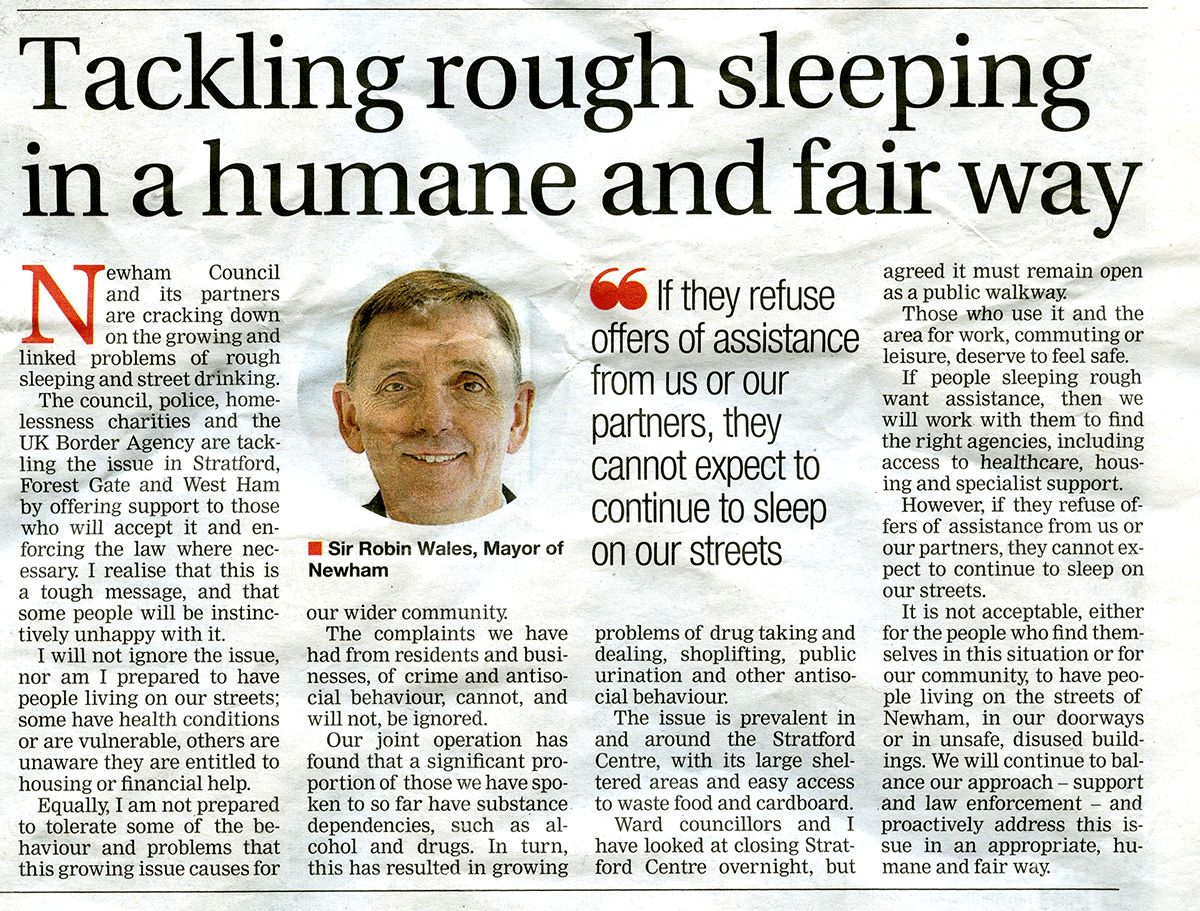
I was unhappy with it. I was very unhappy with it. The part that made me especially unhappy was the nasty, vengeful note in those statements – the “people with problems are not entitled, so they’ll damn well take what they’re given, or else,” line that informs so much of today’s political discourse. There was nothing in Wales’ article about the many reasons why people might be sleeping rough. There was nothing about the fallout from this government’s dreadful social security “reforms.” There was just a magnificent oversimplification of the reasons for homelessess and justification, if you can call it that, for lording it over rough sleepers. There was a real nastiness there.

You find that nastiness everywhere in political discourse on housing, of course. You find it, for instance, in this discussion with Hastings council leader Jeremy Birch, who told me that upgraded estates in his borough would not be open to people on benefits. People like the Focus E15 mothers hear it all the time, too. So do I when I’m out with them. For example: More than one Labour worthy at this women’s event last week asked me if I really thought that the Focus E15 mothers deserved the local social housing that they’ve been campaigning so hard for. Did I really think that would be the best thing for them? The concern seemed to be that housing the Focus E15 mothers securely would awaken the dreaded, so-called sense of entitlement in them. I found this extraordinary and extraordinarily patronising. It seems that young women who think they should have somewhere to live are now considered grossly pushy and grabby. Of course – no mention was made at this luvvies event of the startling sense of entitlement that the well-appointed have. Nobody asked me what I thought about Kate Middleton’s sense of entitlement when it comes to housing, or Nadhim Zahawi’s sense of entitlement when it comes to getting the taxpayer to pay to house his horses in heated stables, or MPs’ sense of entitlement when it comes to flipping and selling homes, etc. The political class never mentions those people. Their big concern in life is that everyday punters are on the make. Continue reading