A rise in the number of rough sleepers? Bet those shocking numbers don’t show the half of it. Look at these two guys.

The Guardian has a story this morning about the shocking rise in the number of people who are sleeping rough.

The government should be smashed for that rise alone. Slashing social security to the point where more and more people sleep outside in this climate is a crime against humanity in anyone’s book. Winter is freezing cold, especially here in the north west. Forcing people to sleep outside during it is murderous. Simple as that.

Point I wanted to make is that there are people who may not appear in these counts, because they have options some nights – if you can call them options – which means they have a bed or couch for that night. Their existences ain’t exactly great. They’re still street homeless. They still have appalling experiences. They are still out a lot in the freezing cold and can be out any minute in the freezing cold. Someone needs to take Theresa May to meet and count these people, and to rub her nose in a few realities.

I’m thinking of two guys in particular – James, 50 and Roy, 64 – who I’ve interviewed in Oldham. They’re both street homeless – but they’re not always on the street.

James, who I often meet with, regularly stays with his friend Vance, who was street homeless for years, but was finally found a council flat about two years ago. This arrangement works well sometimes and badly at others. Late last year, James had the shit kicked out of him – apparently by another guy who was staying at the flat. A roof often comes with considerable compromise.

It certainly did for Roy, 64, who I spoke with at length at Oldham foodbank recently. Roy was street homeless (at aged 64, if you don’t mind – a crime in itself), but sometimes stayed with a “friend” in Chadderton who charged Roy money out of his benefits to stay on the couch. He attended the foodbank that day in the hope that someone could help him find somewhere better to stay.

You see the point. When you spend a lot of time talking with people who are in and out of street homelessness, you talk with many people who are street homeless, but who are sometimes able make other arrangements that remove them from view. Doesn’t mean they’re having a brilliant time of it. I don’t know how many of these people do or don’t appear in rough sleeper counts – the Guardian article makes clear that criteria for counting rough sleepers is strict and only takes in people who are outside. Whatever. My point is that government needs to be strung up for creating this hidden rough sleeper nightmare as well. Like I say – people don’t know the half of it.


Schizophrenia, aged 55, #PIP payments stopped, forced to the foodbank – why are guys like Andrew called society’s leeches but rich Carillion bosses are not?

Back to Oldham foodbank last week, where I talked at length with Andrew Smith, 55 [there’s a transcript from the interview at the end of this post].

Keep Andrew in mind when you read about the extraordinary salaries and bonuses trousered by people who are responsible for the Carillion disaster. Ask yourself how we arrived time and place where people such as Andrew must grovel for food at a foodbank while Carillion chancers are paid unbelievable sums of money for risking and destroying vital public services and jobs.

How dare anyone claim that people such as Andrew are the leeches?

Makes me sick.

Andrew was at the foodbank, because the DWP had stopped his Personal Independence Payment. This meant that Andrew was down several hundred quid a month*. He said the local CAB was appealing the DWP’s decision on his behalf.

Said Andrew:

“I said the wrong thing [at Andrew’s face-to-face PIP assessment] and they [the DWP] stopped it [Andrew’s PIP]… I’m just hoping they give it me back, because if I don’t [get that money], I’m going to be in an absolute mess.”

He was right about that. Andrew’s chances of getting the money elsewhere at his age and with his health problems were zero.

Andrew had a schizophrenia diagnosis. He also had varicose veins which ran the length of both legs (I won’t forget seeing those). He said that it hurt to walk – a statement that was extremely easy to understand when you saw the state of his legs. The DWP didn’t give a damn about the state of Andrew’s legs, though – or any other aspect of Andrew’s life. The department stopped Andrew’s PIP about three months ago. Some genius DWP decision-maker had decided that a man of Andrew’s age and with Andrew’s health problems could manage without money or support – or, I suppose, that he could find that money and support elsewhere.

I despair at these decisions – or at the people who make them, anyway. The benefits bureaucracy is disgusting. It stops people’s benefit money and consigns them to poverty at the stroke of a pen. People are not even given lead time or a grace period to deal with such decisions. They just get a letter saying the money’s stopped, or not coming, or whatever. Benefit decision-makers who cut guys like Andrew loose know full well that the Andrews of this world have neither the health nor the opportunities to make up lost benefit or support money. They can see people’s paperwork and the bank statements. They know the dire financial circumstances that people will be left in when money is cut. The bureaucracy makes the decision all the same.

The government and the DWP know that Andrew will not step out of a PIP assessment and into a job. Job opportunities are especially scarce when people are older. I’ll punch the next worthy who says otherwise. I’ve lost count of the number of men who I’ve talked to at foodbanks and jobcentres who are in their 50s and 60s, who did manual work when they were younger and who are now on the scrapheap. Fitters and joiners, painters and decorators, general kitchen assistants: their health goes and they’re dumped.

Andrew said that in his working days, he had jobs on building sites:

“I did wet stone walling with sand and cement,” and, “I worked on canals and paths at Greenfield… building sites.” Needless to say, Andrew can’t do that work now. He’s too old for it and his health has gone, as health does in these circles.

“They [the CAB] have put an appeal [against the DWP’s PIP decision] into tribunal and the tribunal should get it me back… I’m very poorly. I’ve got schizophrenia and I’ve got very serious varicose veins. Horrible, love… I said the wrong thing [at my PIP face-to-face assessment] and they stopped it.”

Yeah. That’s what they do. The bureaucracy casts people adrift and lets them sink. There’s no justification for that, no matter where you sit on the political spectrum and no matter what you think people should or should not have done to “take responsibility” in their lives. I don’t pay my taxes to keep people like Damian Green on the payroll, or to line the pockets of the swindlers who’ve run Carillion into the dirt. I pay tax to keep guys such as Andrew from having to visit foodbanks. Continue reading

“I got sanctioned nine months altogether – sanctioned, sanctioned, sanctioned.” And £2k rent arrears. No money for fares to work. More stories from the foodbank

Below is another transcript from an interview made at Oldham foodbank on 5 December.

I post this as an example of the lives that people without money must lead when they’re trying to get things together (after prison in this case).

This interview is also an example of somebody who has decided to put distance between himself and the jobcentre as he re-organises his life. I find this a lot. People sign on at jobcentres, because they need the money (such as it is), but that’s the sole reason they attend. They don’t expect support, or help to rebuild from jobcentres and the DWP. They expect aggro and a lot of cat and mouse around sanctions. No more and no less. That’s it.

This interview was with Terry, 43.

Terry was an ex-heroin and crack addict who’d recently done time in Risley for burglary. He said that he’d been in and out of jail since he was a teenager – mainly for robberies which paid for his habit. Terry said that he’d cleaned up in jail and hadn’t used for a couple of years.

Terry had a small flat in the Spring Street hostel in Oldham. He also had casual work as a labourer across sites in Greater Manchester. He was meeting a friend the next day who had a day’s work for Terry at another site.

That was the good news.

The not-so-good news was the number of obstacles that Terry faced getting to these jobs.

A charity had paid for the work boots, hard hat and work clothes that Terry needed for labouring work on construction sites. Terry said the jobcentre had not helped with these costs.

He shrugged when I asked why. I see that shrug a lot. Could have been that the jobcentre didn’t offer to pay for the clothes as it should have. Could have been that Terry kept the jobcentre at arm’s length and sorted things out himself where he could. Terry did not view the DWP as a go-to place for anyone who wanted to rehabilitate. Terry said he’d been sanctioned three times in the past for three months at a time.

“The dole should be doing all that [paying for work clothes], but they didn’t…the charity paid for my CSCS [worksite accreditation card]. They paid for me work boots, work pants, work coat work gloves, hard hat, everything. They got me everything to be able to work. Without any one of those things, I wouldn’t been able to go.”

Terry also had trouble meeting travel costs to and from work sites. The jobcentre would pay for his travel, but only as a reimbursement if he paid up front. That’s always a problem for people who can’t afford fares.

“They will help you get to work – but afterwards. If I am working with my mate tomorrow and it’s in Salford, I haven’t got a penny. So I can’t get there. If I had the money and had the bus fare and showed them [the jobcentre] the ticket two weeks later…[they’d pay]. They won’t give it you up front.”

Continue reading

In a refuge, domestic violence, no Universal Credit money since October. This government is vicious

Yesterday, I spent another couple of hours at Oldham foodbank for more interviews with people who needed food parcels.

Here’s one of those interviews.

I spoke for a short time with a young woman.

She’d been abused by her partner, had left him and had been living in a refuge since July. Her kids were in care, I think (she was emotional and had struggled to speak at points). She said she was waiting to find out from the courts whether or not she’d “get my kids back.”

She had a Universal Credit claim, but hadn’t received any money since October. There was a problem, because she’d moved addresses to get away from the violent partner:

“I haven’t been paid for two months, because of a mixup in address – something to do with the address and all that… I suffered a domestic violence relationship, so I went into refuge.

[I am] trying to fight for my children in court. Don’t know if I’m going to bring the children back with me or not. All depends on whether I’m entitled to a three [unclear] or a one bedroom property.

That relationship. I lost everything.”

The foodbank volunteer asked her if she needed tampax. She said yes, so the volunteer made up a bag of sanitary items for her.

This woman’s mother was with her. She’d come along to do what she could. She was obviously concerned.

I’ve said it before and I’ll say it again, because it becomes truer by the hour – we don’t have a safety net now. Social security hasn’t been reformed. It has been reduced to this rubble. People who need help most – help to stay alive, if you will – can’t access it. I meet more and more people whose circumstances should put them at the head of any queue. As things stand, they’re not in the queue at all. This is criminal.

I gave the woman and her mother my number. Maybe they’ll call.

Excerpts from the interview transcript:

“I’m ashamed of coming here, I don’t know why, but I’m ashamed… food, because I can’t afford to feed myself. Can’t afford to live let alone feed myself.

Haven’t had any money since October …Universal Credit. Can’t afford to go anywhere… if it involves money, I can’t do it

The foodbank volunteer came over with bags. “Not got any tampax in there… do you want…?”

“Yes, tampax please…”

“Haven’t been paid for two months, because of a mix up in address. Something to do with the address and all that, because the refuge I’m staying at. I suffered a domestic violence relationship, so I went into refuge…

Trying to fight for my children in court. Don’t know if I’m going to bring the children back with me or not… all depends on whether I’m entitled to a three [unclear] or a one bedroom property. That relationship… I lost everything.

Trying to fight for my kids… been in refuge since July… ex-partner isn’t the father. He’d hurt me by using the children and hurting me physically and emotionally. I was on Universal Credit with my ex and then I went onto a single claim, from where I lived… and now have made it into my own combination.

I don’t know my future until I get the result of what is happening with the children… haven’t got a clue, had no money for a month.”

“If you don’t pay your rent, we’re going to look at every penny you spend and see whether you’re intentionally homeless…” How contempt for homeless people really plays

This is the third article in a series with a housing officer who talks about the realities of providing housing services at councils in austerity across London and Greater London councils.* There’s a transcript from the interview at the end of this post.

In this article, the officer talks about two issues that should enrage everyone:

1) the grossly unfair intentional homelessness decisions that some councils make

2) the contempt for benefit claimants and homeless people that drives some intentional homelessness decisions and some frontline officers generally. I and others have certainly seen that in the past few years.

The officer in this article says that some housing officers have completely bought into the government line that benefit claimants are scroungers and deadbeats. This won’t be news to some people, but it needs pointing out for those who don’t realise. Some officers are very fair and helpful (I’ve certainly seen that), but some are not. In austerity, government disdain for benefit claimants can trickle down to officers who are supposed to be providing support services for benefit claimants. Trickle down may not work too well when it comes to sharing wealth with everyone, but it works very well indeed when it comes to sharing disdain.

Says the officer:

“Individual [council] managers will be pushing this [finding people intentionally homeless]. [They’ll be] saying, “let’s look at this… they’re [tenants] expected to pay this [rent] shortfall now. This is why we have benefit caps and LHA rates.”

“They have this idea that these people are sort of scrounging cunts – they should be paying their shortfall and if they don’t, we need to find them intentionally homeless…”

and:

“Since 2010, you’ve got all the benefit porn on TV – this whole idea of unemployment and benefit claimants being scroungers and getting the blame for having to bail the bankers out… and that is coming into housing as well.”

Some of the “bullshit” intentional homelessness decisions that this officer has overturned at the review stage include an intentional homelessness finding against a woman who left a flat and the local area to get away from a man who’d raped her, and an intentional homelessness decision made in the case of a woman who was evicted for rent arrears after her abusive husband left and stopped paying rent.

Intentional homelessness decisions can have nasty repercussions. When a council decides that people have made themselves homeless intentionally, the council doesn’t help those people sort their homelessness problems out long term. It holds those people responsible for their homelessness.

I realise that’s a simple take, but simple is fine in this context. That is how people on the rough end experience intentional homelessness. I realise that the Homelessness Reduction Act should improve support to an extent, but I’m not talking about acts, or the rules that staff should follow in this post. I’m talking about the ways people can behave at a point in history when whole societies are encouraged to write benefit claimants off. I’m talking about officer mindsets in austerity. I’m talking about the contempt behind some decisions – the institutional contempt which can permeate minds and organisations at a time when political derision of claimants is rife.

Continue reading

#UniversalCredit is based on a poisonous government loathing for people in poverty – and a genuine belief that people in poverty are lab rats

This is a rant, but let’s have it:

Here’s a short list of long points re: some of Universal Credit’s fatal problems as I see them (literally – these are based in problems that people I’ve interviewed actually have).

1) Universal Credit is based on a truly terrifying government and political class contempt for people in poverty.

I have a lot to say on this, so let’s go:

The main point I want to make is that Universal Credit  is based entirely on the (false) premise that people in poverty are solely responsible for that poverty and any problems they have finding work. All Universal Credit problems flow from this political contempt.

The (highly misleading) idea behind Universal Credit (and its strict in-and-out-of-work jobfinding conditionaility) is that people only need a kick up the backside to get out of poverty. With Universal Credit, those kicks take the form of sanctions threats, constant reminders to find more hours in jobs that already pay almost nothing, and days on meaningless, fruitless, privately-provided “employability” courses.

In other words – if you’re poor, stop being poor, or else. That’s it.

This should make everyone furious.

It should make everybody furious, because it is entirely about government shifting blame for societal problems onto the shoulders of people who are least able to respond, or to take the financial burden. There is no acknowledgement whatsoever from government that the problems that land people in poverty might be external – that too many people these days can’t find enough decently-paid work to live on. I see this all the time, as does anyone who frequents foodbanks and jobcentres. It’s real.

Why does government think it has a free pass on this? There is no concession AT ALL to the fact that finding secure work which pays a wage that people can survive and thrive on is difficult, especially in some parts of the country, where it is incredibly difficult (I know this, because I travel around). There is no acknowledgement that government needs to address those problems before pointing the finger at the very people it has abandoned. There is also no concession that money which should be spent on wages and social security keeps disappearing into offshore tax havens. How long will this be tolerated?

Readers of this site will know I regularly interview people who experience these employment difficulties. I’ve interviewed cleaners, carers, housekeepers and people who work in warehouses and in other low-paid jobs. They all have the same problem – insecure employment, variable hours and low wages. They never get ahead. They never will. They never have the money to get ahead. They’re thousands of pounds behind, because they’re in debt. Welfare reforms such as council tax benefit cuts (and court fines for non-payment of council tax) and LHA and benefit caps pushed people into debt even before they were moved to Universal Credit.

As I see it (and I do see it, as I say) government’s answer to its own glaring job creation and wages failures is to set up a system such as Universal Credit and to tell people who receive it that they are responsible for the lack of local jobs and money, and that they need to pull finger to sort problems out. They must fix financial problems by meeting Universal Credit’s strict conditionallity rules and working endless hours for very little money in an unreliable, low-wage economy.

If anybody dares to supplement their non-income by thieving or dealing, they’re chucked in jail (I’ve lost count of the number of people on the breadline I’ve spoken to who’ve done time for such offences. Nobody seems to want to talk about that). It’s just a pity that the same strict rules for behaviour aren’t applied to all these tax dodgers we keep hearing about. Those people walk away from the havoc they create (or fly off in their private jets, or sail away in their yachts, or whatever).

Continue reading

There is and will be another kind of austerity death – the slow death through neglect

There’s much talk and fury (there should be more) about deaths related to benefit cuts: people dying after being found fit for work and people committing suicide following cuts to their benefits. There’s no doubt that current and one-time government ministers need to do jail time for this. And they will. There will most certainly be a reckoning.

There’s another sort of government destruction of people taking place that I want to raise again here.

It’s hard to quantify, but very obvious when you keep seeing it. A lot of people talk about it.

It’s the all-round annihilation of people’s health via the universal destruction of all the services they rely on – housing, care and income help in particular. The life expectancies of people in these situations MUST be adversely affected (to say the very least) by this all-round destruction. I really don’t care if anyone thinks such a statement is hysterical. It isn’t.

I know what I see. I keep interviewing people who are assaulted by government cuts on all fronts. Assault is not too strong a word.

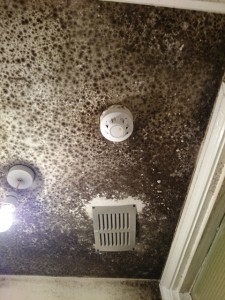
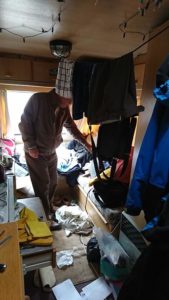
People live in cheap rented housing which is disgusting and full of mould (I’ve posted pictures of some places I’ve been in below). This is the only housing that people can afford on LHA rates. I’ve interviewed people who live in tiny, grotty, falling-apart static caravans because they can’t afford anything else.

People’s care services have disappeared, because they can just about achieve the daily basics such as shopping and dressing on their own. They’re left to it as a result. No matter that they struggle with other aspects of running a home, such as keeping the tiny places they must rent clean and clear of mould (you can see that in the pictures below).

They are getting older, but must drag themselves to weekly jobcentre meetings to talk about work they’ll never get. They’re banned from jobcentres because they lose their tempers (perfectly understandably) when the DWP insists they apply for jobs that everyone knows they’re not eligible for. They’re thrown out of jobcentres when they try to drop in the sick notes their doctors must keep writing to cover people’s very obviously deteriorating health. The hours I’ve spent posting or delivering sick notes to the DWP and jobcentres for people who everyone at the jobcentres knows is neither fit nor eligible for work – I tell you what.

The “lucky” people are supported by collectives such as the Kilburn Unemployed Workers’ group who really do make herculean efforts to keep things afloat for people. Other people just rot.

There’s no doubt in my mind that each of these problems hacks away at people’s health. Together and over time, these problems are dynamite. Because I see people again and again, I see the deterioration as it gathers pace over time – the weight loss, the worsening diabetes and respiratory health, and the decline in mobility. It’s neither hysterical nor naive to say that. I spend most of my time out talking with people who are in these situations.

People like me and plenty of others know what we see. We’re not the ones who are hysterical or in denial. Seriously. This is not exaggeration, or hysteria, or even the dreaded fake news. Fake news is the sort of thing you find in the average DWP press release – press releases which say, for example, that the DWP provides “tailored” services for sick and disabled people, even while jobcentre advisers are telling you that the DWP does nothing of the kind. I think that every mainstream outlet which publishes a DWP justification-for-policy statement at the moment is publishing fake news.

—————

Here are some pictures of places I’ve taken in the last few years.

You can’t tell me that the health of the people who lived in these places hasn’t been affected by these cramped, mouldly, filthy conditions. Anyone who says otherwise really is naive.

The man who lived in the first two places (he has learning difficulties and diabetes) has recently been found sheltered housing thanks to the efforts of the Kilburn Unemployed Workers’ Group.

Mould in one-room studio flats in London (kitchen, bed, living space all in one room):

Man in his 60s living in an old static caravan (Oldham):

Is anyone getting information out of the DWP at the moment?

I got a note from the DWP FOI yesterday to tell me a response to an FOI request that I sent last month about deductions from Universal Credit for tax credit debt would be delayed.

Of course – that’s happened before and not just to me. The point I making today is that I can’t get anything from the department on any front. The press office wouldn’t give me even a one line response to use about a fortnight ago for a question about private companies which do or don’t run Universal Credit contact centres (the department sent me a list I had and then I had to send another FOI. I couldn’t understand why the DWP wouldn’t just tell me who ran the contact centres).

And then there’s the fact that people’s requests for their own benefits paperwork go unanswered by the department.

Don’t like it.

“We’re cutting your benefit, but won’t say why. Get your arse to the jobcentre” – DWP to woman with serious mental health condition

Readers of this site will know I’ve written regularly about Maggie (name changed), a 41-year-old Northampton woman with a schizophrenia diagnosis.

Maggie has been sectioned in the past and has spent time in hospital.

Maggie receives the Employment and Support Allowance benefit. Up until recently, Maggie was in the ESA Support Group, which is the group for people with the highest support needs.

The DWP suddenly changed that about a month ago. Maggie was sent to a Maximus face-to-face assessment. She got a letter at the end of September which told her that her ESA claim had been downgraded. She was now in the ESA work related activity group (which means that she must attend jobcentre meetings about finding work) and her benefit money had been cut.

The DWP did not tell Maggie why it had suddenly decided she was able to look for work and live on less money. Her condition has not changed. It’s actually worsened since local mental health support services were cut. No reasons for this decision were included in the DWP’s letter.

Maggie rang the DWP to ask the department to send her a list of reasons for this decision to push her into the ESA WRAG group. The DWP said it would send her those reasons by post. That was three weeks ago. The list of reasons has not arrived. Maggie can’t properly challenge the decision to change her benefits without understanding exactly what it was about her condition that the DWP thought had changed.

However – the DWP HAS managed to send other post to Maggie in the last few weeks. The department sent her a letter which told her in no uncertain terms that she must turn up to her jobcentre for a work-related interview, or risk benefit sanctions. The DWP has no problem getting that sort of letter – ie a threatening letter – in the post. That part of the system works absolutely fine.

That letter about the work interview at the jobcentre arrived almost immediately after the letter which told Maggie that her benefit had been cut (I was actually speaking to Maggie on the phone about the first letter when the second one dropped through the door). Maggie had to attend that first work-focused interview at her jobcentre last week.

I am getting very, very sick of this. You think the sex scandals in parliament are bad. This sort of story is as bad and worse. This is cutting off support to people in great need and dropping them in it.

With one pen-stroke, David Gauke and the rest of the DWP’s geniuses cut money and support to someone who has previously been hospitalised because her mental health condition is so serious. Nobody gives a stuff about that, of course, or about the effects that such letters have on people whose are already struggling to keep things going. After cutting her money, all the DWP offered Maggie by way of “support” (ha) was a threat about attending a jobcentre meeting.

How do Gauke and his bureaucrats still get paychecks for running this intentionally disastrous system – the system that people in the greatest need in our society must use? The situation I’ve described above is exactly the sort of scenario that sets desperate and unsupported people up for suicide attempts – horrible threats, pressure and reduced money, and nobody to help (welfare support and advice in Northampton is hard to come by). It isn’t even subtle.

So much for government taking mental health seriously. Do me a favour.

I won’t be letting this one go.

Why can’t/won’t the DWP send a #UniversalCredit claimant details of tax credit debt it is deducting?

Not a trick question…

Readers of this site will know I’ve been working with a young woman in Colchester who receives Universal Credit. She is very concerned about the random amounts of money that the DWP suddenly started to deduct from her Universal Credit payments for an alleged tax credit debt.

The woman disputes the debt. She wants a chance to challenge it and to stop the deductions.

The DWP is taking over collection of tax credit debt from the HMRC for Universal Credit claimants. People are complaining that the DWP has started to deduct tax credit debt repayments without notice from their Universal Credit payments each month.

Problem is – people who want to challenge these deductions run into bureaucratic problems at every turn. It’s very hard not to feel this is intentional. It really, really is. Here’s an interview I posted yesterday with an Oldham woman who has the same tax credit debt problem.

Three weeks ago, the Colchester woman asked the DWP to send her a full statement and breakdown of her alleged tax credit debt. She wanted a statement which showed the debt and listed all repayments deducted from her benefits and tax credit claims for to date.

She’s found getting that information impossible.

On the phone, she was passed from the HMRC to the DWP to the DWP Debt Management department.

The DWP finally agreed to send her a statement history in a fortnight.

That was three weeks ago. The statement has not arrived.

This means the woman is no closer to being able to challenge the tax credit debt, or the DWP’s deductions from her Universal Credit payments.

The DWP’s bureaucratic failures and institutional indifference deny her that right. The department continues to deduct tax credit debt repayment money she can ill afford to lose from her Universal Credit payments.

She will go further into debt because of that – a point that should concern everyone. This woman just took out another Universal Credit advance payment to cover the tax credit debt deductions – having just finished paying back the Advance Payment she took out to cover payment delays when she started her Universal Credit claim (you can see that deduction in the image above).

The whole thing is absolutely hopeless. I’ll post more on it as we make further requests for statements and repayment histories. Continue reading