My latest at Sentinel News: the DWP really is leaving people with no money to live on at all.
Sanctioned while waiting to be sanctioned
3
My latest at Sentinel News: the DWP really is leaving people with no money to live on at all.
Of the many twisted punishments that the DWP likes to hand out to JSA claimants, I’m thinking atm of the one where advisers make a claimant wait for days to find out if they will be sanctioned for missing a meeting or a supposed jobsearch transgression. Making people wait days or more to find out if they’re going to have any money for the next fortnight really is one of the perverted acts. You have to wonder about a bureaucracy that hands out that kind of thing.
Twice in the last couple of months I’ve spoken with a couple of people who said they were nervously awaiting the outcome of a decision about a potential sanction. Neither of these people had a) any idea whether or not their next JSA payment would be made and b) any real idea when they’d formally be told if they’d been sanctioned and for how long. They were told only that the outcome would be sent down by a decisionmaker of some variety at some point and that there was no point asking before then how things were progressing. I actually sat with one of these people as that person asked an adviser – plaintively, it must be said – if there was any news on a potential sanction for a missed meeting. That person was told a decision would be sent by letter. If there was no letter by the end of the next week or so, the person could assume that there was no sanction. Similar story for the second person, who has also been told to Wait And See.
I’m sure there’s an explanation for all of this to do with systems. Sadly for the DWP, I’m not interested in hearing it.
Here’s a story that I’ve taken from the interviewing work that I’m doing at the moment:
Last Thursday evening, I attended a meeting held by the Leeds Hands Off Our Homes housing campaign group in a small church hall in Middleton Park in Leeds. Issues discussed included the housing bill, the ongoing problems that local people had with the bedroom tax, the likely effects of a lowered the benefit cap, social housing selloffs, the shared accommodation housing benefit rate for younger people – a real range of topics. Housing problems, as we all know, affect a great many people in one way or another. The turnout wasn’t bad. Local troubles were discussed with concern.
So.
Representation.
Present and correct down the back for this event were two local councillors – Kim Groves and Judith Blake who is also leader. I’ll be the first to admit that I know little about these councillors and their work on the ground. They may be good on some level, so I suppose we should allow for that. What I can tell you for a fact is that the two of them did my head in at the church hall last Thursday night. I’m sure that I don’t exaggerate when I say that they were utterly useless, at least as far as offering hope and leadership on the housing topic went. It seemed that their chief concern was to convince meeting attendees not to blame Labour or the council for the housing crisis. It was Don’t Blame The Council this and Focus Your Anger On The Government that and (my personal favourite) Please Don’t Ask Us To Do Anything Illegal As Part Of Your Housing Campaign (someone gently suggested that the council might like to try a bit of non-compliance to fight government housing policy. This person spoke well and put his points politely, but neither of those things helped much. I find that they rarely do. Anyone who suggests a bit of genial civil disobedience to nervous councillors these days is quickly sidelined as the evening’s wacky radical. *Sighs*).
You see where I am heading with this. No leadership was offered by councillors. No inspiring speeches about seizing the day, or descending on parliament to give the government a knuckle sandwich on housing or cuts came down. Maybe they do that on other days. They didn’t on Thursday. Meeting attendees were actually told to be realistic about the council’s limits. Which was a buzzkill, to say the very least. Talking about limits is not a great way to lead or inspire. You could practically see people’s passions and hope congealing in their veins as this came out. I briefly entertained the idea of standing up and shouting You Labour Persons Have Got A Socialist Leader For Christ’s Sake – Isn’t Now Meant To Be The Hour!?, etc, but I didn’t do it. I felt a bit secondhand by this point. It all seemed a bit hard.
My first outing on the Sentinel news blog:
Homeless mother of two Alicia Phillips explains how the housing crisis and an expensive commute from Boundary House – an isolated temporary accommodation hostel in Welwyn Garden City – are destroying her work and training options.
Alicia says that Waltham Forest Council told her she’d have to give up her job as a nursery nurse in London if the commute from Boundary House was too expensive and difficult.
This is how single mothers are punished in austerity. They’re actively relegated to a poverty trap. So much for Stephen Crabb’s fantasies about the government’s commitment to getting women out of that trap.
“I felt like I was being totally bullied in the playground by this big bitch… it’s like the more white and English you are, the more fucking shit you are. I’m not being funny, but it’s true.”
So. That’s a quote. That’s the sort of thing people say when I talk with them at jobcentres. These places are not pleasant, you know.
I give you the transcript below as an example of one sort of discussion that I have a lot of – discussions with people who are over 50, out of work and signing on at jobcentres where they must participate in jobsearch activities. In the past couple of years, I’ve met a lot of people who are over 50 and sometimes getting on for 60 at jobcentres. Some are on Jobseekers’ Allowance and some are on Employment And Support Allowance, and some go backwards and forwards between the two as they’re found fit for work and then found not-so-fit-for-work when advisers see where things are really at. I’m not sure exactly what point I’m trying to make by uploading these stories. I think it is probably that signing on when you’re older is grim and that I hope I never have to do it.
This is a transcript from a discussion that I had a few months ago outside Kilburn jobcentre with a guy called Terry, who was 54. He said that he’d been sanctioned by a jobcentre adviser a few days earlier and that he had no money in his bank account. He’d come to the jobcentre to ask for a hardship loan. He was furious about the sanction. No surprises there. People who’ve been sanctioned generally are furious. Being sanctioned does not usually bring out anyone’s best (even though government believes that sanctions teach people very important life lessons and make them better claimants. Or something). People must go through the motions of looking for work. They must fill in jobsearch booklets and talk about answering job ads. Everyone is perfectly aware that these so-called jobsearch activities are pointless. You’re generally no closer to work at the end of them than you were at the beginning, particularly when you’re over 50. To be sanctioned for the poor performance of a task that you know was meaningless in the first place doesn’t teach you much, except that you’re stuck in a farce. And to hate everyone, I guess.
Anyway. I’ve had conversations like the one below as a matter of course at jobcentres over the past couple of years. The main lesson that I take away from these stories is Don’t Age. You may not think your best is behind you when you get past 50, but everyone else sure will. The system will certainly rub your nose in your failures as it perceives them. Nobody reacts well.
What a comforting thought.
Terry, 54:
“I’ve just been sanctioned. I will tell you why. I have to describe this sort of stuff (he showed me the jobsearch notebook in which he had to write details of his jobsearch activities) with my supporting jobcentre like samples. Anyway, that’s what I’ve done. Anyway, she [the jobcentre adviser] signed it. She was just about to send it and she said – “Oh, you’re still hoping to teach guitar from home, still, right,” because I’m saying this that and the other and I’m hoping to start teaching. She said – “you’re just repeating yourself. You’re cutting and pasting.”
I said – “what?”
She said “I’m taking it to my manager,” and so that’s it. She hasn’t signed me on and she’s said “I’ll leave it to my manager to sign anyway” and Monday came and my money wasn’t there, so obviously I’ve come down here. I phoned Belfast as well [the Belfast benefits centre] and they said I’ve been suspended. So I’ve come down here and I’ve got a hardship form for jobseekers, so I filled that in and given them my bank statements, but basically, this is unbelievable. I felt like I was being totally bullied in the playground by this big bitch. Yeah, it’s like the more white and English you are, the more fucking shit you are. I’m not being funny, but it’s true.
Finishing a project up over the next couple of weeks, so blogging will be (very) light until mid-April. Back & ready to go then.
Still available for contact here.
See you soon. Don’t take any shit.
I give you below an example of an older, sick and disabled JSA claimant being treated like trash by the DWP via her jobcentre.
This story is for anyone who has bought into Iain Duncan Smith’s very peculiar “I destroyed social security, because I care about sick and disabled people” logic. It should give you insight into two of Iain Duncan Smith’s key legacies for sick or disabled people who must use his ex-department’s services: 1) a breathtaking bureaucratic callousness which even decent DWP staff seem forced to affect and 2) utterly threadbare support and services for sick, disabled or at-risk people who are out of work. One measure of a minister’s “success” is surely his department’s behaviour towards people who need that department’s services the most (and who likely will always need those services in one form or another). You’d expect people in those situations to be treated with the least bureaucratic contempt, not the most:
From time to time, I attend one of the London jobcentres for JSA signon meetings with Linda,* 51. Linda has a learning difficulty and a list of health problems that has lengthened fast in recent times: shortness of breath (she stops a lot to rest when she walks), shakiness and a pallor so stark that one adviser remarked on it at meetings in February and March: “what’s happened to make you so pale?”
When you get down to it, though, nobody really gives a damn about Linda’s terrible paleness, or the reasons for it. There is certainly no system or support in place to make sure that people in Linda’s situation are protected from the cruellest excesses of the DWP’s punitive sanctions and benefits-stoppage regimes. Linda found that one out the hard way. In January, Linda’s jobcentre closed her JSA claim. Linda missed a couple of JSA signon meetings, because she got sick. She wasn’t able to walk to the jobcentre. The jobcentre took a “Two Strikes And You’re Out” approach to the missed meetings. They shut Linda’s claim down altogether. She went without money for several weeks. She had to borrow money from a family member who wasn’t happy about the loan.
“I couldn’t come in [to the jobcentre for the signon meetings]. I was too ill,” Linda kept weeping when we met at the jobcentre late in February to try and restart her JSA claim. She was certainly unwell that day. I was shocked at her pallor myself. I hadn’t seen her for a couple of months and was taken aback. I went very quickly from thinking that she needed to get her JSA claim back on to thinking that she should probably see a doctor as a priority. She was pale, shaky and weepy in the way people are when they’re too unwell to be out.
More on the garbage that the DWP and government talk when they say that the aim of ESA cuts and fit-for-work assessments is to encourage sick or disabled people into work:
As readers of this site will know, I regularly attend signon sessions at a north London jobcentre with a guy I call Eddie in these posts. Eddie is 52. He spent most of his working life as a general assistant in kitchens. He was made redundant seven years ago and has been out of work since. He signs on for JSA. Eddie has learning and literacy difficulties (he finds writing especially hard – here’s an example of a Morrison’s job application he filled in by copying notes I made). Eddie is unable to use a computer or email. He can’t open a browser on a laptop, or type in links, or navigate to a wegpage.
But here’s the thing. Eddie’s jobcentre adviser keeps giving him handwritten weblinks and email addresses to take home and use for job applications. His adviser does this at every third or fourth signon meeting. He prints or writes out a link that he knows Eddie can’t use to type into a computer that he knows Eddie doesn’t have. You can see the most recent hard-to-read handwritten instructions and link here:
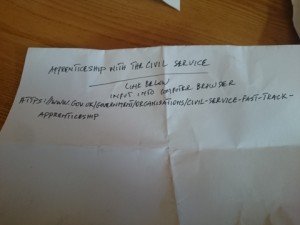
Eddie was absolutely furious when he was handed that piece of paper. He is furious every time that he is given a link to pursue. “That man knows I haven’t got a computer,” Eddie said angrily. “He’s taking the piss.” I imagine that the jobcentre adviser also knew that Eddie didn’t have a hope of landing one of civil service apprenticeships advertised on the link. Eddie is older, in poor health (he has diabetes and leg pain, which he struggles to manage) and has regular hospital and GP appointments. His literacy levels are not good. He has none of the skills mentioned on the link as far as I can see.
“Taking the piss” doesn’t begin to cover it. I don’t know if the adviser meant to be cruel, but that is neither here nor there. Eddie feels the insult, as well he might. This is a bureaucracy humiliating a person that the job market has discarded. This is a bureaucracy making an older sick and disabled person traipse to the jobcentre every fortnight and go through the motions of jobseeking before being allowed his paltry benefit. Eddie knows and the adviser knows and I know that these signon meetings are the ultimate exercises in uselessness. There’s no point in Eddie being forced to attend the jobcentre at all – except, I suppose, that Iain Duncan Smith gets off on the idea that he can rub a sick and disabled claimant’s nose in that person’s lack of options every fortnight. Other than that, I don’t know why we’re here.
Here’s a little more on the petty tyrannies of the DWP, particularly when it comes to sick or disabled people. I give you this as yet another instance of the institutional disdain that trickles down, if you like, when a government gives strong signals that it’s fine to treat a group of people with utter contempt.
Last week, I attended a JSA signon meeting at Kilburn jobcentre with Linda (named changed). Linda is 51. She has a learning difficulty and a growing list of health problems as she ages: shortness of breath, swollen ankles and a pallor that at least one adviser keeps remarking on (“what’s happened to make you so pale?”), etc.
Because she is finding breathing difficult, Linda struggles to walk up stairs. Unfortunately for Linda, JSA signon meetings take place on the first floor of the jobcentre. Unfortunately too, a jobcentre security guard last week insisted that Linda must climb those stairs if she wanted to sign on and receive her JSA money. The guard also said that there was no lift – an absence which presumably would cause access problems for other disabled people at this jobcentre. I did ask about access for disabled people generally. The guard took a pass on that query.
“All the signing is on the first floor,” the guard said.
“I can’t get up there,” Linda said.
“She’s had a breathing problem,” I said.
“I’m afraid there’s no lift,” the security guard said.
“Last time I come here, I couldn’t bloody breathe,” Linda said.
“No, you have to go,” the security guard said.
So much for making reasonable adjustments for sick or disabled people.
This situation needed resolving, though, so I grovelled for a while. If Linda did not sign on, she would not receive her JSA money. “Tough shit” wasn’t really the right answer to this. In the end, the guard said I could go upstairs and ask Linda’s adviser if she could meet Linda on the ground floor for the signon session.
Had to grovel there, too. The adviser agreed to come down in the end.
I think these stories are important to post. You can just about see a jobcentre channelling government contempt for sick and disabled benefit claimants at these moments. Institutional disdain, you know. Some people have just enough power to make other people beg. Right now, they feel very comfortable making people do just that.
Video from last Friday’s Old Street roundabout roadblock protest against the placing of job coaches in GPs’ surgeries (read more here).
Includes short interviews with DPAC’s Paula Peters, junior doctor Mona Kamal and footage of some tosser who said he didn’t care why people were protesting. Charming.
Transcript after the video:
Transcript:
Paula Peters, Disabled People Against Cuts
Right, welcome to the Surgeries for Treatment, Jobcentres for Jobs protest. We are seeing now jobcentre coaches from Maximus, the US healthcare company based in GPs’ surgeries such as this one behind us which is City Road Surgery. What we’re seeing here is GPs in this surgery prescribing job coaching for hard to reach claimants on Employment and Support Allowance. This is targeted at mental health claimants.
Mona Kamal, Junior Doctor
I’m here today because I am a psychiatrist, I work in mental health, I’ve been working in mental health for several years and I’m here basically because I witness first hand the impact of these austerity cuts on psychiatric patients in particular. I’ve witnessed this over the years and we’ve also seen the evidence now in terms of the research that came out towards the end of last year about these additional suicides that have been linked to the work capability assessments in particular.
Chanting:
The NHS makes us well. The Tories make us sick.
Martin Tolley:
With the DWP it’s not voluntary, it’s mandatory. We all know that and then to allow these job coaches to have access to your medical records and be able to leave notes on your medical records, and I’m not standing for it. My medical records are private. They are not there for every Tom, Dick and Harry to have a look at and add their comments to it.
Member of the public:
Can you get out of the way.
Protestor:
Do you know why we’re doing this?
Member of the public:
No and I don’t really care. Because the rest of us… the rest of us…have had enough.
Paula Peters:
…disabled people would have taken their own lives, due to the stress and the fear of government policy. So I think you can bear with us as we block the road for a bit, don’t you.
Posting here will less frequent for the next few months while I work on a case studies project. There will be more from this article in that project. You can still get in touch here.