The PIP assessment system is garbage. And dangerous.

This is a story about Capita’s abject failure to adjust its PIP assessment procedures for people who need adjustments.

Here’s a Personal Independence Payment decision letter received last week by Sean (named changed), a man in his 50s who has Asperger’s and severe depression and anxiety:

comply_letter_


You’ll see the letter says that Sean – a long-term Disability Living Allowance recipient – has been denied PIP altogether. He has been denied PIP, because, the letter says, Sean “failed to comply at the assessment centre,” (Sean was assessed for PIP at a Capita assessment centre in earlier this year). That would appear to be that.

Except that it is not. I think this is a significant decision. It is significant because it suggests that Sean’s PIP assessors made no allowances or adjustments for Sean’s mental health and problems dealing with stress at his assessment. Sean says that he got angry and upset at his PIP assessment and that the assessor cut the meeting short, because Sean was clearly not able to cope. Now, Sean has been told that the official interpretation of this event is that he failed to comply at his PIP assessment. He won’t get PIP as a result.

This makes me wonder. It certainly makes me wonder how things pan out for other PIP applicants who have complex spectrum diagnoses and mental health conditions, and who exhibit so-called challenging behaviour in stressful situations such as PIP assessments. Is it One Strike And You’re Out for everybody? Does Capita actually have processes in place to make sure that people who clearly struggle with assessments have other assessment options? Sean says that the Capita assessor suggested a home assessment when his face-to-face meeting was ended – but the home assessment never happened. It turned out that Sean and his GP were responsible for organising a home meeting themselves. (I rang the DWP to try and get to the bottom of all of this and the officer I spoke to said that was how the “system” worked). Sean didn’t realise this. The upshot was that a home visit never took place. Continue reading

Video: jobcentre adviser says disability support is wrecked. Fix this, Mr Green

This one goes out to our new work and pensions secretary Damian Green. What will he do about the destruction of disability support in jobcentres? Hope the answer isn’t Nothing, or Get Lost, Kate.

Throwing this out there as a conversation starter:

I post below a video extract from a meeting at northwest London jobcentre earlier this year.

In the video and the meeting, the jobcentre adviser freely conceded that services for benefit claimants with extra support needs had been wrecked by cuts. More than that: the adviser conceded to me and Linda*, a 51-year-old sick and disabled JSA claimant whose JSA claim had been closed and housing benefit suspended, that “the most vulnerable” claimants who “can’t cope with the complexity of the [benefits] system,” were at extra risk of sanctions, claim closures, housing benefit shutdowns and other bureaucratic screwups because the service had been wrecked by cuts. They were at extra risk because the DWP had radically reduced the number of specialist disability employment advisers in jobcentres. Disability employment advisers were jobcentre advisers who had the time and training to support sick or disabled benefit claimants. They weren’t all great, but some were better than nothing. On occasion, they acted as a buffer between disabled claimants and sanctions. Some would argue in defense of a sick or disabled claimant who missed a meeting, or they’d make sure not to sanction a claimant who couldn’t use a computer and meet online jobsearch requirements.

In various press statements over months, the DWP tried to tell me that DEAs had been replaced by work coaches who offered a tailored service. In reality, jobcentres advisers were telling me and sick or disabled claimants such as Linda that DEAs had been replaced with nothing:

(Video transcript at the end of this post)

You’ll understand why I’m very keen to hear about the sort of plans that our new secretary of state for work and pensions has to address this particular disaster area. I’m not keen on receiving more press releases, or empty statements from the DWP about so-called tailored support for sick or disabled people. I asked the DWP last week about the number of DEAs in jobcentres/how things were coming along, etc. They chucked me a link from an early-June Hansard debate in which already-forgotten DWP head and baton-dropper Stephen Crabb rattled on about plans to double the number of DEAs in jobcentres. If I am honest, this doubling didn’t seem a great result to me, given that the number of DEAs had been cut by more than half in the first place. God knows, too, if any action on the doubling front has or will actually be taken. It is my experience that commitments made by ministers and the DWP don’t always exactly match the reality of the everyday journey on the ground. Let’s add that to the list of issues to explore. I’m keen for Mr Green to open jobcentre doors at all times to journalists, claimant representatives and anybody else who wants to forensically examine the facts of the DWP’s support for sick or disabled benefit claimants.

Continue reading

#PIPFightBack: Day of Action Against PIP tomorrow Wednesday 13 July

From Disabled People Against Cuts:

Personal Independence Payment (PIP) is the replacement for Disability Living Allowance (DLA).

While DLA worked to provide support for the extra costs of being disabled, and the system worked well, the whole PIP system is rotten to the core.

The whole purpose of making the change from DLA to PIP is to remove people’s entitlements to the vital support which DLA provided to help enable disabled people to live a life on more even terms with non disabled people.

With the PIP assessment regime now in place, thousands of people have already lost out and reports of the shoddy nature of the assessments are growing every week. While the success rate at tribunal is high, it is taking up to 6 months or longer for cases to be heard – leaving disabled people struggling.

Read more here and find out about tomorrow’s protest events and online action.

How people are treated like garbage when they are trying to apply for PIP

Here’s an example of the way the Disability Living Allowance to Personal Independence Payment system “works”:

Sean (name changed) is in his 50s. He has an Asperger’s diagnosis and serious depression and anxiety. He struggles to leave his house. He relies on his partner to do much of their shopping and to make many of the endless phone calls that people who must navigate the benefits “system” must make. His partner has a schizophrenia diagnosis.

Sean is in the support group for Employment and Support Allowance. I’ve attended two of his ESA work capability face-to-face assessments in the last few years. Sean and his partner pay the bedroom tax on their so-called “spare” room. They also pay council tax now, because their council tax benefit has been cut. The mail that pours into their letterbox from the DWP and the council is pretty much non-stop. Last year, Sean even received a letter from the DWP which asked him to consider attending so-called work-focused interviews at his local jobcentre. People in the ESA support group are supposed to be exempt from job-finding requirements and activities, but still Sean got that letter. “They are relentless,” he says most times we speak. Indeed.

Now he’s stuck in the shambles that is PIP. Earlier this year, Sean received a letter from the DWP which said that his Disability Living Allowance was about to end and that he should apply for the new Personal Independence Payment. This news and new pile of forms was upsetting enough in itself. Sean says the income that he received in DLA made up an important part of the money he relies on to survive. The thought of losing that money or even part of it was of great concern. He found the PIP application form daunting, but filled it in with the help of a local advice group. The form was submitted. Next, he waited to hear from Capita with a date and time for a PIP face-to-face assessment.

As far as Sean is concerned, this part of things has been dire. Sean says that early in April, right out of the blue, he got a call from someone at Capita who asked if he could attend a PIP face-to-face assessment the very next day. This was not a good approach to make to someone who has Asperger’s and depression, and who struggles with sudden change. Sean was certainly rocked by that call. He and his partner rang to tell me about it. A next-day appointment gave him no time to prepare. For the ESA assessments we’ve attended, Sean’s arranged in advance for his father-in-law to drive him to the assessment centre. He’s also made sure that someone could attend with him. Surely ringing a person with Sean’s health history and asking him to attend a feared assessment the very next morning was reckless. In the extreme.

Continue reading

The future will be wrecked for generations while women and little kids live like this

Think this fractured society will be healed soon? It won’t be while women and little kids live in the rotten conditions described below, and with no way out. Nobody builds a united future when young families must live in chaos and when the social security systems that should support them have been destroyed:

On Monday last week, young mothers who live with their kids in cramped single rooms in the Welwyn Garden City Boundary House homelessness hostel protested at Waltham Forest Council about their living conditions. All the women are homeless. All were placed in the Boundary House flats by Waltham Forest Council. The accommodation at Boundary House is horribly cramped and isolated. Placements at Boundary House are only meant to be short-term. Most of the women I’ve spoken with this year say their councils told them that they’d be in Boundary House for a couple of months at most – but some have been stuck in Boundary House for more than two years (Newham council used to place homeless families in Boundary House as well). The rooms look like this:

flat_interior_

Photo credit: Snapsthoughts http://photos.snapsthoughts.com/

It will surprise nobody to hear that relations between Boundary House residents and Waltham Forest council have reached breaking point. In the video below, you can see the women and council officers yelling at each other as the women descend on the council’s housing office to demand better housing and to make the very valid point that their living conditions are intolerable and that they need better housing:

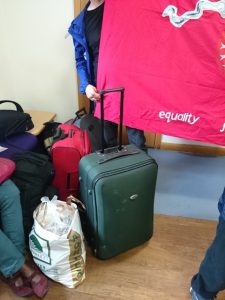
Things are not generally good at places like housing offices and jobcentres these days, whether there’s a protest on or not. Furious homeless families and overstretched frontline staff have been abandoned to fight it out with each other in austerity. Shouting is not unusual. Desperation is certainly not unusual. Security guards are not unusual. When the mothers arrived, the housing office was already very busy. Some people who were waiting to be seen even had their suitcases and belongings with them. I’ve seen that in a number of housing offices in the last year or so. This is how a lot of people live now, if “live” is the word:

Bags__

Bags_

There was a heavy security presence, as there often is at housing offices and jobcentres now. I’ve attended enough meetings at frontline offices to know that you get guards at these places whether there’s a protest on or not.

The Boundary House women have two major problems. The first is that their accommodation is unpleasant, but they must raise their small children in it. The second is that they know their chances of getting money together for anything better start to evaporate as soon as they arrive at Boundary House. The Boundary House women live with their children in small, single-room flats in the hostel. The families only have that one room. Beds, kitchen, clothes and belongings are all crammed into that single space. Each flat has a small, separate bathroom. People complain about cockroaches and woodlice – you can hear the women talking about that in the video above. The building itself is isolated. Boundary House is down a suburban side street. The walk to Welwyn Garden City train station takes a half-hour and from there, people face an expensive (around £300 to £400 a month) commute to London. Continue reading

While politicians amuse themselves, austerity continues rampant, etc…

Just so that you know:

This week, I have already spoken with:

  • Homeless young mothers from the Boundary House hostel in Welwyn Garden City who’ve been placed in cramped, single-room “studio” flats with their kids miles away from their jobs and study. They were terrified (rightly) that they’d never find even halfway decent accommodation.
  • A young woman (aged 22) who told me that she’d been sanctioned for missing a meeting, even though she’d let her jobcentre know that she couldn’t attend, because she’d been placed in housing out of the borough. She said that she didn’t know she could appeal the sanction decision. She also said that she hadn’t been told about hardship payments. She has a two-year-old daughter. She had no idea how to address any of these problems and nobody to ask.
  • A 53-year-old man who has serious mental health issues (his depression and anxiety are so bad that he often can’t leave the house). He has to pay the bedroom tax. His council tax benefit has been cut. And now, it seems that his DLA has been stopped, or that anyway, he’s getting nothing. He filled in a PIP application form with assistance several months ago and was called to an assessment. He says that he couldn’t cope with the face-to-face assessment, though, and so the assessor told him that a home visit would be organised. But it seems that it wasn’t. He says that assessment just never happened. He contacted me on Tuesday, because no money went into his account as it did when he was receiving DLA. He says that he’s been told he has to start again with a PIP form. He’s very confused and worried. He no longer has a social worker. God only knows what has happened. The point is that there’s nobody around to help him navigate any of this. (Disabled People Against Cuts are planning a national day of fightback on 13 July against the abject mess that is the Personal Independence Payment system. Find out more here).

I just want you to know that all this is still going on while the political and media classes amuse themselves with their appalling game of thrones. I’d also say that the chances of these so-called systems being improved, or even acknowledged, in the next few years are about zero. Probably less than that.

You’re the kind of immigrant that we want

Make of this what you will:

A month or so ago, I spent some time with a family in Middleton Park in Leeds. I went around to their home after a local meeting about government attacks on social housing tenants. The family was Irene and Desmond Lovatt, both retired and in their 70s, and their daughter Michele, who was 38. The three lived together in a council house that the elderly couple had first moved into more than 40 years ago.

The family was open, friendly, talkative and very welcoming. We chatted for a long time. The three spoke in detail about the difficulties they’d dealt with over the years. There was no doubt that things had been a real struggle. Michele said that insecure employment and local companies failing had long been a problem: “I got a job in administration, but after 11 months, they had to let me go, because they relied on jobs coming through the fax machine [and no orders were coming through]. It was a storage company. Even manager was playing solitaire at the computer, because [there was no work coming through].”

Signing on for JSA brought a raft of problems. Michele said that at one point, jobsearch requirements at her local jobcentre were so strict that she’d had to attend the local library to use computers for jobsearch activities almost every day. Being ignored by potential employers was also infuriating. “When I’ve been to interviews,” Michele said, “I’ve gone to an interview and then at the end they say – “sorry, we’ll let you know. We’ve got other people to see.” They don’t say you haven’t got it. Then you get a letter saying you’re unsuccessful. Big firms doing that want to be fined, because if you’re good enough for damn interview, you’re good enough for friggin’ job.” Michele now worked as full-time carer for her mother Irene, who’d had a stroke in 2014. Michele received Income Support and Carers’ Allowance for this and was obviously pleased at this formal recognition of caring as a job. “I wash up. I wash the floor, bathroom. I go shopping. Like my mum comes with me, but I take the bigger shopper and she takes the small shopper. She gets the lighter stuff. I do the heavy, like milk, cat meat and tins, stuff like that… I also attend when she has to go to doctors’ appointments. I’m seeing to her tablets.”

All three were pro-Brexit. I asked people how they planned to vote in the then-upcoming EU referendum. OUT! everybody said with enthusiasm. Everyone was animated about it. We talked about the reasons why the family wanted a Brexit. Sovereignty came up as a topic. Desmond felt that an Out vote would make Britain stronger again as a manufacturing base: “We’re not building. That’s what making it bad.” Desmond also mentioned “bloody foreigners.” He was particularly exercised by foreign ownership of power companies. “Why should we be dictated by foreigners when it’s our country?”

“That’s how I look at it as well,” Irene said. Getting Britain Back from foreigners was a theme. It wasn’t the only theme by any stretch, but the topic was certainly raised.

Anyway, as the evening went on, I told people that I was an immigrant myself. I have dual Irish and New Zealand citizenship and live here as an Irish citizen. The point I want to make is that this revelation was met with no hostility at all. It rarely has been for me. I have a strong accent, but am never mocked or pulled up on it. That may change, of course, but at the time of this meeting, things were fine, on the ground at least. In fact, since the referendum, I’ve spoken to a couple of Leave voters who were at pains to point out that they weren’t referring to people *like me* when they talked about wanting to stop migrants. Meanwhile, people around the country who presumably are being referred to when this subject comes up are suffering horrendous racist abuse. I can only conclude that people are talking as much about race and difference and Other as they are about numbers when they talk about immigration. As I say – take from this what you will. That night in Middleton Park, the old lady even took my hand as we talked about antipodean migrants. She beamed at me and said something along the lines of: “Oh, Australia! But you’re the kind of immigrant that we want!”

Making people wait to find out if they’ll be sanctioned is truly sick

Of the many twisted punishments that the DWP likes to hand out to JSA claimants, I’m thinking atm of the one where advisers make a claimant wait for days to find out if they will be sanctioned for missing a meeting or a supposed jobsearch transgression. Making people wait days or more to find out if they’re going to have any money for the next fortnight really is one of the perverted acts. You have to wonder about a bureaucracy that hands out that kind of thing.

Twice in the last couple of months I’ve spoken with a couple of people who said they were nervously awaiting the outcome of a decision about a potential sanction. Neither of these people had a) any idea whether or not their next JSA payment would be made and b) any real idea when they’d formally be told if they’d been sanctioned and for how long. They were told only that the outcome would be sent down by a decisionmaker of some variety at some point and that there was no point asking before then how things were progressing. I actually sat with one of these people as that person asked an adviser – plaintively, it must be said – if there was any news on a potential sanction for a missed meeting. That person was told a decision would be sent by letter. If there was no letter by the end of the next week or so, the person could assume that there was no sanction. Similar story for the second person, who has also been told to Wait And See.

I’m sure there’s an explanation for all of this to do with systems. Sadly for the DWP, I’m not interested in hearing it.

Looking for hope or leadership and finding it only in Brexit. Isn’t much in evidence elsewhere

Here’s a story that I’ve taken from the interviewing work that I’m doing at the moment:

Last Thursday evening, I attended a meeting held by the Leeds Hands Off Our Homes housing campaign group in a small church hall in Middleton Park in Leeds. Issues discussed included the housing bill, the ongoing problems that local people had with the bedroom tax, the likely effects of a lowered the benefit cap, social housing selloffs, the shared accommodation housing benefit rate for younger people – a real range of topics. Housing problems, as we all know, affect a great many people in one way or another. The turnout wasn’t bad. Local troubles were discussed with concern.

So.

Representation.

Present and correct down the back for this event were two local councillors – Kim Groves and Judith Blake who is also leader. I’ll be the first to admit that I know little about these councillors and their work on the ground. They may be good on some level, so I suppose we should allow for that. What I can tell you for a fact is that the two of them did my head in at the church hall last Thursday night. I’m sure that I don’t exaggerate when I say that they were utterly useless, at least as far as offering hope and leadership on the housing topic went. It seemed that their chief concern was to convince meeting attendees not to blame Labour or the council for the housing crisis. It was Don’t Blame The Council this and Focus Your Anger On The Government that and (my personal favourite) Please Don’t Ask Us To Do Anything Illegal As Part Of Your Housing Campaign (someone gently suggested that the council might like to try a bit of non-compliance to fight government housing policy. This person spoke well and put his points politely, but neither of those things helped much. I find that they rarely do. Anyone who suggests a bit of genial civil disobedience to nervous councillors these days is quickly sidelined as the evening’s wacky radical. *Sighs*).

You see where I am heading with this. No leadership was offered by councillors. No inspiring speeches about seizing the day, or descending on parliament to give the government a knuckle sandwich on housing or cuts came down. Maybe they do that on other days. They didn’t on Thursday. Meeting attendees were actually told to be realistic about the council’s limits. Which was a buzzkill, to say the very least. Talking about limits is not a great way to lead or inspire. You could practically see people’s passions and hope congealing in their veins as this came out. I briefly entertained the idea of standing up and shouting You Labour Persons Have Got A Socialist Leader For Christ’s Sake – Isn’t Now Meant To Be The Hour!?, etc, but I didn’t do it. I felt a bit secondhand by this point. It all seemed a bit hard.

Continue reading