Getting stuff-all from Maximus – how the PR offensive really works

Readers of this site will remember that a couple of weeks ago, I posted questions about people’s right to record and film face-to-face assessments as they go through the work capability assessments that are to be run by Maximus.

I wanted to know if Maximus will allow people to record their face-to-face assessments on their phones or any recording gear that they have – from the point when Maximus takes over the grisly WCA process. I also had other questions, which I put to Maximus last week. I’ve listed these questions below, along with the answers I got back (perhaps I should say “answers”). I had to lean on Maximus’ US office for a response in the first instance, but got one of sorts in the end.

Needless to say, the entire exercise was a complete waste of time. You’ll see below that the responses give us five-eighths of fuck all as far as concrete information, timelines and/or actual process detail is concerned. No surprise there, of course – but I thought I’d post the responses anyway, because I think there is merit in highlighting the PR guff and detail-free twattery that Maximus has decided to specialise in when it comes to this contract. There’s also a dismissive aspect to a lot of the language, which you might find illuminating – a sort of “we’ll do things at our pace and you lot can wait” – air which nettled me badly. It should get on your nerves, too.

This sort of thing, for example:

“Change cannot occur overnight”

“[We] will take forward this and other ideas to the Department for their consideration”

“I am unable to comment on such speculation,” when I raised a perfectly valid point about Maximus’ view of the future of the ESA Support Group.

Sue Marsh actually got in touch with me after the press office did to say that I could speak with her, because my questions “come under her job,” but that attempt at overture got right up my nose, as well. For one thing – if Sue Marsh is the person who is best placed to answer questions in the sort of details required, then the Maximus press office should go to her for those answers before responding to whoever asked them. It’s not my job to sweep together Maximus’ various outputs on its own assessment processes as and when those outputs drop out of different holes, or to wait around for the responses that Maximus feels it has best finessed. For another thing – I can’t see myself responding well to any aspect of the many-pronged charm offensive that Maximus has launched in its sorry and very costly attempt to sculpt and polish the WCA turd. Let’s face it – any company that comes out with a phrase like “more touch, more communication,” apparently in all seriousness, should not be encouraged to contribute further to any dialogue on any topic, or to remain involved in any process where people require something better than bullshit. It’s my view that in a general sense, any company that speaks lines like “more touch, more communication,” needs a smack in the soft parts right there.

Anyway. Continue reading

Support Barnet careworkers as they strike against pay cuts this week

From Barnet Unison:

Unison members who are careworkers for the outsourced Barnet care company Your Choice Barnet (YCB) will take further strike action this week in protest at the harsh 9.5% pay cut imposed on them by their employer. The strike dates are 24 and 25 February.

This will make a total of eight days of strike action since the dispute began. The careworkers provide support and care services to disabled adults in Barnet. They say the service is deteriorating as a result of cuts.

Unison Branch Secretary John Burgess said:

“The driving motivation for our members in this dispute is their fears about what is happening to the quality of services. Low pay in the care sector does not deliver high quality services. It does not appear to work for Capita, we are at a loss as to understand why this would work for care workers in YCB.”

Barnet Unison says the council has clearly been giving preferential treatment to its private contractors with the news of Capita has already received £110 million in the first 16 months of the two contracts. If YCB were to receive this, it would carry on producing a service to the residents on the scale it does for the next 18 years with no pay cut to staff!

24 & 25 February picket line details

Flower Lane Day Centre
41 Flower Lane
Barnet
London NW7 2JN

Rosa Morrison Day Centre
83 Gloucester Road
Totteridge
Barnet
London EN5 1NA

follow @barnet_unison for updates from the pickets.

The start times are 7.30am to 12noon. See Barnet Unison for more details.

Please sign and share the petition to save services for disabled adults in Barnet from this ongoing privatisation and destruction:

https://you.38degrees.org.uk/petitions/stop-the-ongoing-destruction-of-services-for-adults-with-disabilities-in-barnet

Recordings of how JSA claimants are spoken to – and why the DWP must be stopped from arresting witnesses

Recordings from a jobcentre meeting are further down the post. The argument between the adviser and the JSA claimant is the third clip – a classic of an adviser slapping down a claimant who decided to challenge the DWP:

On Wednesday this week, people plan to gather at jobcentres to protest about the arrest of an activist who accompanied a woman to an appointment at Arbroath Jobcentre. The thought of that arrest and upcoming court hearing gets on my nerves very badly, for a couple of reasons. One of the reasons is completely selfish. I accompany people to jobcentre appointments all the time and I don’t want to hear that someone has been hauled off by the police for doing similar. I hope the DWP isn’t getting ideas here. It already has jobcentres in near-lockdown. I’ve had run-ins myself with security guards who police jobcentres and know they can be extremely unpleasant if they feel like it. This sort of crap could inspire them to further triumphs.

And there’s more. Plenty more. I wonder if this arrest means that the DWP will begin to push the idea that JSA claimants should be denied the right to take someone along to their jobcentre meetings. God knows that accompanying people is tricky enough already. I’ve been stopped by security guards who have demanded to know my name (I’ve always refused to give it) or who have simply said You Can’t Come In. Different people at the same jobcentre sometimes tell you different things about access. One guard at a northwest London jobcentre stopped me from accompanying a man with learning difficulties to his appointment until we explained that the disability adviser in the very same jobcentre said that the man could bring someone to help with his forms. The man has literacy difficulties and can’t use a computer. He struggles to apply for jobs online, which means he is at risk of sanctions.

Other people feel exposed without a witness. They’re right to. They are. There’s an awful power discrepancy at jobcentres, you know. I’ve met advisers and guards who are decent and helpful, and I’ve met advisers and guards who are not. Certainly, there are jobcentres where JSA claimants report that some advisers run terror campaigns: “there’s a woman in there who signs people on. She is bullying people…She shouldn’t be working there.” People feel that they must keep their heads down to avoid sanctions: “They are a bit stroppy. You can’t say nothing to them, because if you argue back to them, the security is there and they will sanction you…you have to keep quiet.” People hope for the best, but they may not get it. The equation balances out if the person who is signing on can take a supportive witness to appointments.

So. To show you why people often want to take someone along to their jobentre meetings, I’ve published below some short audio recordings from a recent meeting where people were patronised, reminded non-stop that their benefits could be sanctioned, and then where things turned sour between one claimant and an adviser. (These recordings are not from the Arbroath jobcentre where the recent arrest took place. They’re from a group induction meeting for new JSA claimants at a jobcentre in London. About 12 new claimants attended the meeting, which was run by one adviser). Continue reading

Older and with a sickness history? Is your best hope to lie about it.

Who knows.

Outside one of the North London jobcentres this week, I spoke with woman in her early 50s who signs on for JSA and works for several hours a week as a cleaner (she’s one of the many people I meet at jobcentres who must claim JSA because they need to subsidise the crap wages they’re pulling at low-paid, part-time work). This woman said she once worked as a dinner lady, but had to leave that job, because she has a heart condition (an enlarged heart and an erratic heartbeat, etc). She said that getting up at six o’clock in the morning for the cleaning job was a struggle, because of her heart problems. But hey. That’s us today. Nobody cares about older women with heart conditions. They can still drag a vaccum-cleaner about between pains and palpitations. Needless to say, this woman had been chucked off ESA, because she’d been found fit for work.

She said that a family member found the cleaning job for her. She felt that getting work through family and friends was her only real option, because of her sickness history. She didn’t think that she was likely to land anything substantial through more formal job application routes. Her health and her sickness record worked against her. Anyone who has ever got a job knows that you usually have to give your new employer your sickness record and sign some sort of declaration – and that your last employer can even be contacted by your new one for your sickness history. Depends a bit on where you work and how robust HR is, I guess, but I think we can safely say that it can be hard to leave your sickness history behind. This woman said that she’d even been told by an adviser somewhere that her best shot was to play her sickness record down, or to not really mention it until she had to, or something along those lines. So – that was great.

Does make me wonder, you know. I wonder how many older people out there with health problems are thrown off ESA and into this twilight-y world where they get a bit of JSA, and then a bit of cleaning work and a bit of caring work in places where nobody asks too many questions/will take them on to do someone a favour. I wonder how many people are spending their later years on that circuit.

Severe mental health condition in SG? Tough. We think you might be fit for work even if Atos didn’t.

This fits in nicely with David Cameron’s “let’s smack a few more people on benefits around and not talk about corporate tax-dodging theme:”

Here is a letter received very recently from a DWP “work coach” by Sean* (name changed), a Northamptonshire man who I’ve known and written about for several years. He has Asperger’s and severe depression.

Letter from the DWP

Sean finds day-to-day life very difficult to handle (he struggles to leave his house a lot of the time). He actually finds day-to-day life so challenging that even Atos agreed that he shouldn’t have to work. After a face-to-face assessment for his WCA about two years ago (I attended that assessment with him), Atos placed him in the support group for Employment and Support Allowance. As many of you will know, people in the ESA support group are neither required to work, nor to look for work. That’s the whole point of the support group. It’s an acknowledgement (a grudging one, I suspect) by the system as we have it that some people simply aren’t in a position take a job. From Benefits and Work: “the ESA support group is for claimants who the DWP consider to have such severe health problems that there is no current prospect of their being able to undertake work or work-related activities.” Once you’re in the support group, that should be the end of that, at least until your next assessment.

But here is this letter all the same. Disturbing reports of other people in the ESA support group getting letters like this, or calls to attend work-focused interviews, now abound. Sean received this letter out of nowhere and it scared the hell out of him. I imagine that scaring the hell out of him was at least in part the point of the exercise. The DWP doesn’t like people with mental health conditions to feel too secure.

And they don’t. As you can read for yourself, this DWP letter calls Sean to an interview this week to talk about “returning to work” or “starting a new job,” how to “find the right job” and how Sean’s benefits might be affected if he did go to work (even though the government’s assessor has said that he can’t). Even more incredibly, the invitation calls Sean to a group information session. This suggests to me that whoever sent it never read Sean’s file, or even glanced at it. A group session? Sean finds groups of people so challenging that he can barely bring himself to leave the house a lot of the time. He said he couldn’t handle the idea of travelling across town to sit in a room with complete strangers to discuss very personal details.

That is one of the many reasons why the letter is crass in the extreme. There’s a flimsy attempt in it to acknowledge that Sean is not actually obliged to attend the meeting (“not attending will not affect your [benefit] payment,” etc), but the real message is loud and clear. Continue reading

We’ll “disallow” your housing benefit for two weeks when you’re sanctioned. Wtf is going on here.

Update February 12: It is interesting to me that the DWP hasn’t answered my questions or returned my call on this. You’ll see in the comments that people do indeed have their housing benefit stopped sometimes when they’re sanctioned and that they should ask to have HB restarted if that happens. Unfortunately, the jobcentre I refer to below sends new JSA claimants out believing that a housing benefit sanction is part of a JSA sanction and that’s that. DWP needs to address this. We’ve got a situation here where a jobcentre adviser told a large group of JSA claimants that their housing benefit would be sanctioned for two weeks as part of a JSA sanction and gave a lot of detail. I know too many people who would not challenge that, or know to ask to challenge it. I must say that I’m wondering why the DWP won’t address this, or even discuss it.

—————————————————

Original post:

Feel free to feed back on this. I can’t work out what is going on:

A few weeks ago, I attended a group induction meeting for new JSA claimants at one of the north west London jobcentres.

About 20 minutes into the session, the jobcentre adviser running the meeting told the 12 new JSA claimants there something that intrigued me. He said that people’s housing benefit and council tax benefit would be stopped for two weeks (he used the word disallowed) if people got a four-week JSA sanction and that they would have to cover their rent and council tax. This confused me. As I understand it, housing benefit and council tax benefit are sometimes stopped with a JSA sanction when councils are advised of the sanction, but that those claims should be restarted and can even be backdated to the time the JSA sanction began (which surely means you’re entitled during the course of a sanction). Any sort of formal disallowance process – with no mention of restart – would surely be another story. Certainly, mention of such a thing worried the hell out of people at that group meeting. Losing your housing benefit would, after all, put you on the fast track to homelessness. I’ve spoken to several welfare rights and housing people about this now and they agree that housing benefit and council tax benefit should not be formally sanctioned as part of a JSA sanction. So it is all very weird.

As luck would have it, I have a recording of the event in question. Here it is:

And here’s a transcript of that recording (have put the relevant sentences in bold type):

“Now, as I was saying, if you are on one of our courses and you either don’t bother to attend that course, or if you are removed from it by your own actions, those things and the other things that I mentioned, if you can remember, could cost you four weeks’ jobseekers’ allowance. When you have your signing on appointments, things are slightly different… if we don’t think that you have applied for as many jobs as you could have, if you don’t provide sufficient detail on the jobs you have applied for, or if you do nothing at all, not only do you run the risk of losing four weeks’ jobseekers’ allowance, there is also a two-week disallowance of other benefits you are receiving. The only exception being child benefit. Now, most people who claim jobseekers’ allowance are also claiming housing benefit and council tax benefit as well. The disallowance means that you would be liable to cover your rent and your council tax costs for two weeks, as well as losing four weeks’ jobseekers’ allowance. Now, these sanctions have been in place for over two years. If it’s never affected you, you may never have known any of this. I’m just giving you the worst case scenarios.”

Okay. The are several possibilities here. One is that the adviser was wrong. Another is that the adviser was right (and let’s face it – he sounded pretty well-versed. People who run these induction courses know what they’re saying and the messages they’re sending, more to the point). Is it possible to misconstrue what the adviser said, or the message being sent here? – if it is, I’m sure someone will put us right. I certainly don’t mind saying that I’m confused.

If anyone can shed any light on things, please do. As I say, people left that meeting very much under the impression that there would be a two-week and non-challengeable loss of housing benefit and council tax benefit if they were sanctioned. If that is not the case, they certainly should be told and some sort of clarifying statement made for everyone, including jobcentre advisors who run induction sessions (I have asked the DWP for such a statement. They generally never get back to me these days, but who knows. Perhaps this post will motivate them). There was certainly no mention of the ways to restart housing benefit if it stopped when you got a JSA sanction, or any indication that asking for backdated housing benefit payments to the start date of a sanction was a possibility – ie, the things people can do when their housing benefit is stopped because of a JSA sanction. It was just the usual “you can kiss all your money goodbye.”

Which is par for the course at jobcentres, I must say. You hear an awful lot about the ways you can lose your benefits. You hear a lot less about the ways that you can get them back. You also hear a lot of confusing, worrying things about the hits you’ll take if you’re sanctioned and the benefits that will be affected. This stuff is done far too casually. It needs a serious sorting out.

“Why should I pay for other people’s kids?” Because that’s real social security. Stop whining.

A few thoughts on the modern world’s fear and loathing of single mothers:

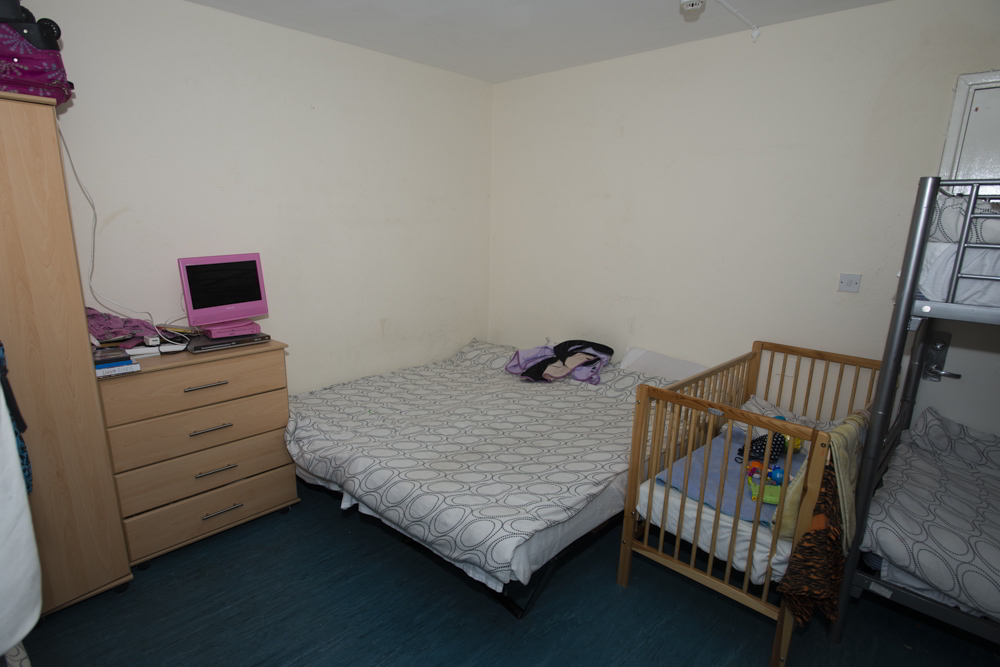
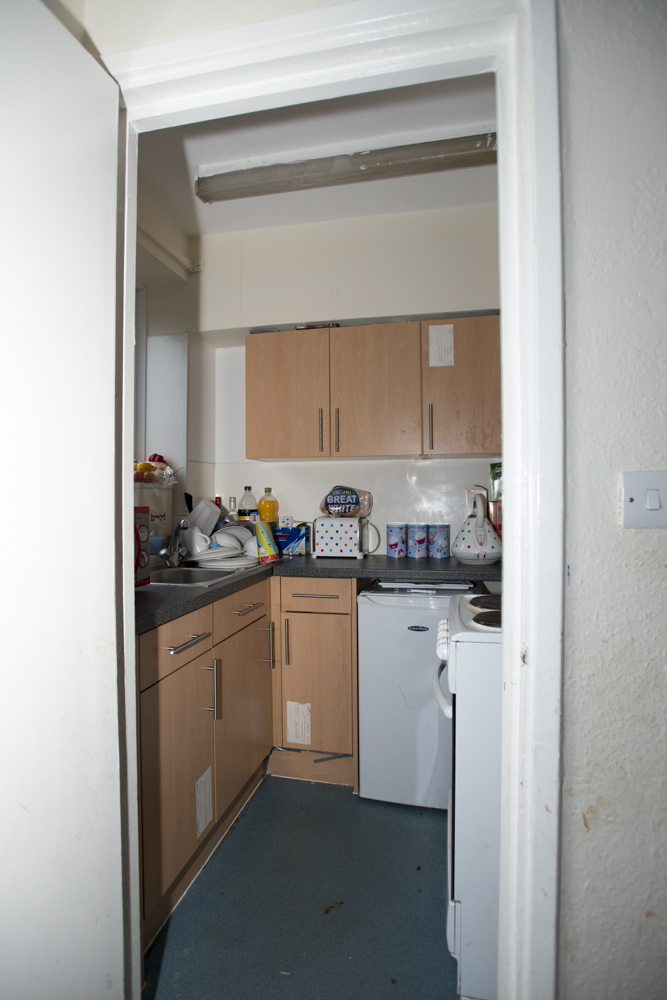
A couple of weeks ago, I went to see a woman who we’ll call Becky. She was in her early thirties. She and her six children (aged seven and under) were living in a one-bedroom flat in a temporary accommodation hostel in South East London. The whole family (the family included an 18-month-old baby) slept in that one bedroom. You can see the beds and bunks in the photos below. The kitchen was tiny. There was just enough space for two adults to fit into it if neither of them moved around very much. Cockroaches rattled across the floor. Becky had plugged holes in the walls with foam to stop the cockroaches from getting into the flat and into the baby’s cot:

Foam In Wall

Apparently, Becky’s local council had told her the family might have to stay in the one-bedroom hostel flat for months. Big houses for large families were in short supply. Becky had 11 children altogether, but the eldest ones had been removed from her care and adopted into other families (Becky said that the council adopted out her white children. The six children she still had living with her were mixed race). One of her older sons lived with her sister. So, Becky was living in this one-bedroom hostel flat with her six youngest children. Her school-aged kids had to sit on the bunk-beds to do their homework while the littler ones raced around the room. This overcrowding was yielding exactly the results that you’d expect. Becky showed me a health visitor’s letter which said that her kids were falling badly behind in their milestones, at least in part because of their living conditions. That in itself is reason enough to find and finance decent accommodation for this family. Every kid deserves a chance.

Beds and cot

Anyway. I’ve thought a lot about Becky and her kids in the couple of weeks since I saw them. Mainly, I’ve thought about the shit that hits the fan whenever somebody writes about mothers who ask for state support. We all know how this one goes in our punitive age (read a few of the comments under this story if you don’t). Why, people will ask, did Becky have these children if she couldn’t afford to look after them? Where are the fathers? Why should this woman and her children be found a decent home? Why should taxpayers pick up the tab?

And on it goes. For myself, I have to say that I find this sort of dismissal – this slamming of doors, particularly in children’s faces – harder to handle as time goes on. It solves nothing and helps nobody. You find in it one of our era’s most poisonous political ideas: that you can sort a situation out simply by insisting it should never have come to pass. As it happens, there are – as there usually are – many reasons for complex situations: ill health, mental health, domestic violence, manipulation and a host of other forces that are beyond my perception and grasp. I don’t need to know the details and neither do you. Knowing the details doesn’t change the facts. Either everyone is entitled to basics like housing, or nobody is. That is social security. All that matters is the need at the hour of need.

Kitchen

Hope Maximus is totally up for us filming and recording WCAs. I’m all set either way.

Update Monday 9 February: Not much of an update, sadly. Have heard fuck all from Maximus about this issue of recording and filming face-to-face assessments, or anything for that matter. I thought they were supposed to be customer focused and all that. ZZzzzzz.

Anyway:

Here’s a very good list of DPAC protest actions planned for March 2 against Maximus, the Atos duplicate that is due to take over work capability assessments with the help of persons who should know better. I have 2 March blocked out in the diary for protest attendance myself, so hope to see you there. (Update 9 February: more details of protest action and online action now here).

In the meantime, I have a couple of questions for Maximus re: its plans for the work capability assessment. Putting these out there while we continue to campaign to scrap WCAs altogether:

1) Will Maximus allow people to record their face-to-face assessments on their phones or any recording gear they have? Disabled people had to threaten the DWP with court action to get recordings on the table last time around and even then, the so-called system the DWP and Atos came up with was garbage. People either had to wait for Atos to produce a dual recorder and an assessor who agreed to be recorded, or they had to be able to produce equipment that made dual recordings themselves. Almost nobody has that sort of dual CD-recording gear in the cupboard at home, so that was all pretty shit.

2) Will Maximus allow people being assessed/journalists/friends to film their assessments? I had to film people’s assessments on the sly when Atos was in so-called charge and while I’ll certainly do that again, it’d be great to just be able to turn up anywhere with a camera in my hand, as well the little hidden one I sew into my jumper. Just throwing that out there.

I can’t see Maximus objecting to either of these concepts, given their claims that WCAs will forevermore be conducted in the spirit of decency and openness. I fully expect a positive email response from Maximus on both points, in which case we can all start tooling up with recording gear. That way, we can all see for ourselves whether or not Maximus is performing with “more touch, more communication,” whatever the hell that means. We can also decide whether performing with “more touch, more communication,” and the recent Maximus charm offensive matters a damn (spoiler: it doesn’t). I mean – being treated halfway decently in a face-to-face assessment is not the whole story if you’re thrown off your benefit and into poverty. That part of the equation will never add. We know this government’s agenda for disabled people.

Also – I fail to understand why these companies think they should get a pat on the head for deciding to treat people decently – or at least, deciding to go through the motions of treating people decently. People who have to go through WCAs should be treated decently as a matter of course. The fact that they were treated so badly by Atos should actually see IDS in jail.

Anyway – if you can find any references to Maximus assessments and filming and recordings, please send. Always good to get these things straight from the off.

See you on 2 March. I’ll be the middle-aged bird covered in recorders and cameras.

#ScrapWCA