“[MPs] don’t worry about money. They don’t worry about where the next electricity is coming from. You never see anyone like that knocking down at foodbank.” #UniversalCredit

Have posted below a longer transcript from recent interviews at Oldham foodbank with Michelle, 38, and Jeanette, 53 (I published excerpts earlier here and here).

Like so many interviews I post on this site, this transcript highlights two important points:

1) Political and press obsessions such as government, voting and Brexit barely register in many lives.

I asked both woman for their views on government and Brexit.

Michelle said:

“I ain’t got a clue me, I don’t understand it. I really don’t.”

Jeanette said:

“Neither me…You never see anyone like that knocking down at foodbank…They don’t worry about where the next electricity coming from.”

2) The benefit systems that people in poverty rely on are in tatters, but that fact is ignored. Nobody cares.

Politics refuses to intervene, or to offer constructive answers. Mainstream politics is fixated on Brexit and central politics to the exclusion of everything. Meanwhile, people in poverty are being dragged down by failing state bureaucracies. Online benefit application forms fail. Helplines are hopeless. Claimants go months without money, which makes debt inevitable. The idea is, of course, that anyone who has ever received a state benefit deserves the worst. Dependence on the state justifies aggression from the state.

Michelle had rent arrears, because the DWP took ten weeks to make her first Universal Credit payment. She was also repaying a tax credit debt that she disputed and an advance loan that she took out to buy food during that ten-week wait for her Universal Credit:

“Oh God – it were a nightmare signing on for Universal Credit. You have to do it online and I had to [keep] ringing the jobcentre. I had to keep ringing them, because it were so hard.”

Jeanette had had a stroke in 2009. She struggled with balance and speech. She’d recently applied for Personal Independence Payment application, but missed an award by five points. She’d decided not to appeal that decision, because the appeals process was too complex and wearing:

“Too stressful. I’ve got to think of my health. Just rely on family and friends to get me around.”

I’ve said it before and I’ll say it again: no part of this mess helps people find stability, or work. Quite the reverse. Any stability people had has been torpedoed. Prevailing government theory is that destabilising people by throwing them off benefits motivates them (whatever “motivates” means). It does not. These broken, maddening public sector bureaucracies mire people in debt. Unfortunately, that fact is below the radar.

Transcript: Oldham foodbank, 7 March 2018.

Michelle:

It hasn’t been this bad before. [They] moved me over [from Employment and Support Allowance to Universal Credit] in October last year. They made me do it, yeah.

They told me… I applied for ESA again, but they said because I was in the catchment area for Universal Credit, that I have to have that instead…but I went for [an ESA face-to-face] assessment on 25th of October [2017] and I’ve still heard nothing…nearly six months. [The assessment was at] Albert Bridge House, yeah.

I don’t sign on. I just have to go and see my advisor at the jobcentre every few weeks.

Oh God – it were a nightmare signing on for Universal Credit. You have to do it online and I had to [keep] ringing the jobcentre. I had to keep ringing them, because it were so hard.

[I] could do one bit of it, where they told you to do your details, but then it told you to do something else – a separate thing which is a new ID thing what they’ve set up. You’ve got to do that to prove your identity. You’ve got to choose which company to do it with.

I did mine with the Post Office. Got to set that account up and then go back to Universal Credit [with the registered identity details] Oh, it is horrible. Then, you’ve got to get an appointment to go up to the jobcentre to do the rest of it there…

You just do it [the identity proof] online while you’re filling your form out. It just takes you to another site and it tells you choose which one you want to use, so I clicked Post Office. Then you have to like create an account with them just to prove your identity, because they’ve got more information on you then – so that they know that it is you, because there are a lot of people trying to claim benefits under different names, so to try and stop that basically.

Had to give my passport, yeah, because it was online…

I had no money for about eight, ten weeks. They let me have an advance payments, but it were only for £200. I’ve got two kids and got behind on all me payments and everything. It were horrible…

Jeanette: It puts you behind with your rent.

Michelle: Yeah, I’ve been having to pay extra each month, because of my rent was in arrears and it wasn’t my fault. It was horrible. [I] rent with First Choice Homes…arrears, about two months, about £700 I think. I have to pay about £20 every month on top of the rent, because the rent’s £330.

They [the DWP] are deducting [money from my monthly Universal Credit payments] for advance loan – about £40 a month. They are taking [repayments for a] child tax credit [overpayment], because when I went onto Universal Credit, the child tax credit stopped, because it all goes in with that. Then after I had been on Universal Credit for a few months, [the DWP] decided to say that they had overpaid me [tax credits] and I owed £300. So now, they’re taking £49 a month off me for that as well.

[So that’s] £49 [taken out each month] for child tax credit debt, £40 for advance payment and £20 for arrears. Not much left at the end of the month once I’ve paid my bills and gone shopping. Only have a little bit left. If my girls need anything, I can’t…do it. Once that little bit of money has gone, I’ve got to wait another month again. The only other thing I get is child benefit, but that is £34 a week. That goes on the stuff like I need like the gas and electric. I can’t give it to my girls. Girls are [aged] 17 coming up and nearly 13.

[The DWP never contacted me to negotiate deduction amounts I could afford]. Oh, no, no, no. They just tell you. They don’t ask. They don’t discuss it with you. They just tell you.

Continue reading

Ten week Universal Credit start delay, rent arrears as a result, advance loan repayments, tax credit debt…How debt is built into Universal Credit

The excerpts below are from another interview I recorded last week at Oldham foodbank. I’ll post the full transcript when I’ve finished it.

The interview below was with an Oldham woman called Michelle, 38. Michelle had two daughters aged 13 and 17.

I post this to make the point again that Universal Credit is designed to start claimants off in debt and to keep them there. People are utterly powerless within that. They feel that they can’t fight or negotiate with the DWP.

Michelle applied for Universal Credit in October last year. She had to wait about ten weeks for her first payment (she’s also still waiting to hear the outcome of a Maximus medical assessment which she took at that time).

That long wait for Universal Credit had the usual devastating knock-on effects – the knock-on effects which push Universal Credit claimants into debt from the off.

First problem: while Michelle was waiting for a first UC payment, she went into rent arrears (she rents a place from First Choice Homes at £330 a month). She is now paying those arrears off at about £20 a month. That money comes out of her Universal Credit.

Second problem: because of the delay to the start of her Universal Credit, Michelle had to take out a Universal Credit advance loan to cover costs. She’s paying that back now at about £40 a month. She said she took out a second loan to cover costs as well.

Third problem: Michelle’s child tax credit claim was moved to Universal Credit and the DWP when she made her Universal Credit claim. Like a number of women I’ve interviewed now, Michelle was informed out of the blue that she had been overpaid child tax credits and would have to pay the money back. Without warning, the DWP started to deduct nearly £50 a month from her Universal Credit. There was no negotiation, or discussion with Michelle about these deductions, or about amounts she could realistically afford to pay while still supporting her two kids. The money was simply removed from Michelle’s Universal Credit.

I’ve heard that story time and time again. It’s obscene. These are people in financial hardship. They have children. They can’t make a case with anyone. They’re not even invited to make a case. Nobody wants to hear from them.

I’m making a simple point here, but I’ll make it again and again.

With its delays, loan culture (people in hardship must apply for advance loans while waiting for their first UC payments and then pay that money back) and these random, unexpected deductions for debts from people’s benefit accounts, Universal Credit is designed to ensure that people who have no money start their benefit claims in debt to the state and under real pressure. They are forced to take out advance loans, because their first payments are delayed for months. They are forced into rent arrears while they wait for their first Universal Credit housing costs payments. Money is deducted from their Universal Credit accounts without warning or discussion.

People’s powerlessness in this is disgusting, as I say. They have no choice but to follow the DWP’s line. Organisations such as the DWP have total authority in these scenarios. There is something very disturbing about this. We should all find it disturbing – a government department’s magisterial dismissing of and disinterest in those people who most rely on it.

I asked Michelle if she’d talked to the DWP about reducing some of the repayment amounts, or if anyone had talked to her about manageable amounts before actually taking the money from her.

She said:

“Oh, no, no, no. They just tell you. They don’t ask. They don’t discuss it with you. They just tell you,”

and:

“Just don’t think it’d make a difference really [ringing the DWP to negotiate repayments]. It would just make me worry more…And I suffer from stress and anxiety and panic attacks so…it’s just hard,”

and:

“I just can’t get used to it. It’s just so hard. They should tell you they’re going to do it [deduct money for debt repayments] but they didn’t… because a week before you get paid, you can go onto your [Universal Credit] journal and it tells you how much you’re getting that month. I went on that month and it just told me they were taking it out.”

I wonder why we allow this bullying. The world is run by sociopaths. This isn’t about deciding whether people are deserving or not deserving of support, or whatever the hell it is that policy thinks it is doing. It’s about the state declaring open season on people who claim benefits. They’re the acceptable targets. The normal rules of courtesy or even basic civil human interaction don’t apply.

When the stress of applying for disability benefits is dangerous to disabled people’s health…

Food for thought, as it were:

I went to Oldham foodbank last week.

One of the people I talked with there was Jeanette, 53.

Jeanette said she’d had a stroke in 2009. She used to receive Disability Living Allowance, but like most DLA recipients, was recently told by the DWP that her DLA payments would end and that she needed to apply for the Personal Independence Payment.

She applied for PIP and went for the medical assessment for PIP. She failed her assessment by just a few points. Her PIP application was declined.

I asked if she had appealed this decision – if she had asked for a mandatory reconsideration of the decision not to award her PIP and/or if she had gone on to file a full appeal.

“No,” Jeanette said. “It’s too stressful.” Specifically, Jeanette was worried that the stress of filling in appeal forms and sourcing more medical information would lead to another stroke. “I’ve got to think of my health,” she said. “I just rely on family and friends to get me around…since my stroke, I’ve found it bloody hard to walk… up and down my right side it’s affected the right side of me and the speech, that goes, doesn’t it?”

This is a common story, as many people will know. I can’t tell you how many sick or disabled people I’ve talked to over the past few years who decided not to apply for disability or support benefits, or to appeal negative decisions that they might successfully have overturned, because they were too unwell to cope with our dysfunctional, ridiculously bureaucratic and stressful benefit application and appeals processes.

In other words – people are too unwell to pursue the support that we are supposed to have in place for people who are unwell. Anyone with experience in this area knows this, of course. People know that government separates people from their benefit entitlements by presenting them with a series of soul-destroying bureaucratic hurdles.

Sure, people can try and find welfare advice and support, but often, that’s just another challenge that people could do without. So they do without.

Let me tell you how useless councils are at answering questions about homelessness, intentional homelessness and threats to separate families. I give you Barking and Dagenham…

I post this article as an example of torture by council.

I want to show those who don’t generally have the pleasure how evasive and uhelpful councils are when approached for information on topics such as homelessness and intentional homelessness. They drag non-answers and the silent treatment out FOREVER.

It’s a miracle I haven’t kicked in a town hall door yet.

With that in mind, let’s go to Barking and Dagenham:

As readers of this site will know, I’ve written recently about a woman who was evicted from her Barking and Dagenham flat last year. She had rent arrears of several thousand pounds.

She has three children under 12.

The woman says her housing benefit stopped and rent arrears grew, because she had trouble registering a JSA application.

She, the council and I have spent ages arguing about whose “fault” this was. Fact is it hardly matters. Pretty much EVERYONE I talk to these days is in serious rent arrears. That’s the part that matters – the fact that so many people have housing, rent and eviction problems. I’ve got an inbox full of emails from people who can’t afford housing, or who’ve crashed into debt and conflict when rent problems have arisen. I inevitably find that a council’s primary concern is to make sure that it is not blamed for such problems. A council’s main aim is to rush to prove that the fault is entirely the tenant’s. I’m sick of this. Why even bother to sift through a small corner of the wreckage at this point in the national housing disaster? Council fingerpointing doesn’t solve the core issues (I get to these core issues as i see them later in this post).

By the time the woman in the story and I talked in January, the family had serious problems.

The woman and her kids were homeless. They were sofa-surfing between her mother’s flat (which itself was temporary accommodation) and a friend’s place. Eight people were living in the mother’s temporary accommodation when I visited in February. The eight people shared one toilet and one bathroom. Two of the kids slept on airbeds in their grandmother’s room. The third child slept on a rollout mattress on the floor in another room with two adults. The kids commuted to Barking and Dagenham to school. I need hardly mention the effect that these arrangements will ultimately have on the kids’ schooling and life chances, etc.

There was more.

In a letter to Barking MP Margaret Hodge, the council said it would likely decide that this woman had made herself intentionally homeless.

The council also said that if it found the woman intentionally homeless, it wouldn’t house her. It would, however, refer the kids to Children’s Services (you can see that paragraph here). The woman took this to mean that Children’s Services might separate her from her children. Everyone who reads such sentences thinks that. Needless to say, this sort of text makes people even more reluctant to contact a council to discuss housing problems. A threat of referral to Children’s Services works as a form of gatekeeping. It is disgusting. I see it time and time again these days. Councils insist they’ve tried to contact people to help sort problems out. They also send letters which guarantee people will do anything BUT get in touch.

Which brings me to the core reasons for rent arrears which I mentioned above.

I find there are two main reasons why so many people end up with serious rent arrears. Both need addressing on a national scale.

The first is very simple. People don’t have enough money. They can’t afford rent, LHA shortfalls and/or rent arrears. They don’t have £2000 (or £200 for that matter) to throw at problems such as stopped, delayed, or sanctioned benefits, or to bridge gaps while benefit problems are fixed. They’re already in debt to the public sector for council tax arrears, court fines and DWP loans. God knows I’ve written about that. Let’s not forget either that benefit problems can take MONTHS to fix, because DWP and council bureaucracies are so often outrageously dysfunctional. Arrears grow and grow as problems drift. Continue reading

Getting inside Universal Credit: callout to #UniversalCredit claimants in the Northwest and Northamptonshire

To Universal Credit claimants in the Northwest and Northamptonshire:

As part of ongoing news stories we’ve done and campaigning on Universal Credit problems, journalists Natalie Bloomer, Charlotte Hughes and I want to attend Universal Credit meetings at jobcentres and to speak to more Universal Credit claimants about their experiences claiming UC.

We want to stay in contact with people who claim the benefit, to record people’s experiences in navigating the system and how/if problems are handled by the DWP.

We also want to accompany UC claimants to jobcentre and claimant commitment meetings if possible, to record those meetings and report back on people’s experiences.

Between us at the moment, we can attend meetings in the Northwest and Northamptonshire, and meet with people in those areas. As things continue, we may be able to travel further afield.

If you live in those areas, claim UC and are interested in talking with us, you can contact us by using the contact details or form on this page.

Waiting 3 months and more for #UniversalCredit for rent: “I was ringing the DWP in tears saying: ‘I’m really scared I’m going to lose the house’.”

Article by me on politics.co.uk today about a disabled woman’s three month+ wait for Universal Credit:

“Karen Sheader, a Hartlepool film company director, has the bone condition osteopetrosis. Her bones fracture and can take months to heal. In 2017, bones in her legs broke. She was forced to take sick leave. She made a claim for Universal Credit.

What followed was a tortuous three month wait for Universal Credit payment.

“It got to 14 weeks and I was constantly on the phone to them. I kept being told, ‘somebody will update your [Universal Credit] journal by 6pm tonight’. They didn’t… and I was getting conflicting advice from people. It has such an effect on the way you feel. You’re stuck in the house with two broken legs and nobody seems to give a fuck.”

Read the whole article here.

Does anybody actually work at the HMRC or the DWP anymore, or are we now just down to a couple of (useless) answering machines?

Posting this because I am very badly pissed off, even for a Monday:

For nearly two weeks, I’ve been trying to get answers from the HMRC and/or the DWP for a story I’m writing about a disabled woman who had to wait THREE MONTHS for her Universal Credit claim to start.

She was receiving statutory sick pay each month, because she had to take indefinite leave from work.

As I understand it, the HMRC was supposed to tell the DWP how much statutory sick pay she received each month, so that the DWP could adjust her Universal Credit claim accordingly and pay her some money (she particularly needed the Universal Credit to meet her rent). i think this might have to do with the famous HMRC-DWP Real Time system. Who can really say. God knows how any of this is meant to work. Probably it isn’t. It’s all a total pile.

Needless to say, neither the HMRC nor the DWP managed to do what they were supposed to in this woman’s case. They were even more useless in this instance than they are on the rest of Universal Credit, which is an amazing achievement.

The HMRC couldn’t get the sick pay totals right and the DWP refused to make any adjustments, so this woman’s benefit claim went nowhere for months. I’ll be publishing a longer story about this soon.

Point today is that someone needs to answer questions about the wreckage that is Universal Credit and the relationship between the DWP and the HMRC. Problem is that nobody will.

I’m getting very sick of this. I’ve had it with being ignored by government departments.

I rang and wrote to the HMRC and the DWP asking both departments how Universal Credit and Real Time adjustments are supposed to work, if statutory sick pay was included – and these adjustments don’t work.

All I’ve had back is several emails from some faceless HRMC bureaucrat/actual robot who keeps writing this exact sentence:

“Thanks Kate, I will see what I can do.”

I know what he can do. He does fuck all. He certainly doesn’t answer my questions.

Maybe somebody out there can. If anybody knows anything about claiming statutory sick pay and claiming Universal Credit, and the “system” that the HMRC is supposed to use to inform the DWP about the amount of statutory sick pay a Universal Credit claimant receives, give me a shout.

Putting disabled people in flats with totally inaccessible upstairs toilets, giving pregnant women airbeds because there’s no furniture: more from the housing frontline

This is the fourth article in my series with a frontline council homelessness and housing officer who has worked in housing offices across London and Greater London for 15 years.

There’s a full transcript from this interview at the end of this post.

In this article, the officer explains how basic human dignity and any notion of safety or comfort have gone by the wayside for homeless people in austerity.

The erosion of these basics speaks volumes about society’s real opinions of people in homelessness and hardship. We do better by our dogs.

The officer says that at one council recently, pregnant and sick and disabled homeless people (one person just had major renal surgery) were given cheap airbeds (which didn’t always inflate) to sleep on in temporary accommodation, because there were no proper beds.

There was nothing in the way of furniture at all in these places. Giving homeless people an airbed to take to the accommodation had just become par for the course. Cheap airbeds which often broke were considered good enough, even for people who had trouble moving around and standing up:

“Some woman who was like seven months’ pregnant. You know – she was enormous, because she had this huge big baby in her belly. She was given an airbed to pump up… There was some old guy who’d had an operation. I can’t remember what the operation was – I think it was a kidney operation…? or something like that. He’s given this airbed to pump up.”

The officer also talks about a disabled person being placed in temporary accommodation in a split-level flat in London where the toilet was upstairs and couldn’t be reached by that person. The disabled person had to use a commode downstairs in the main room before a complaint was made and alternative housing found:

“The bathroom’s upstairs and they [the tenant] are like, “well, how am I supposed to use that? I’m in a wheelchair…. [I suppose] they’re [the council is] like, “well, you know, get a commode… shit in a carrier bag…”

So it goes these days, the officer says. Councils place homeless people in any accommodation that serves the two basic purposes of housing people in immediate need and getting them out of the office fast:

“It is just the fact every council is scraping the bottom of barrel a lot of the time for TA [temporary accommodation]. I think a lot of the time, they [councils] just put people in shit and just hope they don’t complain. If they do complain – okay, we’ll do something about it…but we will wait until they do that [complain].”

The officer says the airbeds situation came about because the council rented blocks of empty flats from landlords who bought flats to let out for as much money as they could get – but spent nothing on making the flats habitable.

The officer says that in the past, when there was more money around, councils would put in place programmes to make sure temporary accommodation was furnished:

“The council might say, “give us a ten-year lease on these and we will put some furniture in them, or something,”

but in austerity:

“Now, it’s just money-saving – like, “fuck it – we’ll just take it as it is and give somebody an airbed…These were really cheap airbeds, so you would get people coming back the next day saying, “this airbed didn’t even…it’s got a puncture, or the pump don’t work.” So, they spent last night sleeping on some half-inflated airbed.”

Continue reading

Intentionally homeless with kids? Council will house the kids but not you – ie, you’ll be separated from them. The hell with this.

This does my head in. It should do yours in as well.

I spent an hour this morning interviewing a young woman who has three kids under the age of 12.

She was evicted from her flat at the end of last year for rent arrears. I have a letter from her council to her MP which says the council is likely to find her intentionally homeless, because of those arrears.

The young woman believes that the council has found her intentionally homeless. She has no fixed address, so she isn’t sure where any post advising her of her situation is going, or if it is being posted at all.

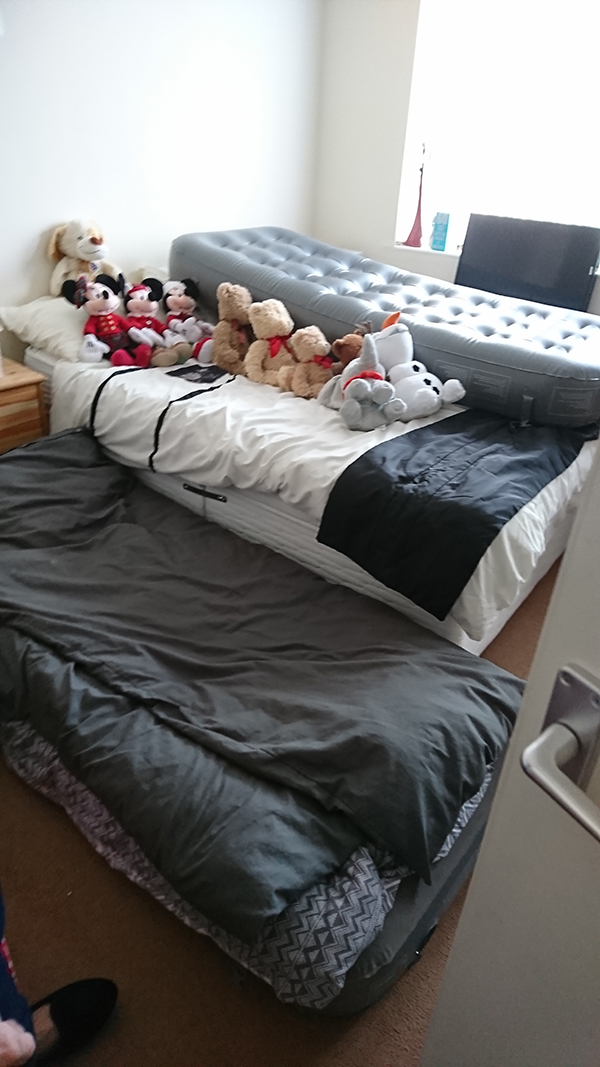
She’s sofa-surfing with her three kids at the moment – sometimes at a friend’s place and sometimes at her mother’s place. Her mother is in temporary accommodation herself and has eight family members in the flat with her. Two of the school-aged kids are sleeping on airbeds with their grandmother in the grandmother’s room. The older child sleeps on the floor in a room with two others.

At the end of that letter is this sentence:

“If [name removed] is found intentionally homeless, then the Housing Options team will not assist her into alternative housing and will only give her advice and support to find her own accommodation. A referral will, however, be made to Children’s Services in respect of the welfare of the children”:

In other words, people who are found intentionally homeless risk having their children removed, or, at least, having their children housed away from them. What a threat that is – and to so many people. So many people are evicted for rent arrears these days. So many women tell me that they are terrified that the council will remove their kids if they can’t find decent – or any – housing for them. Getting evicted and finding yourself without a roof is bad enough. Now, homeless people believe they risk losing their kids if they return to to their council to challenge an intentional homelessness decision, or if they approach a council for further housing help.

This shit has to stop. Councils cannot be permitted to threaten women with the loss of their children, just because those women are poor.

This situation is untenable. Let’s have some #metoo outrage about it. Imagine the headlines and fury if some council tried that that sort of threat on with a middle class family, or – gasp – a celeb.

“We’ll come after your kids.” I think not.

Image: the two airbeds on either side of the grandmother’s bed:

A rise in the number of rough sleepers? Bet those shocking numbers don’t show the half of it. Look at these two guys.

The Guardian has a story this morning about the shocking rise in the number of people who are sleeping rough.

The government should be smashed for that rise alone. Slashing social security to the point where more and more people sleep outside in this climate is a crime against humanity in anyone’s book. Winter is freezing cold, especially here in the north west. Forcing people to sleep outside during it is murderous. Simple as that.

Point I wanted to make is that there are people who may not appear in these counts, because they have options some nights – if you can call them options – which means they have a bed or couch for that night. Their existences ain’t exactly great. They’re still street homeless. They still have appalling experiences. They are still out a lot in the freezing cold and can be out any minute in the freezing cold. Someone needs to take Theresa May to meet and count these people, and to rub her nose in a few realities.

I’m thinking of two guys in particular – James, 50 and Roy, 64 – who I’ve interviewed in Oldham. They’re both street homeless – but they’re not always on the street.

James, who I often meet with, regularly stays with his friend Vance, who was street homeless for years, but was finally found a council flat about two years ago. This arrangement works well sometimes and badly at others. Late last year, James had the shit kicked out of him – apparently by another guy who was staying at the flat. A roof often comes with considerable compromise.

It certainly did for Roy, 64, who I spoke with at length at Oldham foodbank recently. Roy was street homeless (at aged 64, if you don’t mind – a crime in itself), but sometimes stayed with a “friend” in Chadderton who charged Roy money out of his benefits to stay on the couch. He attended the foodbank that day in the hope that someone could help him find somewhere better to stay.

You see the point. When you spend a lot of time talking with people who are in and out of street homelessness, you talk with many people who are street homeless, but who are sometimes able make other arrangements that remove them from view. Doesn’t mean they’re having a brilliant time of it. I don’t know how many of these people do or don’t appear in rough sleeper counts – the Guardian article makes clear that criteria for counting rough sleepers is strict and only takes in people who are outside. Whatever. My point is that government needs to be strung up for creating this hidden rough sleeper nightmare as well. Like I say – people don’t know the half of it.