DWP: “Closing jobcentres will improve the service.” People who use jobcentres: “No it won’t”

Another interview from people who use jobcentres:

I recently went back to Clay Cross, where the DWP plans to close the local jobcentre.

People who use and work in the jobcentre are furious about the closure plans.

On the day I attended just before Easter, Derbyshire Unemployed Workers’ Centre people were collecting signatures for a petition to keep the jobcentre open. It was one of the easier petition exercises I’ve been involved in over the years. Everyone signed. Even the jobcentre’s G4s security guard was happy to see people out the front collecting signatures.

“Oh, good,” he said when the petition was revealed.

The reason for this unity was obvious. People are angry about service closures in the area. The jobcentre is not the only local target at the moment. The Clay Cross Lloyds bank branch is due to shut. People also said that they worry generally about the local library staying open in the long term and/or about library hours being cut, because local councils are under such pressure. I got the impression that a lot of things feel tenuous.

Not that the architects of such closures give a damn about that, of course. Those people don’t even make sense a lot of the time.

“We’ve been clear that this is about improving the services we deliver, while making best use of taxpayers’ money,” the DWP told me when I asked last month about the impending closure of Clay Cross jobcentre.

Closing a service improves it, eh? I love this sort of line from officials who are trying to justify service closures. I really do. It makes absolutely no sense whatsoever. I would argue that it’s not actually possible to improve a much-needed service by closing it – certainly, locals never think it is – but government is always keen to argue that such a concept is perfectly logical everywhere. I’ve been interviewing people about service cutbacks for over a decade and I’ve never once heard anyone who uses jobcentres/libraries/banks/hospitals/whatever say “Yay – our local jobcentre/library/bank/hospital is closing. That’s a step forward for the town. That’ll make life easier.” Closures don’t make life easier for people who actually use the services. No doubt that’s the point.

Certainly, locals think that’s the point.

Take Mark, 46, at Clay Cross. I spoke to Mark outside the Clay Cross jobcentre for about half an hour (there’s a transcript from this conversation below).

Mark signs on for JSA at Clay Cross. He said that he would have to travel the half-hour by bus to Chesterfield to sign on if Clay Cross jobcentre closed (the return trip costs £4.20 and Mark did not think he’d be reimbursed for every trip. The DWP says that people won’t be reimbursed for signon trips: “claimants will only have to pay fares when they sign on – on other occasions if they are called into the jobcentre, fares will be reimbursed,” the department told me. I’m not sure how people who must sign on daily and so on will handle this. I suppose people who make a trip to a jobcentre to ask a question or get a form, etc, particularly when they can’t get through to the DWP on the phone, will have to fund their journeys themselves. There can be no doubt that people with support needs will find themselves on the rough end here. It’s definitely my experience that people with support needs who struggle with the DWP’s complex phone and form systems prefer to drop in to local jobcentres to try and get face-to-face help. Continue reading


“Rich get richer and poor get poorer… The greed is becoming demented greed.” More views from people on benefits

More views on politics and benefits outside the bubble:

Each Tuesday from 11am, a group called The Ark puts on a few hours of free sandwiches, coffee, cake and bible readings at the Salt Cellar resource building in Oldham. There’s a pool table in the room which is popular as well. People from all walks attend. Some are in and out of street homelessness. Some have alcohol and drug addictions. Some have mental health problems. All worry about money.

A sign at the salt cellar

Image: A sign at the Salt Cellar

Many people at the sessions are affected by welfare reform. They have problems with housing, benefits and paperwork. I attend the Tuesday sessions every few weeks to record interviews on these and other issues. We talk about all kinds of topics: politics, Brexit, Theresa May, Jeremy Corbyn, benefits, service cuts, housing, street homelessness, addiction, jail, family, aspirations – the works.

The transcript in the second part of this post is from a February interview with James, 50 and Paul, 47. I’ve spoken with James and Paul at length before.

For this post, I wanted to ask the guys for their views of people who must live exclusively on benefits – people such as themselves. Everyone else in the world has very strong, and often very negative, views of people who receive benefits. I like to ask people on the rough end what they think.

This can be hard. Not everyone wants to talk politics. Westminster is a world away much of the time.

When I arrived at the Salt Cellar, James and his friend Vance, 43, were out the front of the building, pushing bottles and belongings into their rucksacks.

Vance, James and I have known each other for about six months (you can read more about their stories here). They often ring me very late at night for a chat.

We all laughed as they put their bottles in their backpacks.

“It’s my Lucozade,” James grinned.

We sometimes meet outside the building. People who drink must drink their alcohol outside and behave when they go in. They don’t always. They get chucked out of lunchrooms if they’re pissed and/or aggressive, or when they bring in booze in backpacks. Different lunchrooms have different views on enforcement.

I’m for turning a blind eye to the boozing. I understand that people who run lunchrooms need to keep order – people bring babies and little kids to these places and you can’t have people smacked out on spice or booze or whatever – but there are dimensions that are hard to ignore. Sickness is one. Vance is definitely getting sicker. He’s lost so much weight in the past six months that I don’t like to ask him how he’s going any more. It’s obvious how Vance is going. His health sits in the mind. He’s skeletal. He looks pinched and pained around the eyes.

There was something else going on around Vance’s eyes that Tuesday, too. He had deep, bloody scratches under both of them.

“Jesus,” I said, pointing at Vance’s face. “What happened?”

Vance laughed. “Fuckers threw a cat at me,” he said. “If I find that cat, I’m going to fucking eat it.”

“He coulda lost his eyes,” James said. “That cat is really scared of the owner.”

“Bet it is,” I said.

Vance and James have neighbour problems. They live in a central Oldham flat. Vance was placed there by the local homelessness office in 2016 after years on the streets. James has lived at Vance’s for several months. Before he moved into Vance’s place, James was street homeless. Vance found James trying to sleep on the concrete landing outside of Vance’s flat, so Vance invited James in to stay. Says Vance: “He [James] was sleeping outside on the landing. I can’t see that, because I’ve been homeless meself…It is very cold and wet. You can’t sleep.”

There are dealers, users and all sorts in the neighbourhood. Smooth sailing is rare. A few months ago, a bunch of guys beat James up and threw him out of the flat (you can read about that here). I don’t know how the cat incident came about. I do remember that a couple of weeks after it, James turned up to lunch with a black eye.

“Relationship breakdown,” people usually say when I ask how people end up street homeless.

Pool table at the Salt Cellar

Image: Pool table at the Salt Cellar

Continue reading

“Towards Work” activities to get a DHP and stayed housed. How big is conditionality going to get?

Throwing this one out there for your inspection:

Recently, I came across strict, new-ish Derby City Council conditionality rules for people who apply for Discretionary Housing Payments, Council Tax hardship payments and Local Assistance help.

Those rules are here.

For those who don’t know the territory: Discretionary Housing Payments are short-term payments to help people cover housing-cost problems such as rent shortfalls. Local Assistance Schemes buy items like furniture and fridges when people can’t afford them. Council tax hardship payments are, obviously, for people who struggle to meet council tax bills after council tax support.

Since November 2016 in Derby, this help has come with hefty conditions for some applicants. Of course – it is not unusual for councils to ask people to engage in an activity such as debt advice in exchange for a DHP, etc. That’s happened for ages. The Derby list sets out more hoops to jump through. That’s why I’m posting it. I found it while I was searching for help generally for a single mum. Other councils may have similar. No doubt more and more will as time goes on and more funding is cut.

You’ll see from this page that people who apply for DHPs, Council Tax help and Local Welfare Assistance and fall into certain categories: “must be willing to take up and remain engaged with appropriate support recommended by the council.”

This “support” may include:

– money advice
– budgeting support
– access to banking products
– access to digital skills support
– access to job clubs
– training and housing advice

Failure to participate could mean you get and/or keep nothing:

“If you do not engage with your support programme, any award that you receive from the Single Discretionary Award Scheme may be at risk.”

“Towards work” requirements are among the conditions as you can see.

So.

You may think this is all perfectly fair.

I do not.

This is the kind of list which gets on my nerves very badly. It smacks to me of gatekeeping and of the state’s ever-tightening grip on people who are in extreme financial hardship. Conditions for receiving benefits and hardship help become more and more invasive and exacting, as anyone who signs on for JSA or Universal Credit will tell you. Anyone who requests state help these days automatically loses all right to autonomy. Continue reading

DWP: We can’t attend a public meeting on a jobcentre closure because the meeting is public. BOLLOCKS.

A total classic from the DWP:

Last night, I attended a public meeting in Clay Cross about the DWP’s plans to close the Clay Cross jobcentre.

On arrival, the Derbyshire Unemployed Workers’ Centres people said that the DWP’s Midland Shires district manager had pulled out of an invitation to attend the meeting.

I was intrigued to hear this. Everyone was.

The DWP’s explanation for this non-attendance seemed to be that the meeting had been tweeted as public and public attendance at the meeting had actually been encouraged. Public = Bad. In an email to the DUWC organisers, the DWP said that they couldn’t come, because the district manager’s attendance at a public meeting would “break the consultation conventions.”

You may be wondering what the hell that means. Here’s a bit more detail (I trust I have this straight in my head):

The DWP’s jobcentre closure plans had been open to a public consultation earlier this year. That consultation is apparently now closed. The DWP doesn’t attend public meetings after a consultation is closed, because that is Wrong. Or breaks “consultation conventions.” Or is Against Protocol. Or something. I did try to find out this morning – an investigation that didn’t go too well. After an arsey conversation with the DWP (see below), the DWP emailed me to say that the district manager in question had originally agreed to attend the meeting because the DWP thought the meeting was private. The DWP pulled out when they found out it wasn’t. I can’t say that admission actually helps the DWP’s case if we are talking about transparency, openness and readiness to meet with service users, which we are. They think it does for some reason.

What I can say is that people at the meeting weren’t impressed. It sounded very much like the DWP didn’t want to attend a meeting that might a) include actual pissed-off service users who were angry about their jobcentre being closed and b) end up as a matter of public record.

What? said people when the DWP’s non-attendance was announced.

“Unfortunately,” DWP Midland Shires said in its email on the topic to DUWC, “due to the fact that the meeting on 16 March has been “tweeted” (sic) as a public meeting and attendance encouraged, to that end we have been advised by our policy team that it’s not appropriate for him [the district manager] to attend as this would break the consultation conventions.”

I am not afraid to reveal that this kind of shit really hurts my head. The DWP couldn’t come to a public meeting because that public meeting was public. The fact that the public had been encouraged to attend this public meeting might make the meeting even more public. This last being the case, the DWP needed to keep further away. Consultation conventions (whatever they are – the DWP didn’t quite touch on these in its response to me) aside, the district manager could, surely, have attended as a show of goodwill at the very least. Or as a show of responsibility, even. The closure proposal has the district manager’s name on it. At the very least, someone from that office could stand up and answer to it. In public, etc. But no. The public meeting was too public.

Do go on, I thought.

The email did.

Continue reading

Homeless and placed in a neighbourhood where people think you’re a nark

More life and political views from people who must rely on benefits:

Posted below is a transcript of a recorded interview made recently with Michael (named changed on request). Michael is in his mid-50s. We made this recording at a foodbank and kitchen lunch in the Manchester area in February (Michael asked for his details to be kept anonymous).

Most weeks, I spend several hours at foodbanks and kitchen lunches recording interviews with people who rely exclusively on benefits. In the mainstream press and politics, we hear a lot about Just About Managing Families and the Squeezed Middle, and other groups that have some political clout. We hear less from people who are marginalised and considered irrelevant. That’s a pity, because people who are considered irrelevant have a lot of relevant experiences, particularly when it comes to dealing first-hand with fallout from welfare reform. We talk about everything at our meetings: homelessness, housing, money, work, politics, Brexit, drug and alcohol addiction, mental health, family and the DWP.

Michael talked about most of those things.

He was particularly concerned about his living arrangements.

Michael had recently been street homeless. He’d even stayed on the floor of his local church for a time. A few months ago, he was placed in a flat on an estate by his local homelessness office. He liked the flat, but wanted to move. He wanted to get away from another drinker on the estate. He said that his neighbours bullied him, because they thought he was a nark.

Michael said people thought this because he spent a lot of time in the company of a copper. (I wasn’t sure if Michael meant a copper, or a community support officer, or another sort of volunteer. People deal with countless agencies and support workers. Wires get crossed). There may have been other problems, but Michael didn’t volunteer them. He said the policeman worked with a local community partnership. This support worker sometimes took Michael to benefits assessments and GP appointments. He helped Michael fill in benefit application forms.

Michael received Employment and Support Allowance. He’d had a serious heart attack a couple of years ago. Michael said that money was tight. He couldn’t afford to run the heating at his flat for more than half-an-hour a day. He wore many layers of clothing on the day that we met: a shirt, several sweatshirts and his coat. The clothes were dirty. He said he wore the clothes to bed for the warmth.

Michael was informed and eloquent. He read the papers. He said he had a degree and had worked in different parts of the world in well-paid professions. He’d lived in Asia for years and knew a great deal about different countries there. He’d also had a serious drink problem for years. In recent times, the booze had caught up with him, as it does when people reach 40 or 50. The pancreas goes, the liver goes, the heart goes, the balance goes and the mental health goes. The money’s gone. People talk a lot about things they did and things they say they did. Michael was still drinking. He looked unwell. His face was pale and pouchy, and his hands trembled. He held them out to show me. He looked sick with hangover and he probably was. It was good to know that he was at least housed and had some money coming in. Alcohol is such a wrecker. There’s nothing much left at the end.

We talked about the booze, Michael’s heart attack and his homelessness, government, Brexit (“the most unfortunate thing is that David Cameron ended… George Osborne…they were rebuilding the economy, doing a fantastic job,”) and his fears for his safety in the neighbourhood he’d been placed in. Being pegged as a nark weighed heavily on Michael’s mind.

This is the story that Michael told. This is the sort of conversation I have with someone every week or so. Michael began by talking about the way his relationship with the copper had come about:

“When I went to hospital [for a recent appointment, because of Michael’s health problems after his heart attack] – they’ve got a new community support team there. You’ve got the housing company, the health people, [the] council and the police. They all work together in a team in this unit.

A policeman is my designated support worker. He’s plainclothes CID, quite senior, but he’s a really nice bloke and we’re good friends now. He is my personal support worker. [He] give me lifts in his car – makes sure I get to the hospital and dentist’s, and things like that… [he] helps me with all my paperwork. Without him, I’d be absolutely lost.

The trouble with it is because I’ve only been there [living in the flat he was placed in by the local housing office] for six months, I’m seen as a relative newcomer… The people who have lived as residents for many years there really dislike the police, so they see me as some sort of police informant. They don’t get it that when he’s [the policeman] is working at that hub, he’s not being a policeman. He’s not being a copper on duty. He’s actually working as part of the community team.

What they’re trying to do [with that team] is instead of the people going to the authorities, the authorities go to the local villages to support the people with all kinds of issues – health, financial, gas, heating, hate crime. They’re there to support…not to go around arresting people, or hindering people. But the local residents just don’t get that this guy is supporting me…

People have made lots and lots of threats. [I’ve] been hit a couple of times… I live there on my own. I’ve got no backup at all. My mother and father are dead. The only friends I’ve got are in London… plus, I’ve got a degree, so they see me as some sort of pseudo-intellectual… foreign… outside that’s come in working in conjunction with the police and knocking at their world. Which I’m not.

Continue reading

More recordings: intentionally homeless if you’re evicted for benefit cap rent arrears…?

More food for thought from conversations about the benefit cap at the actual coal face:

I’ve posted below a recording in which a Basildon council officer says that people who are evicted because of benefit cap rent arrears could be found to have made themselves intentionally homeless.

Which was not the best news. Council help for you is very much reduced if you’re judged responsible for your homelessness. You’re more or less on your own with your homelessness problems if that happens as I’ve seen it. You would have thought that people evicted on account of rent arrears caused by the benefit cap should and would be cut slack in this area – particularly if they were placed in housing that they could afford before the benefit cap was lowered – but maybe not.

Certainly, officers make interesting remarks on the ground. It’s all important to note:

The recording below was made at a February meeting with a woman who has serious rent arrears because of the recently-lowered benefit cap. The woman and her three young children were placed in a Basildon flat by Newham council. Basildon council handles the family’s housing benefit claim. This woman’s housing benefit was cut by about £100 a week when the cap was lowered at the end of last year. A small discretionary housing payment covers part of her rent shortfall until the end of March. We went to Basildon council to ask what else she could do.

The officer said the woman should go back to Newham council to ask if Newham thought her flat was still affordable now that her housing benefit had been cut.

The officer then said intentional homelessness was on the cards if this woman was evicted because of benefit cap arrears:

(This audio has been altered to disguise voices. Am not particularly in pursuit of individual officers here. It’s the message that’s the issue).

“If you become homeless, it could be that you’d be seen as intentionally homeless anyway, because you… if you’ve been evicted for rent arrears, then it is through non-payment of rent that you’ve lost your property.

That got my attention, all right. In the recording, you hear me ask:

“Would that mean no one would have a duty to house her? Is that the case, even when [the rent arrears have been caused by] something like that [benefit] cap that’s come in subsequently….?”

“This is why you need to see Newham council about the affordability, because if they say it is affordable, then you’re going to have to struggle by and get it paid…” the officer said. “If they don’t think it’s affordable, then because they have a duty, they have a duty to assist you to find something cheaper, or…”

Or what? I thought.

I contacted Newham council to ask whether or not the council was likely to decide that people had made themselves homeless intentionally if they were evicted because of rent arrears caused by the benefit cap. Unfortunately, the council did not respond. Think I must still be on their blacklist (we apparently fell out over my Focus E15 stories. Do they hold a grudge or what). If anyone else can get an answer out of them, by all means let me know. It would be good to have that peg in the ground for future reference.

Anyway. Official positions don’t always matter when you get down to it. This is the sort of thing you hear on the ground. Putting it all out there.

Many thanks to @nearlylegal for help with benefit cap questions over the past while.

The very personal information you must give in public if you need state help

A short post on the state and petty humiliations:

Posted below is a list of questions taken from a recorded conversation between a woman affected by the recently-lowered benefit cap and a Basildon council housing options officer last week.

This woman is already in significant rent arrears because of the lowered cap. She went to Basildon council to ask what would happen if she couldn’t pay the arrears (the answers, which you probably can guess already, are at the end of this post). I went with her.

Basildon has an open-plan public services hub: council services, the library and the jobcentre all in one enormous ground-floor room. Security guards roam the place. You take a ticket and wait for your number to come up on a computer screen.

“There’s no privacy,” the woman I was with said when we got there.

She was right. There wasn’t. There were a few private rooms off to the side here and there, but you weren’t invited to use one. There were open cubicles all over the place across the floor. You could hear absolutely everything that was going on in the ones around you. At one point, we sat next to a guy who was explaining to an officer why he was struggling to pay his council tax. We might as well have been attending his appointment with him. We could hear every single word that he said. Continue reading

Look at the state of this flat. Here is independence vs neglect in austerity

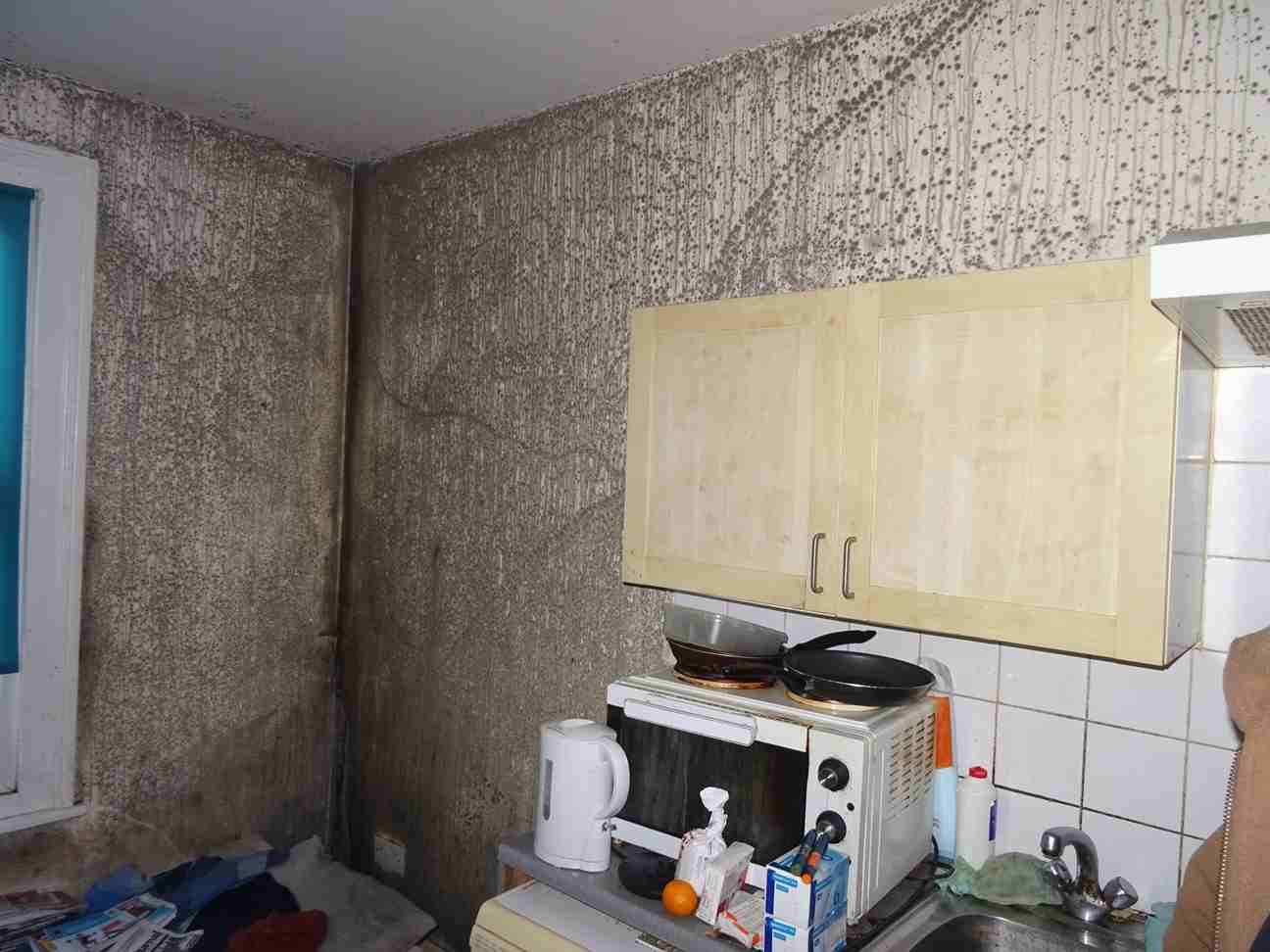
These recent photos show the mould and mess in a one-room Haringey flat that is occupied by a man his mid-50s (I’m withholding his real name in this story).

This man has learning difficulties. He also has diabetes, which he struggles to manage, and is in poor health. These photos were sent to me recently. I visited this flat a number of times a while back and have known this guy for several years. His living conditions are usually atrocious.

He is about to be evicted from this flat, because it is in such an appalling state. He received a court notice last Thursday. He brought the notice in to show members of the Kilburn Unemployed Workers’ Group at their Thursday afternoon meeting (he also had other photos of the mould in the flat, which he showed us).

Some history:

This man lived with his mother until she died over a decade ago. While his mother was alive, he always had work as a general and kitchen assistant in hotels and kitchens.

This man was made redundant from his last job about nine years ago. He signed on for jobseekers’ allowance and has been put through the DWP’s usual Work Choice/Work Programme mill, with no results whatsoever. He has not found work again. His health has deteriorated to the point where he needs to apply for Employment and Support Allowance. Members of the Kilburn group are helping him with his forms.

Since his mother died, housing has been a major challenge for this man.

So.

There are two main problems for people in this sort of situation.

The first is accommodation itself – finding places in the private sector which people can afford to rent when they rely primarily on housing benefit. Continue reading

Benefit cap arrears and eviction threats for women and children. Already.

Another short post on impossible situations:

Here’s a rent arrears demand recently received by a woman who lives in a Basildon flat with her three young children (the arrears have increased since she received this letter).

It appears these arrears have come about because of the recently-lowered benefit cap.

This woman’s benefits exceeded the Out of Greater London limit of £384.62 by about £100 a week. As a result, at the end of last year, her housing benefit was cut by about £100 a week from about £188 a week to to £87 a week (think the sums are correct, looking at the paperwork. Give me a shout if you think the totals need looking at. Maths problems with these things are not at all uncommon).

Basildon council recently gave this woman a discretionary housing payment of £20 a week to cover some of the rent shortfall. That helps a bit, but only a bit. She only gets the DHP for the short term, too. After that, she either finds the full whack each week, or moves house again (this time with a serious arrears history) and takes the kids out of school again (she was recently in temporary accommodation in another borough)… or she ultimately gets evicted, I guess:

“I don’t know what to do,” she says.

I don’t really know what to do either, if I’m honest. Which is not particularly helpful.

What I do know is that I spend an awful lot of time these days with people in different parts of the country who show me demands for rent money they can’t pay and/or which say court and eviction are on the cards. As I write this, an email about a looming eviction in Haringey has landed in my inbox. I go to foodbanks and foodbank-lunches and inevitably end up talking to at least one person who is clutching a folder of letters about rent arrears.

Continue reading

Councils, housing associations and the DWP are crushing people with debt

While Brexit and Trump hoover resources and headlines, the state and so-called social landlords continue to get away with screwing people into the ground:

Last week, I spent several hours at the South Chadderton foodbank in Oldham speaking with people who’d come in for groceries.

We talked about the reasons why people needed to use the foodbank.

One explanation in particular came up, as it does a lot: Debt repayment plans are leaving people with no money.

People on benefits and low incomes are repaying arrears or loans money to councils, housing associations, the DWP, bailiffs and god knows who else – but they can’t afford it. The loss of the fivers and tenners that authorities deduct in repayments make a tolerable life impossible. People certainly don’t have the hundreds, or sometimes thousands, of pounds that are really needed to shift these debts. Simple equation, when you look at it. Debts grow and penalties grow, but income does not.

Still, we have these repayment plans.

At South Chadderton, I talked for a long while with a young guy called Neil (name changed. There’s a transcript from the interview we recorded at the end of this post).

Neil needed a food parcel, because Oldham’s First Choice Homes housing association and the DWP were taking cuts from Neil’s benefit for rent arrears and loan repayments. Other authorities were queuing up for a share: Neil had been summonsed to court for council tax arrears. Neil couldn’t afford the repayments, but he had to pay all the same. You’ll see from the letter above that First Choice Homes is taking £30 a fortnight for rent arrears (out of a benefit total of about £130).

Neil said that talking to the housing association was hopeless (I offered to make a call).

“They say the lowest they can go is £30…they’re on the phone, going on with themselves.. I said, “hang on a minute.” They said, “can you make a payment now?” I said, “I’ve got nothing to give you.” (I’ve had plenty of similar conversations where I’ve tried, fruitlessly, to convince organisations to go easy because people can’t meet their debts).

It should come as no surprise that Neil was recently done for theft. He did a stretch last year for theft by finding – “[it was] a load of slates in the alley. They’d been there for two year.” This sort of story is very common indeed. I’ve met a number of guys in the area now who’ve been in and out of jail in recent times. (Two out of the three people I spoke to at the foodbank last week had done time).

The problem is life when people get out. Neil lost his housing benefit while he was in prison. He ended up with rent arrears. That total has gone up again, because he didn’t make repayments over Christmas and New Year. Neil decided to keep hold of his benefit money instead. Might as well be hung for a sheep as a lamb, etc. I’d take the same view myself. Neil couldn’t stand another call with the council or the housing association on the topic. I find this all the time these days as well. Every contact with the bureaucracy is a bitter fight. People don’t even want to talk to an officer to ask if calculation mistakes have been made, or to question sums they don’t understand, or if letters are correct, or if there are other options for help.

Continue reading