Posting will be light this week as I work on a few things. Back soon.
Back soon
Reply
Posting will be light this week as I work on a few things. Back soon.
Update Friday 16 October:
Received a response yesterday from Brent Council which details the council’s rent in advance and deposit support scheme, and outlines the flat-inspection process that the council has undertaken to get the deposit paid retrospectively in this instance. The council says that having completed its checks, it has “now arranged to pay the money to the agent who has agreed to return the deposit he received.” Sounds very good. Will update this post when everything is finally settled and write more detailed article about this issue of rent in advance and deposit payments for people who can’t afford those payments as housing pressures intensify. The council’s response did not include comment on the request for the inspection findings for the previous flat, so will make another request for that.
Was intrigued by a line in the council’s response which said I’d never emailed or phoned the council press office about this issue. I find this an interesting remark, given that I’m sitting here looking at the email I sent to the press office about the rent in advance and deposit issue on 30 September at 12.23pm and also at the phone log record of the call I made about an hour earlier on the same day, but I’ll let that one go for now because I am feeling uncommonly generous today. It is Friday after all.
————————–
Original post.
Well – it’s been about a week since I posted this attempt to get answers re: Brent Council’s policy on paying rent in advance and deposits for re-housed tenants, and reimbursing people who pay that money on behalf of others. I also asked in that post if Brent Council could let me know how a flat inspection carried out about six months ago panned out.
I’ve been completely ignored. Being ignored is not something that sits well with me in the general run. Am presuming Brent Council is still there (their twitter feed is), so am starting to think that there may be reasons to take this silence personally. Which I am.
My contact details are here, Brent Council. Am standing by.
On workfare:
Am making my way through several hours of interview recordings that I took earlier this year with three people who were on a six-month forced workfare Community Work Placement (CWP) at a north London charity called Embrace UK. With CWP, these people on jobseekers’ allowance had to work for 30 hours a week for six months on workfare in local charities and organisations. These JSA claimants had no choice. If people refused, they risked benefit sanctions.
Anyway – I thought I’d post the letter below.
This is a letter that JSA claimants on that six-month CWP workfare placement at Embrace UK asked the charity’s managers to write for people to take to their jobcentres in January this year. In these letters, Embrace UK asked jobcentres to allow the letter-holders to stay on at the charity as volunteers when the six-month forced workfare placement ended:
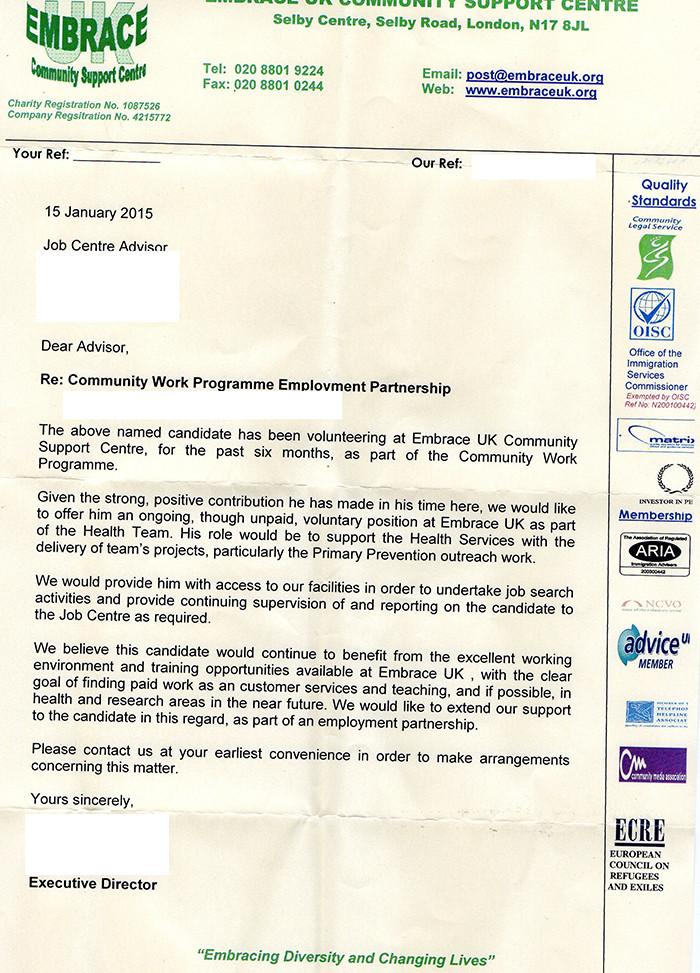
The reason that people on workfare at Embrace UK asked the charity’s managers to produce these letters to take to jobcentres? – they wanted to stay on at Embrace UK because the charity’s managers were civil and the workfare work wasn’t brutal. Staff at Embrace UK treated people on forced workfare decently. Being treated decently as a workfare worker was considered a monumental bonus and something to try and hang on to. The six-month workfare placement at Embrace UK was about to end. People were very worried about being sent on a CWP workfare placement at another charity. They could not be sure that they’d be treated well at a new placement, because they were workfare workers.
None of these people were doormats – quite the reverse – but they knew the odds on this scene. Workfare workers have very little power. They certainly don’t have much by way of workplace protection in reality. These people could complain about bad treatment, or refuse to attend a difficult workfare workplace if they really wanted to, but that sort of response would put people at risk of sanctions. All three people I interviewed in this case had been sanctioned at one point or another for spurious reasons. People knew exactly what it was like to have their benefit money suddenly stopped. Nobody was keen to go through that again if they could help it. That’s why people put a great deal of energy and effort into organising the letters that might convince their jobcentres to let them stay at a charity where they were treated like human beings.
This is the big worry: that people on workfare must hope for – rather than expect – decent work and decent treatment on workfare placements. It’s luck of the draw stuff. I wonder who is meant to monitor these placements for standards, and if they do. On the circuit, stories certainly abound of people on mandatory workfare placements being sent to charities where the work is gruelling and the management nasty. Being sent out in all weathers on charity bucket collection is something people dread (god knows I would): “I’m going out fundraising as well – doing bucket collection. I did a couple of days bucket collection down out the front of the shops,” an older guy called Graham told me when we discussed his workfare placement at the end of last year. His work programme provider, the notoriously unpleasant Urban Futures, had sent him on a CWP stint at a charity where he “worked” as a security guard and also went outside on bucket collections (he had a criminal record, as it happened. He hadn’t been CRB-checked by the charity and thought both jobs were interesting choices for someone with his recent background). The weather was freezing at the time of his placement. I know I wouldn’t have enjoyed being shoved out into the cold with a bucket on a threat of a benefit sanction. Continue reading
From Barnet Unison:
Barnet UNISON members whose jobs haven’t yet been outsourced will begin a 24 hour strike action on Wednesday 7 October (the strike excludes community schools).
The strike involves social workers, coach escorts, drivers, occupational therapists, schools catering staff, education welfare officers, library workers, children centre workers, street cleaning and refuse workers, all of whom have made it clear they want to remain employees of Barnet Council and don’t want their jobs outsourced.
Picket lines on Wednesday October 7 will be at:
Barnet House from 7 am.
Mill Hill Depot—Starts 6 am onwards.
East Finchley Library—Start 9 am onwards.
Rally 12.30 – St Johns Church Hall, Friern Barnet Lane.
Read the rest (including council plans to cut library services) here.
Update and council’s response here.
Right. This is a post about trying to house a disabled tenant and trying to find a deposit and rent in advance… Read on for more about one weapons-grade shambles that I’ve seen first-hand. I wonder how many people are having this sort of dire experience as more and more people are shifted out of inner London boroughs…
This is a story about Brent Council’s great reluctance to cough up the rent in advance and deposit on a place for a disabled man who was rehoused out of an absolute dump of a flat earlier this year. This situation really is a shambles. I would be happy to talk about it with the council, except that the council won’t talk to me. My attempts to contact the council have gone unanswered to date, so I am saying Boo Hiss to the council right now. I am posting this to talk to the internet about the problem instead. I am also hoping Brent will see this post and respond to me and everybody else and FINALLY AGREE TO MEET TO RESOLVE THE PROBLEM.
Earlier this year, I attended an emergency homelessness meeting at Brent Council with a man in his 50s who has learning difficulties and health problems. The meeting was held at Brent Council‘s very flash Civic Centre which is next to Wembley stadium. (This is the Civic Centre that the council opened a couple of years ago with a legendary £98,000 ceremony if I may digress for a moment . Brent is also the council that famously found £12,000 for a virtual assistant hologram for its reception desk. I like holograms – who doesn’t – but you see where I am going here. There is some money sloshing about at Brent Council – for opening ceremonies and holograms, at least).
Money can be harder to come by if you’re looking to rehouse a disabled man, though.
The man with learning difficulties had been living in this mould-encrusted hellhole in Kilburn:

He’d received an eviction notice, because his landlord wanted the property back. He needed rehousing fast. This man was terribly stressed by all of this. He hates change and he had also been distressed for months about the mould and mice in his flat (the council came and inspected the place when I called to complain about the mould, just by the way. I asked the council for the results of that inspection a couple of months ago. I’ve heard nothing more on that, either. Brent Council may be good opening ceremonies, but it really is useless at communication. I held a sit-in at the Brent Council foyer with disabled woman Angela Smith about social care problems around a year ago. Maybe the council’s still pissed off about that).
The council said that it would look for flats for this man. (The council did offer several flat viewings after the meeting, but the man turned them down, because he did not understand then that housing benefit only covered flats as small as the one he’d been living in. He was very worried about being stuck in another tiny, airless flat and getting sicker). Officers at the meeting also put great emphasis on encouraging the man to search for a flat himself. Rent in advance and a deposit would obviously be a problem for this guy (he signs on for jobseekers’ allowance).
The council officer at the meeting said this about the rent and deposit help that Brent Council could give:
“If he finds something to rent and… if you don’t have the incentive, like the deposit, the rent in advance, the council could provide an incentive which could be the deposit and the rent in advance, so there are things that we can do to try to help you find your own accommodation as well as assessing this application.”
As luck would have it, I have a recording of that statement. Continue reading
From Disabled People Against Cuts:
Plenty of action planned for Tory party conference next week as disabled campaigners prepare to protest against austerity cuts.
“Cameron will not get to deliver his litany of spite and lies in peace.”
Amen to that.
I’m guessing years.
I attended a Maximus face-to-face assessment for Employment and Support Allowance with someone about five months ago. It seems that person still hasn’t had a decision about their claim.
Maybe their decision letter got lost in the mail. Maybe it hasn’t been sent. Who can really say. Like so many people I speak with, the person in this instance doesn’t want to raise issues with Maximus or the DWP, because this person is concerned that Maximus or the DWP will respond in a negative way.
People on the receiving end of the ESA application process do not feel that they have a lot of power in it. And they’re right. They don’t.
This is a page from a jobsearch sheet that belongs to a JSA claimant whose fortnightly JSA signon sessions I’ve attended on and off for about 18 months at two jobcentres.
I’m posting this to show you the pointlessness of some of these jobcentre signon sessions and of the DWP’s jobsearch regime in general:

The sheet shows evidence of some of the 14 jobsearch activities that this man must carry out each fortnight to continue to claim his jobseekers’ allowance – so, 14 job applications and CV-drops into shops and supermarkets, and that sort of thing. (I think it’s 14. Seems to vary a bit). This man has some literacy problems and copies words from one fortnight’s sheets to the next. He carries the same spelling mistakes and disordered text over in these records. Nobody’s ever pointed the spelling mistakes out, or said anything about the confusing text. You wonder if anyone ever reads any of it (I don’t wonder, really. I don’t think anybody does read the sheets and if they do, they clearly don’t think the details count).
The thing about the jobsearch activity in these sheets? – nothing ever seems to come of it. The DWP’s jobsearch and Claimant Commitment requirements mean that this guy must show this fortnightly evidence that he has looked for work – but that’s it. The jobsearch exercise ends there. This man must fill his sheets in, but nothing is done with the information that he writes. I’ve never seen an attempt made at a jobcentre to help this guy turn the listings in his sheets into actual work. No phone calls have ever been made on this man’s behalf to the employers he lists – at least, not at the signon appointments that I’ve attended. I’ve never seen an attempt to follow up on the applications that he records. Nobody asks from one signon appointment to the next if the job applications that he listed in previous weeks amounted to anything. Every two weeks, this guy takes his collection of sheets into the jobcentre for an adviser to look at. The adviser glances at the writing, asks how the jobsearch is going and sets another signon appointment for two weeks’ time. That really is about it.
We go in for these jobcentre appointments every fortnight. Some JSA claimants must go in every week. Others must go in every day if they’re at a jobcentre which insists on a daily signon regime. These really are trips to the jobcentre for no reason. Every six months or so, an adviser will try to push this guy into voluntary work or onto the Work Choice programme. He goes on some programmes and not on others. Either way, he’s back at the jobcentre when the work programme is done. We carry on with the fortnightly signons. This guy has whole booklets and sheets filled out exactly like this: pages and pages of poorly-spelled text about jobsearch activities that nobody pursues, or even reads a lot of the time.
Anyway. This is how long-term unemployment looks, at least as far as I can see – endless paper and endless trips to the jobcentre for the hell of it. Nothing changes, or shifts. We all just get older. I suppose that IDS .gets off on that. Or something.
Barnet council UNISON members will begin a 24 hour strike action on Wednesday 7 October.
The dispute involves social workers, coach escorts, drivers, occupational therapists, schools catering staff, education welfare officers, library workers, children centre workers, street cleaning and refuse workers. All have made it clear they don’t want their services or jobs outsourced.
Barnet Council is about to agree outsourcing and cuts across a number of council committees over the next four months which would see the number of staff employed by the council reduced to less than 300.
Okay – this is a minor rant, but I’m having it.
I went to Plaistow jobcentre yesterday to accompany a young woman to her JSA signon appointment.
I couldn’t find the woman when I arrived, so I asked the G4S security guard if I could stick my head around the door on the first floor to see if she was already there.
“No,” he said.
“Could I just see if she’s there?” I asked.
He shook his head. “No,” he said.
That was the end of that.
These G4S people get on my nerves very badly. They can be obstructive in the extreme. I would like to know who they answer to. They seem to go a long way to make sure that JSA claimants are denied their right to accompaniment to meetings. Last time I attempted to accompany this young woman to an appointment at this jobcentre, I didn’t even make it as far as the ground floor entrance. The G4S guards parked me outside the jobcentre with the young woman’s bike. They wouldn’t let her leave the bike inside the jobcentre for five minutes when she signed on and she didn’t have a lock for the bike (she couldn’t afford one), so I ended up standing outside on bike-guarding duties.
I am pretty sure that the guards enjoyed sticking me outside with the bike. I am also pretty sure that the guards like saying No, because they can.
It’s the little things, you know.
Picture: Bike
. 