Shutting homelessness hostels, then slapping Asbos on rough sleepers. Brilliant.

In the Guardian today, there’s a story about cuts to supported housing – the hostels and housing used and needed by people who’d otherwise be on the streets.

It doesn’t take a genius to work out that the loss of this accommodation will mean more people must sleep on the streets:

“Nottinghamshire county council will vote later this month on proposed cuts that will, according to Framework (the Nottinghamshire-based housing association mentioned in the Guardian aticle), result in almost all the homeless and housing support services across the county closing down. As Nottinghamshire’s hostels, and specialist housing support services are decommissioned over the next three years, around 6000 vulnerable clients currently supported by Framework each year – rough sleepers, care-leavers, ex-offenders, addicts and people with complex mental health problems who are not receiving NHS care – will be cast adrift.”

Isn’t that great.

I want to make a further point – that once all those people are cast adrift and forced to sleep rough, they’ll find themselves targeted by the very authorities who shut their hostels. That’s because councils and coppers are going on the offensive as far as rough sleepers are concerned.

Last week, I posted this story about Newham council’s latest gig: slapping Asbo warnings on rough sleepers in Stratford and then bragging about this brand of toughlove. Mayor Robin Wales wrote an entirely charmless piece in the Newham Recorder about his crackdown on rough sleepers round the Stratford Centre. As part of a programme that the council winningly (not) referred to as “a rude awakening for rough sleepers”, the council had handed out Asbo warnings to 28 people who were sleeping out around the mall. The council was being “helped” in this endeavour by the police, the UK Border Agency and Thames Reach.

As I wrote last week, there was a nasty, punitive thread running through Wales’ column. It hit exactly the Clean Up or Piss Off pitch that the likes of Edwina Currie keep aiming for.

“There’s a rough sleeping problem around Stratford centre, Wales said, because there was “easy access to waste food and cardboard,” (he sounded like he was talking about the things that attract rodents in that bit). Rough sleepers who “refuse offers of assistance from us or our partners cannot expect to continue to sleep on our streets,” the mayor said. They could expect Asbos if they tried, it seemed. The council was “offering support to those who will accept it and enforcing the law where necessary,” Wales informed us. “I realise that this is a tough message,” he went on to say, “and that some people will be instinctively unhappy with it.”

Indeed. A lot of us were very unhappy with it. We’re getting unhappier by the day, too. Hitting rough sleepers with Asbos as their accommodation is removed and social housing disappears, and then trying to style that as an example of great local government leadership is an amazingly crappy endeavour. I’ve had word this week too that the mother and baby unit accommodation for homeless young parents at Focus E15 in Newham will definitely close when all current tenants are rehoused. My point here: perhaps keeping that sort of accommodation open would be more of an answer to rough sleeping than issuing rough sleepers with Asbos. The same will surely apply in Nottinghamshire once they’re closed hostels there. What would I know, I suppose.

Meanwhile, campaigners are gearing up to fight Operation Encompass, the Met’s latest wheeze against rough sleepers:

The Metropolitan Police Service has joined forces with Camden, Croydon, Islington, Lambeth, Southwark and Westminster together with UK Border Force, local authorities and other partner agencies to combat begging and rough sleeping across the six London boroughs.”

I’ll be following that one closely. A lot of us are keen to find out exactly how you combat rough sleeping while closing the places where people might sleep. Throwing the book at people seems to be one of the plans. “Support will be offered through support services and making arrests where offences are identified,” the Met informs us in its Operation Encompass press release. Which is interesting. Who knew that arresting people who were trying to shelter from the rain under cardboard was a key route to fixing homelessness. As I say, I would have thought that one of the best ways to fix homelessness would be to find people decent and secure supported housing, rather than shutting that housing down, but now I’m just repeating myself. So – I guess the official take is that it is better for all to hit rough sleepers with an Asbo and push them into someone else’s borough. Or something.

Four people talk about sanctions and the pointlessness of jobcentres

Earlier this week, I spent a morning outside the Kilburn jobcentre with the Kilburn Unemployed Workers Group. The group regularly leaflets at the jobcentre, to let people know that there is help and support available for people who are struggling.

We talked to person after person who was on JSA and signing on. And being sanctioned. The first person we saw was a young man who came out of the jobcentre yelling that he’d just been sanctioned for 13 weeks. He was furious, as well he might be. Thirteen weeks is a hell of a long time to go without money.

He was too angry to talk about that with us in any detail, but we did speak to a lot of other people who had similar experiences. I recorded those discussions and have posted transcripts of those recordings below. I’ll be doing a lot more of this. People need to hear the sorts of things that people on JSA are saying. And I don’t think it will do jobcentres any harm to know that there are journalists out the front of their places asking people what things are like inside.

Because things don’t seem too good at all inside. Just about everyone we spoke with talked about sanctions and appointment mixups and confusing instructions and paperwork, and having to “walk on eggshells” in case anything happened that might lead to a sanction. This part really gets on my nerves. If you’re on JSA, you’re at the mercy of everyone. You’re on the receiving end of everything. People can treat you however they like. And all because you’re unemployed. It’s as though being unemployed has become a hanging offence.

Continue reading

Hoovering cash out of public services: Capita’s How To conference

An amazingly in-your-face titled Capita conference looms for March: it’s called the “Developing Commercialism in Local Government Conference.”

Developing Commercialism in Local Government. That title really is about as blatant as they get. I hardly knew where to spit when I read it. Nobody is even pretending any more. Getting the private sector and a sales “ethos” into the public sector is the name of this game. It’s all about replacing the public service ethos with a commercial one – and outfits like Capita now happily brand their conferences to make that clear.

Back in my day, these private companies used to try and fudge the “aim is to make money out of public services” point a bit. Private companies would attempt to pour oil at our council meetings (I was a union steward representing members whose jobs were threatened by private sector takeovers) with coy phrases like “we just want to help enable public services,” or “we’re only here to assist your council with change management and then we’ll be gone,” and other florid bollocks. Now, we’ve got the likes of Capita turning up at councils with their tongues hanging out and saying point-blank Let’s Develop Commercialism. Read their bumpf and weep. This is the direction that public service “leaders” point themselves in today – “exploring the local drive towards commercialism,” keeping “a keen focus on engendering a commercial culture and overcoming risk aversion,” (hopefully not to the extent that Fred Goodwin did) and pushing heaps and heaps of money at private companies. As those of us who follow these things know, the commercialism of public services is particularly about pushing heaps and heaps of money at companies like Capita. We do keep seeing the same faces at these things.

Continue reading

The real problem with homeless people…they’re attracted to cardboard

This morning, I went to Stratford to report on the Focus E15 young mums‘ attempt to attend Mayor Robin Wales’ proceedings committee. As readers of this blog will know, these young mothers – all classed as homeless and all living in temporary hostel accommodation – have battled for months for secure social housing for themselves and for the rest of us. They wanted to appeal again to Wales for social housing today.

As I arrived, I was handed a copy of this week’s Newham Recorder, which carries a column from Wales about Newham council’s recent crackdown on rough sleepers round the Stratford Centre. As part of a programme that the council charmingly refers to as “a rude awakening for rough sleepers”, Asbo warnings were recently slapped on 28 people who were sleeping out around the mall. The council has been “helped” in this endeavour by the police, the UK Border Agency and Thames Reach.

I found Wales’ column purely extraordinary (you can read the whole thing here). There’s a nasty, punitive thread running through it – a bit like shit through a goose, as the great Justin McKeating would say. It hits exactly the Clean Up or Piss Off pitch that Edwina Currie keeps aiming for. There’s a rough sleeping problem around Stratford centre, Wales says, because there is “easy access to waste food and cardboard,” (he sounds like he’s talking about drawcards for rodents in that bit). Rough sleepers who “refuse offers of assistance from us or our partners cannot expect to continue to sleep on our streets.” They can expect Asbos if they try, it seems. The council is “offering support to those who will accept it and enforcing the law where necessary,” Wales informs us. “I realise that this is a tough message,” he goes on to say, “and that some people will be instinctively unhappy with it.”

Bloody right. I’m one of those people. I bet there are plenty of others. This stuff is appalling. There is nothing remotely forgiving about the piece that Wales has written here. There’s no political context. There’s no detail about the many reasons why people might be trying to shelter from awful weather in cardboard in a walkway and getting pissed to block it all out. There’s nothing at all about the realities of the fallout from this government’s dreadful “welfare reforms” – JSA sanctions, homelessness, severe mental health problems, the loss of hostel housing, being thrown off employment and support allowance and so on and so on and so on. As it happens, I’ve talked with a great many people who are in and out of street homelessness and there’s inevitably a complicated story at the back of it. We need to hear more of these stories and less about Asbos if you ask me. I’ve talked to people with serious mental health conditions who’ve been displaced when their hostel accommodation has been closed. I’ve talked to people who’ve lived in tents while their ESA problems have rolled on and on and they’ve tried to address their serious addiction problems by moving towns. I’ve talked to people who lost their businesses in the recession and ended up unemployed, sanctioned and homeless.

I doubt that Asbos would have sorted those situations out, but it seems that you get councils going for it. And all this in a column from a mayor who Private Eye tells us this week has been using Newham’s repairs and maintenance services to carry out work on his home. This service “undertakes work for non-council tenants and this service is available to any Newham resident,” the council told blogger Mike Law (the story says that Wales paid about £1500 for the work). Which must be great if you have a house and money to pay for its upkeep. It’s probably less exciting if you’re homeless, eating food off the pavement and wrapping yourself in cardboard every night in the Stratford Centre to try and keep warm. There’s something very wrong with all of this. There’s a poisonous inequality inherent in it and the finger of blame is being pointed at people who deserve it least. I think here of the many boarded-up flats on Newham’s Carpenters Estate – homes that sit empty as the council wags a warning finger at 28 people who sleep in a mall and have nowhere to go and may not want to be strongarmed into “specialist support.” Those people may not want to take instruction from mayors who have enough money for their own housing and repairs. They may be sick of seeing the political class come down on the poorest like a shitload of bricks. They may just want decent social housing and paid work, but can’t get either. God knows that is happening everywhere.

Anyway – trying to make that point to the political class is almost impossible now. As I said at the start of this post – this morning, the young women of the Focus E15 housing campaign tried to enter a mayoral proceedings meeting to appeal again to Wales for social housing in the borough. This is a campaign that should interest anyone who isn’t rich and doesn’t own a huge house outright. Without secure social housing, we’re all at the mercy of increasingly merciless private landlords. We’re all looking at short tenancies, badly-maintained flats and skyrocketing rents. But the women have been told that they must take 12-month private lets in the private rental sector, or they’ll will get no more “help” from the council. They wanted to talk to Wales about this again today. Unfortunately, they were told that the meeting was over and that they weren’t allowed in. You’ll see that in this video:

I’d ask the council for a comment on this, except that the council won’t talk to me. That part of things has gone a bit emotional, in a crappy council way. As I wrote here, I can only guess that my earlier stories about the Focus E15 women’s battle for secure social housing and the rotten standards at the temporary hostel they’re living touched a nerve. So, we’ll take what I write as written. Apparently, a press officer turned up later on today to say the mothers should have been let into the mayoral proceedings after all. Pity the proceedings were over.

So. The Focus E15 campaign remains extremely important and will only become more so. These women are pointing up the problems with the private rented sector, the terrible lack of secure social housing and the way that people on benefits and low incomes are treated if they dare to ask for it. Just remember – this is all coming your way, unless you’re rich. Very rich.

Focus E15 young mums’ battle for social housing: an update

Back to Newham now, where the young homeless mothers who’ve been fighting a real battle for secure local social housing have been given an ultimatum by Newham council: they must take 12-month lets in the private rental sector, or they’ll will get no more “help” from the council. The women think if they turn the private-sector lets down, they’ll be considered to have made themselves intentionally homeless. “We have to take them,” the women said on Saturday. “The council says if we don’t, they won’t give us any more help to get housed.” I’d ask the council for a comment on this, except that the press office threw a tantrum a few weeks ago and said it wouldn’t talk to me again. It seems that my earlier stories about the women’s battle for secure social housing and the rotten standards at the hostel they’re living touched some kind of nerve.

Presenting the women with this “short-term private lets” ultimatum is a sneaky move by the council. It breaks the campaign group up by housing the young mothers in far-flung parts of London, away from each other. It also leaves the women and their children very vulnerable to further house moves. In 12 months’ time, when the lets are up, the council can say that the private rents exceed the benefit cap and send the women out of London to live in boroughs where they are not wanted and where there is no work, or family members around to provide childcare. It seems very unlikely that the women will be in private lets in London for the longer term – especially as rents increase and as the benefit cap is lowered even further, as it inevitably will be. If the women have to move again, their kids will have to be moved to new nurseries and schools again. And again and again and again.

This is the problem and future that all renters face – short-term tenancies, skyrocketing rents and no sure place for families to live for more than a few months at a time. That is why the Focus E15 campaign for secure social housing is so important to us all. The Newham quick-fire, private rental solution does not solve a single problem for anyone who must rely on the private rental sector for housing. It does not force the council to build more social housing for all, or to commit to opening up the many boarded-up homes on places like the Carpenters Estate which you can see in the video below. This short-term solution simply breaks up a campaign and shuts down a debate, which is surely the council’s aim.

Anyway. In the video below, you can see some of the many boarded-up flats on Newham’s Carpenters estate and hear the Focus E15 mothers’ views on this:

Residents put up an almighty fight recently to save their flats from council plans to create a UCL campus on the site. Flats on the estate have been boarded up for a very long time though. I asked the council about its plans for those flats and for the estate in general, but as I say, the council refuses point-blank to talk to me about anything. So we’ll have to leave that one hanging and simply look at the video of the boarded-up flats. And make the point again that the real problem here is an absolute lack of will – across the political spectrum – to truly commit to the notion of secure and plentiful social housing for all. Shoving a few campaigners into private lets for a bit won’t change that.

I’ll be at the demonstrations against Atos. I’ve seen WCAs first hand.

On February 19, protesters will gather nationally outside Atos centres to peacefully protest the inhumane treatment of people receiving employment support allowance, and its predecessors incapacity benefit and the severe disablement allowance. I for one have accompanied people through utterly bizarre Atos assessments. Stephen here was awarded zero points on his first assessment in a report that failed to mention his schizophrenia diagnoses. On appeal, he was placed in the Support Group – the group people are placed in when they have the highest needs. So he went from being considered fit for work to being considered someone with the most substantial support needs. As I wrote at the time: “That was quite a turnaround. A lot of us who worked with Stephen at that time wondered exactly what criteria Atos was using.” A colleague noted at the time that Atos’ criteria was “whatever we can get away with.”

The February protests will be spearheded by disabled activists who have had to bear the brunt of the cuts made by the government of millionaires.

A key demand of these protesters is that the government no longer uses ATOS to preform these assessments.

Campaigners come from a wide diverse section of society ranging from disabled people who are directly effected by the changes in the administration of benefits to concerned citizens worried about the treatment of the most vulnerable in society.

Protesters are also calling for an apology from Iain Duncan Smith and Thierry Breton, Chairman and CEO of ATOS to the six families of benefit claimants who took their lives following decisions made by ATOS:

Tim Salter, a 53 year old blind man suffering with agoraphobia.

Lee Robinson, 39, of Crawley, Sussex, who was the first person in whose suicide could be attributed to the government’s changes.

Shaun Pilkington, 58, who was sent a letter saying he was to lose his ­Employment and Support ­Allowance, which he got after a long-term illness.

Edward Jacques, 47, of Sneinton, Nottingham, who took a fatal overdose after his benefit payments were stopped. Richard ­Sanderson, 44, of ­Southfields, south-west London, stabbed himself in the heart.

Jacqueline Harris, a 53-year-old former nurse from Bristol, was found dead at her home, likely having taken an overdose of medications after she was pronounced fit for work in November 2012.

These families should get a lot more than an apology if you ask me.

Campaigners are worried this list is set to grow and grow unless urgent action is taken to reverse the perverse treatment and demonisation of benefit claimants.

See the national demonstration website for full details.

—————————————————————————-

Full blogging will resume next week. Have a lot of interview recordings I’m working through etc.

Young mothers occupy Newham council to demand social housing

Updated with new video:

Some video from today’s occupations of the East Thames Housing Association building (and showroom) and Newham council’s housing offices by a group of young homeless mothers who are battling for decent social housing in Newham. The fight these young women are putting up is becoming more and more relevant to anyone who does not have secure housing – which includes a great many people:

Video: young Newham mothers occupy Newham council housing offices

Video two: earlier in the day, the women occupied a showhome inside the East Thames housing association building, where they held a party. There isn’t room for parties at the temporary hostel they live in, so they decided the HA would be a good venue:

As one of the mothers says in the video at the housing office:

“Stop making people homeless. Stop making kids miss school. It’s not fair. You get to go home to your nice homes, while people here are struggling. People are here crying (they were – a woman in the office was crying, because she was homeless and trying to sort that out). They’re stressed, depressed. It’s not right. You’ve got a place here where you’re meant to help people. You’re meant to help people. You’re not helping people.”

That’s it in a nutshell, really.

I have been interviewing this group of young mothers for a while. They are all classed as homeless and they are all fighting a bloody battle with Newham Council for decent social housing in the borough for themselves and their small children.

At the moment, these young women live in Newham’s Focus E15 foyer – a hostel which has about 16 flats for young parents and about 210 flats across the complex. It’s supposed to be temporary accommodation. I’ve written about the concerns the women have about the health standards at the hostel – the mothers say there are rats, mice and problems with mould and ventilation. Some of the children in the hostel are as young as three months. I’m having something of a bloody battle with the council and HA myself about this. More on that topic soon.

The women’s options for permanent housing are not good. They are having to deal with so many of the problems that face people who are either on low incomes, or benefits (surely, too, these must also increasingly be problems for people who are on reasonable incomes. Nobody is securely housed unless they own something freehold).

Their options are these:

The women can try to find social housing in a borough which has 24,000 people on its waiting list and recently changed its allocations policy to prioritise ex-servicepeople and people in work over people not in work. So that isn’t much of an option.

Or they they can hope to be housed in private accommodation – in an era where private landlords like Fergus and Judith Wilson are asking their housing benefit tenants to leave because, as Fergus Wilson loftily informed the Guardian recently: “”All the landlords will tell you that there is so much default now with housing benefit tenants that you are just simply better off with somebody working.” Mothers like Jasmin Stone have told me that they’ve run up big phone bills calling around private landlords and letting agents – to no avail. So that option isn’t much of an option either.

The other option is that Newham will house the women many miles out of the borough – miles away away from the family members who could provide childcare while the women worked. Places like Hastings, or Birmingham, are often suggested as possibilities. Except I wonder if they are. I spoke to Jeremy Birch, leader of Hasting council last week. The facts are that Jeremy Birch is not keen on taking people who are benefits generally. He can’t stop London boroughs housing people in Hastings’ private rental sector, but he made it very clear that he wasn’t happy to know that was happening:

“We’re a deprived community in the south east, who are trying to reduce the amount of benefit dependency in our own borough. While we welcome anyone who wants to come to Hastings to move here, we are not happy that we would be taking further people who were benefit dependent. That is putting extra pressure on the services that we’ve got in the town.”

He also said – and this is important – that the council had specific housing projects which excluded people who were not in work.

I’ve got a lot more to post on this, but I’ll say for now that this is a very important campaign. We all deserve housing – and this campaign is proving that people are going to have to put up a hell of a fight for it. This is an era of monumental inequality and the political class is thumbing its nose at anyone who isn’t part of that class. MPs happily house their horses in heated stables courtesy of the taxpayer and expect taxpayers to fund their tennis court repairs and housing upgrades and sales. They watch a show about people with nothing and encourage the world to laugh. Clean, warm, decent housing is a right – and not just for horses. Councils and Housing Associations should not be surprised to see people turn up in their offices who refuse to leave without an answer.

Another important point: At the occupation, a lot of people who were waiting in the housing offices to hear about their own housing options joined in conversation with these mothers. Connections were made. One woman who’d been waiting in the queue even started to cry – she revealed that she was homeless. Another woman who had a young baby with her said she’d been told she’d be sent to Birmingham, miles away from anyone she knew.

Other people who were waiting in the queue cheered and applauded when the protestors arrived and explained their campaign for housing. So many people are affected by this. People everywhere, with nowhere secure to live.

Council: unemployed people will not get places in our improved housing project

As readers of this site will know, I’ve been posting recently about social housing landlords (councils and their HAs) who prioritise people in work ahead of people who are not in work for social housing. I have found this worrying, to say the very least. It’s bad enough to know that filthy rich private landlords like Fergus and Judith Wilson are closing their doors to people who are on benefits. It is REALLY bad when you hear that social housing landlords – the landlords who you’d think were supposed to help people who are in real financial straits – are excluding people as well.

I wrote about Newham’s employed-people-are-our-priority housing policy last week. Here’s another example. On Thursday, I spoke for a while with Jeremy Birch, who is leader of Hastings borough council. I rang Jeremy to talk about his views on Hastings’ role as a place where London boroughs send impoverished tenants to live. As you are likely aware, London boroughs are using the private rental sector in Hastings to place tenants who are affected by the benefit cap and/or supposedly can’t be found appropriate housing in London. I’ve been speaking with a number of young women in Newham who are facing that sort of “move” to Hastings, miles away from parents and childcare.

Anyway – Jeremy Birch made a startling revelation during that conversation. He told me that Hastings borough now had housing projects from which it actively excludes people who are on benefits.

We were talking about the effects of rent pressures on rent and house prices when he said this:

“We have a project in one of the wards where houses of multiple occupation are particularly prevalent. We have a project where we’re buying up, with the housing association, some of the worst of these properties and renovating and improving them. The social landlord [that] is responsible for the running of them. The lettings agreement is that they will only take people who are in employment (my emphasis). The reason for that is to try and rebalance the nature of those communities, so that they are more settled and more stable communities.”

In other words – people who are in situations that Birch described as “benefits dependent” will be excluded from those improved homes. I have spoken with a couple of lawyers who think such an exclusion/discrimination could warrant legal challenge.

I’ve got more work to do on this – I want to know more about the definition of “benefits-dependent” in that context and I want to know more about the places that excluded tenants will be sent to, if they’re sent anywhere. Jeremy Birch says that exclusion policy only applies to that housing project at the moment. Elsewhere in the borough, people are housed according to need. You take my point, though. We’re in a messy and very unpleasant environment here. It seems that some people are allowed housing and others are not. It seems that some people are thought worthy of improved and renovated housing, while others are not (which is doubtless why these young mothers and their children are living in this sort of cramped and dirty place). It seems that social housing landlords are taking those decisions blatantly. It seems that private sector landlords are not the only ones who are thinking Cull when it comes to people on benefits.

Jeremy Birch is not keen on taking people who are benefits generally. He can’t stop London boroughs placing London tenants in Hastings private housing, but he makes it clear that he’d like to. “We’re a deprived community in the south east, who are trying to reduce the amount of benefit dependency in our own borough. While we welcome anyone who wants to come to Hastings to move here, we are not happy that we would be taking further people who were benefit dependent. That is putting extra pressure on the services that we’ve got in the town.”

I will be doing more on this. The point to note for now is that this “we’re taking these people, but not those people” rhetoric is the sort of line which ends with people on benefits being chucked in the workhouse, because all other doors have shut. You can find yourself on a benefit for all sorts of reasons – job loss, illness, disability, domestic violence, sickness. Just remember that as all this carries on, it won’t just be private landlords who want you gone.

Don’t forget that councils want rid of housing tenants on benefits too

Much discussion at the moment about megatwat rich landlords Fergus and Judith Wilson asking their housing benefit tenants to leave their lets because, as Fergus tells us: “”All the landlords will tell you that there is so much default now with housing benefit tenants that you are just simply better off with somebody working.”

Says the charming Fergus to the Guardian today:

“If I am heartless all the other landlords are heartless, because we’re all doing the same.”

And yeah – Fergus is right about being heartless. He sounds heartless. He sounds quite the heartless prick. The point I want to make here, though, is that he’s an accurate prick. He’s right when he says he’s not the only one who is at it.

The shocking truth (probably not that shocking tbh – I wasn’t surprised) is that even people who are supposed to provide social housing for people with no money are at it.

For example – Newham council is at it. Newham council is seriously at it. Readers of this site will know that I’ve been writing in details about a group of young Newham mothers who are on benefits and live in this rathole. But they’re struggling to get anything better and one of the reasons for that is Newham council recently changed its housing allocation policy to prioritise people who are in work over people who are not.

Which I’m sure you’d agree is all very Fergus.

The council decribes this change as its groundbreaking “resilience approach” – which is another way, I guess, of saying “tough shit if you’re on benefits.” Said Robin Wales, Newham’s glorious mayor:

Our resilience approach is all about supporting residents to help develop the skills they need to live independent and successful lives. The housing allocations policy has been reviewed with this in mind. Our scheme is about giving something for something.”

Eat your heart out, Fergus.

Said the council to me:

“The way social housing been allocated previously has created a race to the bottom where people are encouraged to emphasise their vulnerability.” Nothing much there about helping people who are ARE vulnerable and in need of housing. Just that, you know “we don’t really do vulnerability anymore.”

So. Fergus is not just telling us where the market is at. He’s telling us where the political class is at. Nobody wants people who are out of work. Even councils are eliminating people who aren’t in work from their considerations. That means we’re heading towards a point where people on benefits simply won’t be housed. And remember – you might be one of those people one day. I might be. Anyone might be. We’re in a very insecure jobs market at the moment and have a fast-disappearing social security safety net. I certainly talk to people who have worked, then found themselves out of work, then found that they were not eligible for benefits. Take Clifford Poole here, a man who worked for years in the Liverpool shipyards before having to leave with an industrial injury. He was only entitled to a year’s contributions-based employment and support allowance – that 365-day eligibility limit was only recently introduced. So now, he and his wife must live off the small salary she makes at her job in a betting shop.

So you know… if you had some idea that you’d be housed and fed, even in a basic way, if you were knocked out of work – well, you need to start thinking again.

Just. Saying.

Rubbish, mice and mould: good enough for young mums without money

Update January 21 2014

In the post below, I described some of the problems that young mums at the temporary Focus E15 hostel have with their accommodation. (These young women are campaigning for decent social housing in Newham borough. You can read more about their fight here). They talked about rubbish, mice and even rats in the Focus E15 hostel that they live in and I saw photographs of trash in the halls and broken sinks as you’ll see below in the original post. The women said that mould was a real problem at Focus E15, as was a lack of ventilation. That concerned me, not least because there are very small children living in that hostel. I could not leave things there.

So, I contacted the East Thames Housing Association, sent them the link to this post and asked if I could have a tour through the hostel with them to see things for myself and discuss some of these issues with them. If they cleaned things up and dealt to problems in anticipation of that visit – then even better. They agreed to that visit, which was good. A meeting was set up for this Monday – me and several officers were due to attend. But then last Friday, East Thames emailed me to say that they were cancelling the visit. I could no longer enter Focus E15. They’d found out that I’d been at the Focus E15 mothers’ occupation of the HA and the council on Friday and had reported on it and that they felt I was part of the campaign. That being the case, they would not take me through the hostel. They thought I’d be biased.

There are a couple of things here. The first is that there were a number of journalists at Friday’s action. Attending a protest does not make you part of a campaign, or allows you in any way to own it. This campaign belongs to the young mothers. Attending a campaign makes you a reporter who is attending a protest and who follows a story closely and who gets to know people who are involved and the things they’re doing. I have certainly spent hours over the past month with the young women of the Focus E15 campaign and gone to meetings and talked to the women as they’ve leafleted and organised – which is what you do when you’re talking to people and getting an understanding of their issues. Once upon a time, when I started out in journalism, that’s exactly what you did. Nobody saw anything strange about it. You spent ages with people affected by policy, rather than with people who wrote policy. Unfortunately, journalists today tend to spend their time with policymakers, not the people who have to live with the fallout from policy decisions. Think about the endless hours that Westminster journalists spend hanging out with MPs, rather than the people who are affected by policy. I’ll be writing a much longer essay about the whole campaign in a little while and that essay will reflect the fact that I’ve spent time with the Focus E15 people through their campaign.

The other point I’d make, though, is that campaigners are exactly the people who should be permitted through the hostel. If you ask me, these hostels should be opened up to regular inspections from housing campaigners – of whom there are a good number in East London – and the people who live there should be allowed to take whoever they like through to raise issues. I really don’t care if the HA wants to call me biased. Fine. I get called plenty worse. And who gives a damn if I am. None of that changes the fact that people have raised serious issues about the living standards little kids are having to tolerate in that hostel and that this needs looking at. Mould and ventilation problems – those things are dangerous. Infants should not be exposed to things like that. At Friday’s occupation, the young mothers raised again the issue of space at the hostel – they say rooms are so small at the hostel that little kids can’t move around and cry to get out. The hostel is only supposed to be temporary accommodation, but some of the mothers and their children have been there for years. There are little kids involved here. Can’t just leave things there.

One suggestion I would make to East Thames is that we reschedule the meeting at Focus E15 and film it. That way, everyone would have an individual record.

————————————————————————————

Original post: January 5 2014.

Since everyone’s talking about single mums and Cameron’s help-to-buy scheme, I thought I’d post a little something about the living conditions of a group of young mothers I’ve been meeting with recently. I thought – let’s just take a moment to inject a bit of reality into this. Let’s take a moment to look at the awful way that politicians of all stripes really treat single mothers who have nothing and need help. Let’s look at the way politicians behave towards young mothers who serve no useful political purpose – young women, say, who’ve had a baby early on, but have no money, no connections and none of the fancy schooling or (publicly-funded) expenses budgets enjoyed by so many of the MPs who judge these young mothers and who encourage everyone else to judge them and even to dob them in to authorities if they want. These mothers are some of the people on benefits who are taking the rap for a recession caused by the financial sector and for the slaughtering of social security that is so championed by politicians across the board. So – let’s take a moment to look at the way that some of these young women and their children live.

The fact is that the young women I’m talking with live in unpleasant places – dirty, mouldy places which, the more I hear about them, sound like the sort of places where small children’s lives are actually at risk. Something needs to be done about this. Probably eff-all will be, given that commentators widely hold that Cameron has won the welfare debate (they say this for all the world as though a two-sided debate has been had) and politicians across the board are too frightened to speak up for the welfare state and/or people who need it. Nonetheless, we press on. We must press on. The group of young mothers I met with yesterday – all classed as homeless and all broke – are fighting a bloody battle with Newham Council for decent, clean housing in the borough for themselves and their small children. Many, apparently, will think they don’t deserve that housing, or housing at all – but that line is rubbish. From MPs, it is monumental rubbish. This is an era where MPs happily house their horses in heated stables courtesy of the taxpayer and expect taxpayers to fund their tennis court repairs and housing upgrades and sales. This is an era in which a career ego like Iain Duncan Smith is permitted to trash whole chunks of the exchequer via his useless Universal Credit “project”. So – the hell with the “scroungers” rhetoric. Clean, warm, decent housing is a right – and not just for horses. It is certainly a right as far as small children are concerned.

Anyway, at the moment, these young women, who I’ve written about before, live in Newham’s Focus E15 foyer – a hostel which has about 16 flats for young parents and about 210 flats across the complex. It’s supposed to be temporary accommodation. Some of the women and their children have lived there for several years.

And what a charming place it sounds. Last time I met with them, the women said it was “like a prison” – visitors must show ID before going in and visiting hours are restricted. Rooms are very small with folding-out beds and damp is a real problem. And there’s more. Yesterday when we met, I was shown pictures of rubbish piled up outside one woman’s front door and of sinks hanging off walls under which small children crawl.

Here are some of the pictures – they’re a bit dark, but fairly clear.

Here’s one of the sinks in the room coming away from the wall:

Image of sink coming away from the wall

Here’s the gap between the wall and the sink in more detail:
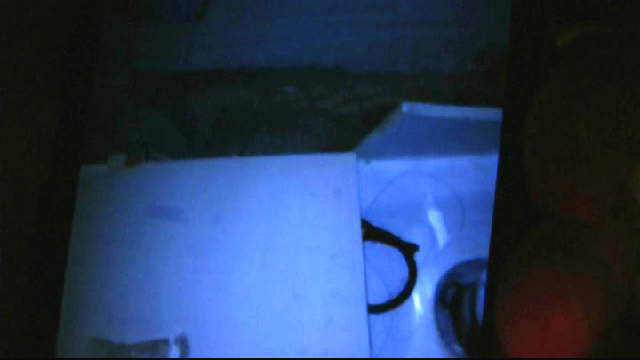
Gap between sink and wall

Here’s some of the rubbish piled up outside one young woman’s front door.
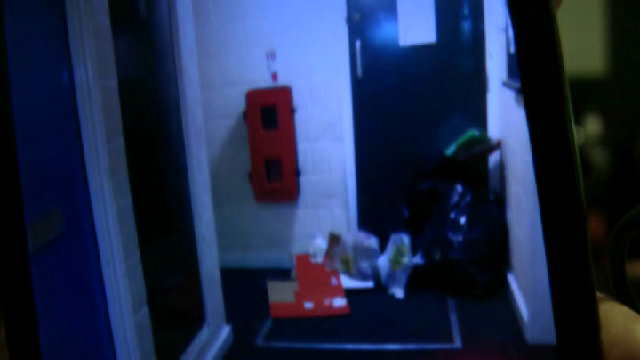
Rubbish piled up at door

Of even greater concern is the damp, mould and rodents the women describe. Says Rachel, who is 20 and the mother of a three-month-old son who has already had colds and a chesty cough: “There’s no ventilation in the toilet… there’s mould upon mould. We’ve had mice and [we’re] constantly getting damp. There are even rats. [The rubbish ends up by my door] because of where the bin chute is. Half the time they never unlock it, so people just pile their rubbish outside. My door is here and the bin chute is there.”

“The smell is disgusting and it is really, really hard to live there. We try and stay out all day,” says 19-year-old Jasmin Stone.

So. I put it to you that such conditions are dangerous for young children – extremely dangerous, even. I also put it to you that nobody has the right to impose those dangers on infants – particularly MPs who blow wads of taxpayers’ cash on horses’ paddocks and upgrades to flipped homes, or even, say, Newham councillors who piss £111m away on new office buildings which served primarily as Olympic vanity projects. You will understand why Austerity has become synonymous with Elimination in many minds. Before Christmas, I asked East Thames housing association (the HA which manages Focus E15) if I could visit the hostel. I wanted to see the place and conditions for myself. The answer was a resounding No, because staff and residents were under pressure. I’m raising these issues, though, because they need to be raised. They were raised with me before Christmas and again with supporters and campaigners yesterday. I post the details here, because a real response is required. Not a defensive response – a constructive response that everyone can work with is needed. Continue reading