The future will be wrecked for generations while women and little kids live like this

Think this fractured society will be healed soon? It won’t be while women and little kids live in the rotten conditions described below, and with no way out. Nobody builds a united future when young families must live in chaos and when the social security systems that should support them have been destroyed:

On Monday last week, young mothers who live with their kids in cramped single rooms in the Welwyn Garden City Boundary House homelessness hostel protested at Waltham Forest Council about their living conditions. All the women are homeless. All were placed in the Boundary House flats by Waltham Forest Council. The accommodation at Boundary House is horribly cramped and isolated. Placements at Boundary House are only meant to be short-term. Most of the women I’ve spoken with this year say their councils told them that they’d be in Boundary House for a couple of months at most – but some have been stuck in Boundary House for more than two years (Newham council used to place homeless families in Boundary House as well). The rooms look like this:

flat_interior_

Photo credit: Snapsthoughts http://photos.snapsthoughts.com/

It will surprise nobody to hear that relations between Boundary House residents and Waltham Forest council have reached breaking point. In the video below, you can see the women and council officers yelling at each other as the women descend on the council’s housing office to demand better housing and to make the very valid point that their living conditions are intolerable and that they need better housing:

Things are not generally good at places like housing offices and jobcentres these days, whether there’s a protest on or not. Furious homeless families and overstretched frontline staff have been abandoned to fight it out with each other in austerity. Shouting is not unusual. Desperation is certainly not unusual. Security guards are not unusual. When the mothers arrived, the housing office was already very busy. Some people who were waiting to be seen even had their suitcases and belongings with them. I’ve seen that in a number of housing offices in the last year or so. This is how a lot of people live now, if “live” is the word:

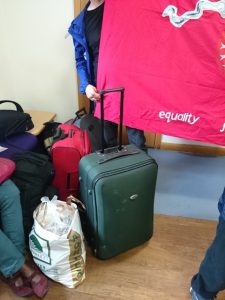
Bags__

Bags_

There was a heavy security presence, as there often is at housing offices and jobcentres now. I’ve attended enough meetings at frontline offices to know that you get guards at these places whether there’s a protest on or not.

The Boundary House women have two major problems. The first is that their accommodation is unpleasant, but they must raise their small children in it. The second is that they know their chances of getting money together for anything better start to evaporate as soon as they arrive at Boundary House. The Boundary House women live with their children in small, single-room flats in the hostel. The families only have that one room. Beds, kitchen, clothes and belongings are all crammed into that single space. Each flat has a small, separate bathroom. People complain about cockroaches and woodlice – you can hear the women talking about that in the video above. The building itself is isolated. Boundary House is down a suburban side street. The walk to Welwyn Garden City train station takes a half-hour and from there, people face an expensive (around £300 to £400 a month) commute to London. Continue reading

Looking for hope or leadership and finding it only in Brexit. Isn’t much in evidence elsewhere

Here’s a story that I’ve taken from the interviewing work that I’m doing at the moment:

Last Thursday evening, I attended a meeting held by the Leeds Hands Off Our Homes housing campaign group in a small church hall in Middleton Park in Leeds. Issues discussed included the housing bill, the ongoing problems that local people had with the bedroom tax, the likely effects of a lowered the benefit cap, social housing selloffs, the shared accommodation housing benefit rate for younger people – a real range of topics. Housing problems, as we all know, affect a great many people in one way or another. The turnout wasn’t bad. Local troubles were discussed with concern.

So.

Representation.

Present and correct down the back for this event were two local councillors – Kim Groves and Judith Blake who is also leader. I’ll be the first to admit that I know little about these councillors and their work on the ground. They may be good on some level, so I suppose we should allow for that. What I can tell you for a fact is that the two of them did my head in at the church hall last Thursday night. I’m sure that I don’t exaggerate when I say that they were utterly useless, at least as far as offering hope and leadership on the housing topic went. It seemed that their chief concern was to convince meeting attendees not to blame Labour or the council for the housing crisis. It was Don’t Blame The Council this and Focus Your Anger On The Government that and (my personal favourite) Please Don’t Ask Us To Do Anything Illegal As Part Of Your Housing Campaign (someone gently suggested that the council might like to try a bit of non-compliance to fight government housing policy. This person spoke well and put his points politely, but neither of those things helped much. I find that they rarely do. Anyone who suggests a bit of genial civil disobedience to nervous councillors these days is quickly sidelined as the evening’s wacky radical. *Sighs*).

You see where I am heading with this. No leadership was offered by councillors. No inspiring speeches about seizing the day, or descending on parliament to give the government a knuckle sandwich on housing or cuts came down. Maybe they do that on other days. They didn’t on Thursday. Meeting attendees were actually told to be realistic about the council’s limits. Which was a buzzkill, to say the very least. Talking about limits is not a great way to lead or inspire. You could practically see people’s passions and hope congealing in their veins as this came out. I briefly entertained the idea of standing up and shouting You Labour Persons Have Got A Socialist Leader For Christ’s Sake – Isn’t Now Meant To Be The Hour!?, etc, but I didn’t do it. I felt a bit secondhand by this point. It all seemed a bit hard.

Continue reading

Placed miles away in temporary housing and can’t afford the commute to work? Too bad.

My first outing on the Sentinel news blog:

Homeless mother of two Alicia Phillips explains how the housing crisis and an expensive commute from Boundary House – an isolated temporary accommodation hostel in Welwyn Garden City – are destroying her work and training options.

Alicia says that Waltham Forest Council told her she’d have to give up her job as a nursery nurse in London if the commute from Boundary House was too expensive and difficult.

This is how single mothers are punished in austerity. They’re actively relegated to a poverty trap. So much for Stephen Crabb’s fantasies about the government’s commitment to getting women out of that trap.

Read the rest here.

The one where the council officer hangs up the phone on a homeless woman…

SIGH.

Here’s an example of the struggle that people who are on the rough end of austerity have even to be heard. Thought I’d throw this one up there as just another example from the many I’m working through:

A couple of weeks ago, I decided to go in for an experiment of a kind. I sat with two women who live with their small children in temporary accommodation in Boundary House, a cramped Welwyn Garden City homelessness hostel, and called the Waltham Forest Council press office so that the women could respond directly to a press statement that the council had sent me about standards at Boundary House.

Waltham Forest Council sends homeless families to live in tiny, one-room hostel flats at Boundary House, sometimes for a couple of years at a time. Some families live four to a single-room studio flat. There are and have been all kinds of difficulties at Boundary House. Residents talk about overcrowding, problems with a lack of hot water, problems with security in the building – so, when I first wrote about the place, I sent questions about these sorts of issues to the Waltham Forest council press office. “We will investigate this further if full details are provided,” the council said in a line about the hot water. I saw that line kind of beaming out at me and I thought – Okay. I’ll read that as an invitation and take the council up on it. The hell with it. I’ll call the press office while I’m sitting with Boundary House residents and hand the phone to residents so that they can provide the press office with those “full details” to pass onto the housing department for resolution.

Some might say that it was unorthodox to ring the press office in that way, but I can’t say that I gave or give much of a stuff about that. Residents were saying then that calling the housing department with problems yielded poor results and I personally long ago reached the point where I’ll try anything to get any officer’s attention on these sorts of issues, so in I went. I thought residents might as well give the press office invitation to investigate “full details” further a whirl.

Alas, this idea tanked: the press office didn’t want to speak directly to Boundary House residents. It seemed the office would take details from me, but not from the residents, even though they were a) better acquainted with their own details than I was and b) sitting right there next to me and available to speak. I argued this toss backwards and forwards on the phone with one bloke for about ten minutes. And then, the kicker: when I handed the phone to Alicia Phillips, a young mother who’d been stuck living in one of these tiny, single-room flats in Boundary House with her two young children for two years and who wanted to pass on “full details” of her problems at Boundary House to the council, the press office bloke hung up the phone. I rang the council and ask for a callback, just in case the hanging-up had been some kind of terrible technical mistake. Alas, that callback never came. The press office emailed me after a while, saying that it was probably better if we stuck to their format for communications. Boo.

Here is a recording of the hanging up:

I thought that the hanging-up was off, to say the least. I thought it was off, even knowing the way that press offices operate. I had the pleasure (ahem) of a job as a council press officer back in the day, so I am familiar with the workings of the role therein: an officer takes questions from a journalist, seeks a response from the relevant council officers and councillors, polishes that response until it is beautifully smooth and about 98% meaningless, and then sends a final, finessed result to the journalist. You’ll hear the council say in the recording that I don’t understand how the system works, but I do. I really do. Been there, etc. I understand perfectly well that press officers don’t resolve problems, as such. They collate council responses to problems.

For what they’re worth. As a rule, these responses are completely useless (certainly, most of the ones I sent over the years in the job meant nothing to anyone. They were paper printouts and faxes then, too. I bet people just used them to line the bottoms of budgie cages). It’ll be news to nobody that press office statements are almost entirely concerned with defending a council’s actions and reputation, as opposed to prioritising and addressing the worries of service users. They’re almost admirable the way that they shine no light whatsoever on the situation that you’re trying to get to the bottom of. You really might as well stick a jpeg of a horse’s butt on the end of your article. Still they come, though, and still we ask for them. I vaguely remember being told at journalism school that you must always ask for a council or government department’s view in the interests of “balance.” I’ve stuck with that instruction for reasons that increasingly escape me. I find that as I age, my patience for some of the garbage I’m sent is wearing thin (you should see some of the drivel that the DWP press office has poured into my inbox over the years).

Continue reading

Wonder how many women in austerity worry about their kids being removed

There is a quote below from one of the women I’ve been interviewing at Boundary House, a hostel for homeless families in Welwyn Garden City.

I’m publishing the quote here, because it’s the sort of comment that I’ve heard a lot in the past few years from women who are homeless and/or who are really struggling to make ends meet. They worry that their children will be removed if a council knows that they are struggling financially, or if they break down because they are under pressure and living in poor circumstances. I’ve written about this before: as I say, women have made this sort of comment to me over the years. People clearly believe that the threat of losing children is there. It is a thought and concern that they factor in:

“Like me and my children, we never had a house which is not overcrowded. Never. It has basically been like this a lot, but there was no support from council… Then, if I’ve gone crazy or something, then they would have taken my children away. That’s what I am saying. They draw you into this kind of situation, into this madness and then they say “Oh, you’re not a suitable mother. We’re going to take your children.”

I think about this a lot. I wonder how many people have this thought and concern in their heads. I wonder how many people decide never to challenge a council about their poor living conditions, or to never apply for, say, a discretionary housing payment to help make up their rent, because they don’t want to draw a council’s attention to their problems. For every woman I meet who has decided to protest about her living conditions, there must be plenty who have decided not to. Fear keeps people pretty quiet.

Posting here will less frequent for the next few months while I work on a case studies project. There will be more from this article in that project. You can still get in touch here.

Could someone from Brent Council please contact me? Hello?

Update Friday 16 October:

Received a response yesterday from Brent Council which details the council’s rent in advance and deposit support scheme, and outlines the flat-inspection process that the council has undertaken to get the deposit paid retrospectively in this instance. The council says that having completed its checks, it has “now arranged to pay the money to the agent who has agreed to return the deposit he received.” Sounds very good. Will update this post when everything is finally settled and write more detailed article about this issue of rent in advance and deposit payments for people who can’t afford those payments as housing pressures intensify. The council’s response did not include comment on the request for the inspection findings for the previous flat, so will make another request for that.

Was intrigued by a line in the council’s response which said I’d never emailed or phoned the council press office about this issue. I find this an interesting remark, given that I’m sitting here looking at the email I sent to the press office about the rent in advance and deposit issue on 30 September at 12.23pm and also at the phone log record of the call I made about an hour earlier on the same day, but I’ll let that one go for now because I am feeling uncommonly generous today. It is Friday after all.

————————–

Original post.

Well – it’s been about a week since I posted this attempt to get answers re: Brent Council’s policy on paying rent in advance and deposits for re-housed tenants, and reimbursing people who pay that money on behalf of others. I also asked in that post if Brent Council could let me know how a flat inspection carried out about six months ago panned out.

I’ve been completely ignored. Being ignored is not something that sits well with me in the general run. Am presuming Brent Council is still there (their twitter feed is), so am starting to think that there may be reasons to take this silence personally. Which I am.

My contact details are here, Brent Council. Am standing by.

Barnet council workers strike against privatisation 7 October 2015

From Barnet Unison:

Barnet UNISON members whose jobs haven’t yet been outsourced will begin a 24 hour strike action on Wednesday 7 October (the strike excludes community schools).

The strike involves social workers, coach escorts, drivers, occupational therapists, schools catering staff, education welfare officers, library workers, children centre workers, street cleaning and refuse workers, all of whom have made it clear they want to remain employees of Barnet Council and don’t want their jobs outsourced.

Picket lines on Wednesday October 7 will be at:

Barnet House from 7 am.

Mill Hill Depot—Starts 6 am onwards.

East Finchley Library—Start 9 am onwards.

Rally 12.30 – St Johns Church Hall, Friern Barnet Lane.

Read the rest (including council plans to cut library services) here.

Fighting Brent Council for rent in advance and a deposit for a disabled man’s flat

Update and council’s response here.

Right. This is a post about trying to house a disabled tenant and trying to find a deposit and rent in advance… Read on for more about one weapons-grade shambles that I’ve seen first-hand. I wonder how many people are having this sort of dire experience as more and more people are shifted out of inner London boroughs…

This is a story about Brent Council’s great reluctance to cough up the rent in advance and deposit on a place for a disabled man who was rehoused out of an absolute dump of a flat earlier this year. This situation really is a shambles. I would be happy to talk about it with the council, except that the council won’t talk to me. My attempts to contact the council have gone unanswered to date, so I am saying Boo Hiss to the council right now. I am posting this to talk to the internet about the problem instead. I am also hoping Brent will see this post and respond to me and everybody else and FINALLY AGREE TO MEET TO RESOLVE THE PROBLEM.

Earlier this year, I attended an emergency homelessness meeting at Brent Council with a man in his 50s who has learning difficulties and health problems. The meeting was held at Brent Council‘s very flash Civic Centre which is next to Wembley stadium. (This is the Civic Centre that the council opened a couple of years ago with a legendary £98,000 ceremony if I may digress for a moment . Brent is also the council that famously found £12,000 for a virtual assistant hologram for its reception desk. I like holograms – who doesn’t – but you see where I am going here. There is some money sloshing about at Brent Council – for opening ceremonies and holograms, at least).

Money can be harder to come by if you’re looking to rehouse a disabled man, though.
The man with learning difficulties had been living in this mould-encrusted hellhole in Kilburn:

ceiling_mould

He’d received an eviction notice, because his landlord wanted the property back. He needed rehousing fast. This man was terribly stressed by all of this. He hates change and he had also been distressed for months about the mould and mice in his flat (the council came and inspected the place when I called to complain about the mould, just by the way. I asked the council for the results of that inspection a couple of months ago. I’ve heard nothing more on that, either. Brent Council may be good opening ceremonies, but it really is useless at communication. I held a sit-in at the Brent Council foyer with disabled woman Angela Smith about social care problems around a year ago. Maybe the council’s still pissed off about that).

The council said that it would look for flats for this man. (The council did offer several flat viewings after the meeting, but the man turned them down, because he did not understand then that housing benefit only covered flats as small as the one he’d been living in. He was very worried about being stuck in another tiny, airless flat and getting sicker). Officers at the meeting also put great emphasis on encouraging the man to search for a flat himself. Rent in advance and a deposit would obviously be a problem for this guy (he signs on for jobseekers’ allowance).

The council officer at the meeting said this about the rent and deposit help that Brent Council could give:

“If he finds something to rent and… if you don’t have the incentive, like the deposit, the rent in advance, the council could provide an incentive which could be the deposit and the rent in advance, so there are things that we can do to try to help you find your own accommodation as well as assessing this application.”

As luck would have it, I have a recording of that statement. Continue reading

Barnet council workers to strike against privatisation 7 October 2015

From Barnet Unison:

Barnet council UNISON members will begin a 24 hour strike action on Wednesday 7 October.

The dispute involves social workers, coach escorts, drivers, occupational therapists, schools catering staff, education welfare officers, library workers, children centre workers, street cleaning and refuse workers. All have made it clear they don’t want their services or jobs outsourced.

Barnet Council is about to agree outsourcing and cuts across a number of council committees over the next four months which would see the number of staff employed by the council reduced to less than 300.

Read the rest here.

Join the Focus E15 campaign this Saturday: March Against Evictions!

From the Focus E15 Mothers’ campaign:

“It’s the second birthday of the Focus E15 campaign for decent housing.

Join campaigners this weekend as they march against evictions:

12pm Saturday 19 September 2015 at Stratford Park, West Ham Lane, London E15 4PT

Bring whistles, horns, sound systems, drums and pots and pans! We will not be cleansed and not be silenced!

The Focus E15 campaign was born in September 2013 when a group of young single mothers were served eviction notices after Newham council cut its funding to the Focus E15 hostel for young homeless people.

To make matters worse, Newham council had recently decided to prioritise access to social housing for people in work – a decision that effectively discriminates against single mothers and their children, who are being especially hit hard by the government’s public spending cuts and welfare reforms. When they approached the council for help, the mothers were advised that, due to cuts to housing benefit and the lack of affordable housing in London, they would have to look for private rented accommodation and were likely to be moved as far away as Manchester, Hastings and Birmingham if they wanted rehousing.

This attempt by Newham council to displace the mothers from London, removing them and their children from their families and local support networks, is just one example of a city-wide process of social cleansing, with low income people being forced to the fringes of London and beyond by soaring rents, benefit cuts and a shortage of social housing. This prompted the mothers to form the Focus E15 campaign, demanding access to decent ‘social housing not social cleansing’. Continue reading