What exactly are jobcentres for?

Photo from the jobcentre by http://photos.snapsthoughts.com/blog

20150811jobcentreI wonder some days.

Here are a few more stories:

Leafleting at the Kilburn jobcentre yesterday with the Kilburn Unemployed Workers’ Group, I spoke for a while with an older woman. She said that she was 62. She was very confused about benefits and her entitlements. She said that she’d received a call the day before from the DWP. The person who’d called had either told her that she wasn’t eligible for employment and support allowance, or that an existing employment and support allowance claim would end. She was agitated and not entirely clear about the call, or the instructions. “They told me I had to ask them about JSA,” she said.

She had brought paperwork from her doctor. I think she had an idea that she could take the paperwork into the jobcentre and that someone there would look at the doctor’s letters and help her sort her benefits out. Nothing of the kind happened, of course. I don’t see too many jobcentres providing an on-the-spot service, even for people who are older and clearly struggling. At best, people are given DWP contact centre numbers to call and told to go outside and call them on their own phones (some of them cost to call. I made a whole lot of 0345 calls to the DWP yesterday. Wonder how that bill will turn out).

I went into the jobcentre with this woman and we were stopped straightaway by security. The security guard we spoke to wasn’t as antisocial as some, but he was adamant that this woman couldn’t see an adviser until she rang the DWP and sorted out an appointment. There was no other option. It didn’t matter that she was in her 60s and obviously concerned. Requests to see someone were just met with a blanket No. The woman had scrawled a number on her doctor’s letter when the DWP had called the day before. The security guard told her to go home and call the number from a landline. That was the end of that. Continue reading

DWP takes up to 4 weeks to decide whether to reduce loan repayments for people in hardship? Wtf.

Any input on this appreciated. Haven’t dealt with social fund repayments before.

Feel free to contact me here if you don’t want to leave a comment.

I spent about an hour on the phone to various parts of the DWP today (more on that exercise soon). I was trying to a) work out why money was being deducted from this young woman’s JSA and b) if the rates of these various deductions could be lowered, seeing as this woman is in an impossible place financially. She has a weekly rent shortfall of a considerable sum each a week, rent arrears because of the shortfall (her Housing Trust said that it might accept a reduced repayment rate on arrears, but that she still has to find the shortfall, of course) and social fund repayments of about £15 a week – a seemingly random amount that was announced by DWP letter about a fortnight ago. These deductions and repayments mean that she will have almost nothing left out of her JSA when all payments are made. That clearly won’t work no matter who thinks it should, so we rang the DWP to try and get the social fund repayment rate lowered. The thinking here was that maybe some of that money could go towards the arrears and help prevent an eviction. The whole thing is a total mess and the paperwork is unreal. No wonder people ignore calls and letters when this shit starts happening. There’s no way to fix it if people can’t pay any of it off, so they ignore it for as long as they can. I’d say that this was the point where people needed the most help sorting things out in a way they could manage, but what would I know. No doubt this is the point where loan sharks come in. I can picture a scenario where people go to loan sharks because the DWP is deducting money from benefits for its own loans – money that people can’t afford to lose each week. Or something. Bloody hell. How does this even work.

Anyway, the woman at the DWP said it would take between two to four weeks to decide whether or not to reduce the repayment terms – with the emphasis on the four weeks end of the scale. That’s an impossible length of time to wait for a decision in this sort of scenario. Two weeks is bad enough. If people are struggling to repay a loan right now and inching ever closer to homelessness because of rent arrears, they’re sure as hell going to be closer to the edge in four weeks’ time. If only outstanding contributions from tax dodgers were pursued with such enthusiasm. That’s the sort of money that would make a difference.

What exactly is the planned endgame for people in poverty? Permanent homelessness? Debtors’ jail?

I wonder.

The letter that you see on the page below is a demand for rent arrears money received recently by a very young Stratford woman I know. This young woman has been through the wringer on the emotional and domestic fronts this year. I’m not giving details here, but her situation has been very difficult. She’s had an experience that nobody would envy.

Financially, things are in tatters. Earlier this year, her benefits were stopped for a while and then reduced. Her housing benefit doesn’t cover her whole rent, there were payment problems a while back that nobody at this end entirely understands (I’ve looked through the relevant papers and I don’t get it), and she falls further behind in her payments each week. She will be evicted and made homeless unless her council and landlord can be talked around.

Housing_letter

It seems unlikely that the council and her landlord will be talked around at this stage. You can see from the letter that her landlord wants £66 a week in payments towards her rent shortfall and arrears, and that eviction and homelessness are very much on the cards. That £66 is an impossible amount for someone whose weekly benefit payment is not much more than that. There’s more, too. Apparently, this young woman just heard that the DWP will start deducting money from her benefit each week for a loan repayment. She recently had a bailiff threat hand-delivered through the door for £746 for an old travel fine that she says wasn’t hers (you can see that demand below). It never stops – demand after demand for money, costs and god knows what else.

Needless to say, this young woman stopped coping with this situation a long time ago. She can’t respond to the torrent of mail, so she ends up responding to none of it. I see this time and time again. The problems get so big that people try to ignore them. The endless post goes unopened, calls are ignored and people fall further behind each day. I don’t know what the planned end game is for people in these situations. Permanent homelessness? Debtors’ jail? The workhouse? Can’t be anything good:

Bailiff_letter

The point of this post? – to remind the world that people in these situations exist, even though government insists that they shouldn’t. Doesn’t matter if the electorate – or parts of it – voted for austerity and against social security. Doesn’t matter if government and the so-called opposition insist that people simply need to pull themselves together to get out of holes. Here people are all the same. Debts pile up, the bailiffs are always circling, court action is always on the horizon, and threatening letters cascade through the door. You either have the money, or the means, or even the mental health, I guess, to drag yourself out of breakdown, or you don’t. If you don’t, you sink. I suppose that’s the idea.

Telling addicts to get sober or get out doesn’t work. I tried that for years myself.

On this government’s ideas about cutting benefits to drug and alcohol users unless they agree to treatment:

Don’t think that punishing drug and alcohol users cures drug and alcohol addiction. If only.

I’ve reposted below a transcript from an interview that I did in 2013 with a guy in Stroud called Darren. When I met him, Darren was trying to beat a years-long heroin addiction. I have a number of interviews with people with serious addiction problems who I’ve spoken to over the last five or so years – people whose supported-living hostels were closed, or who were in and out of street homelessness, usually because they had serious mental health and addiction problems. The Marah organisation in Stroud introduced me to Darren. When I met him at a drop-in lunch, he told me that he’d walked from Cheltenham to Stroud to escape the Cheltenham drug scene. He was living in a tent that Marah had given him, if memory serves. It didn’t sound as though he was having the greatest time in the world. Nobody does when it comes to addiction.

So…this notion that you can push, threaten, or somehow menace someone out of addiction: the main reason that I doubt that’ll work is because I’ve tried it. Everyone who has an addict in the family has tried it. A lot of the time, you try very hard. You certainly try many things. You scream a lot and deny money and affection, and all the rest of it. You run away and come back. You go to Al-Anon meetings for Families Of, decide the key to coping is to change yourself and get nowhere much with that. You do all of these things and often reach commitments, and even as everybody is agreeing to those, the person with the addiction problem steps out of the room and goes off and gets slaughtered.

Continue reading

Is the Guardian anti-Corbyn or just having a clickbait laugh?

Been asking this on facebook and am still wondering:

Is the Guardian actively anti-Corbyn, or is it just trying to wind people up/thrill advertisers with anti-Corbyn clickbait? This whole scene is starting to interest me. Been reading another Corbyn Is Political Death article – this one perpetrated by someone called Kezia Dugdale. I am interested to know if anybody at the Guardian genuinely thinks that Kezia’s opinion counts. Kezia appears to be associated with Scottish Labour and even seems to want to lead it. Both of these things mean that oblivion will soon be hers and both those things make me think that her contribution to public discussion ought to rate even behind mine. To be fair, members of Scottish Labour can probably speak about roads to nowhere with some authority… but wanting the leadership? I feel inclined to take the long view of party members who actively covet the wheel of their own hearse. I can’t be the only one.

Anyway. I’ll tell you why the thought of a Corbyn win intrigues me. Mainly, it’s because the prospect of that Corbyn win is so obviously doing establishment heads in. That part is a major victory in itself and certainly reason to continue reading panicky establishment articles. I do have something more constructive, though. I like to think that for however long Corbyn lasts before the Tories or his own party rub him out, he’ll front up to PMQs with difficult questions for Cameron about the realities of social security cuts. I also like to think that he’ll rattle his own hopeless party with difficult questions about the realities of social security cuts. And…that’s about it. The truth is that the solutions to austerity won’t come from inside parliament, no matter who leads Labour. A few people could make things a little less easy for austerity’s perpetrators, though. It’s not much, but it’s better than the five-eighths of fuck-all we’ve had from Labour to date.

Proof that certain Labour leadership hopefuls just want the rabble to get lost

Wondering why Corbyn is doing well?

I’ve posted below a couple of videos I took at Labour spring conference earlier this year. They feature Yvette Cooper and Andy Burnham being unbelievably useless when asked questions on the very serious topics of the work capability assessment and the closure of the all-important Independent Living Fund.

I post these not as a Corbyn supporter – I am not, because it is not in my nature to back politicians – but to give you examples of the amazing evasiveness that other leadership candidates employ when asked basic questions about social security by people who they don’t recognise and suspect haven’t been accredited.

The shiftiness you see in the videos below speaks volumes about both candidates and about the reasons why the mild-mannered Corbyn’s apparent plain speaking is sort of turning into one of the political finds of the millennium. I went to the Corbyn meeting on Tuesday in London and found it very interesting (it was packed, for starters). There was nothing particularly exciting about his presentation – he doesn’t shout much and he doesn’t punch the air, or stride around the stage a lot, or any of that sort of psuedo-radical carry-on. He just stands there in his Dad-shirt and talks about the NHS, trade union rights and housing in much the same low-key way as he probably would with a couple of mates on a walk. I think his advantage is that he’s coherent, on social security anyway. Which is more than can be said for the rest of them. My experience at Labour spring conference strongly suggested that candidates like Cooper and Burnham had nothing to say on social security and couldn’t get away fast enough when anyone asked. They were apparently so frightened of being labelled welfare-sympathisers that they just looked at questioners in horror, rattled out a few sentences that nobody could follow, and then ran for it. This was an interesting approach from people who were and are purportedly so keen on dialogue.

Here’s Yvette Cooper sprinting away and telling me to go find Rachel Reeves when I asked her what Labour would do about the work capability assessment (this is at Labour spring conference):

Here’s Andy Burnham responding to questions from disability campaigners about the Independent Living Fund closure by saying the ILF wasn’t his policy responsibility. Before he legged it, he told campaigners to get in touch with his office to set up a meeting to talk about the ILF. Curiously, he wasn’t available for a meeting when people tried to get in touch:

And while we’re on the evasiveness theme – here is Sadiq Khan departing the scene very quickly indeed when he was asked to say something to a disabled campaigner who’d been arrested at the Budget protests earlier this month. The campaigner was sitting outside parliament surrounded by police when Sadiq happened by. I realise that Khan isn’t standing for the party leadership, but he does want to be London mayor, so we’ll throw him into the mix, because he fits so well.

The amazing thing was that Khan couldn’t bring himself to say anything about the situation at all. He had absolutely nothing – on the arrest, or the disability funding cuts that people were protesting about. He didn’t say a single word. It was like he shuffled through all the press statements and Spad instructions in his head, but couldn’t find the one labelled “lines to use when meeting disabled protestors.” Unable to come up with a single accredited thought, he left. I wonder if this one of the reasons why Corbyn is doing well. He’s up against contenders who seem to think that the best way to relate to people is to race for the exits.

To say that these people can’t communicate with punters is the understatement of the decade. If social security is your thing – they can’t talk to you at all.

Back soon. This Corbyn thing is extremely entertaining.

Posting will be quiet over the next week while I’ll finish some things.

Will still be around on twitter @hangbitch and enjoying watching the Labour establishment lose its grip as it tries to make sense of/ditch Corbyn. I’m not a Labour party member, or even an interested onlooker generally, but this leadership contest really has evolved into a summer page-turner. Am particularly intrigued by the panic on the Guardian’s front bench and now find myself refreshing their homepage at five-minute intervals to check for new and even more desperate installments (this is probably one reason why it is taking me a while to finish some things – see first line of post). It would seem that a lot of people have a great deal invested in making sure that things stay as they are.

Anyway – there really is nothing I like better than watching the political and media establishments reel in genuine horror. Whatever happens to Corbyn in the end – and I’m sure it won’t be good – I will always look back on these few months fondly. I might even fork out £3 and vote for Corbyn as a kind of Cheers For Roughing Them Up card. I guess it is more likely that I’ll put the £3 towards at least one of the beers that I’ll need to sustain me while I’m on the long job that is following the Graun’s commentariat meltdown, but I hope Jez knows that the thought is there.

Be good.

One of the many things that pisses me off about these Labour abstainers is…

…that they all know exactly how bad things are for people who need social security. Their surgeries must be full of people who can’t meet the rent, have been sanctioned, must live in shitty housing, are being treated badly at jobcentres, can’t get support workers, or enough carer hours, or can’t meet an energy bill, or have massive forms to fill in to claim a benefit and so on. They must absolutely know how things are.

I can say this, because I know a lot about the way these things are myself. I get heaps of emails and contacts from people who need help with these things. I’m just one blogger and and I can’t keep up with the number of people who need some kind of help. I’m not even sure what to tell people anymore. People just get angry if you suggest the CAB. They say that they’ve tried and the CAB is oversubscribed. I don’t even reply to some emails these days, because I just don’t know what to say and I end up making a sort of non-decision to do nothing. I haven’t got anything helpful to say. Everyone I know who works in these areas – paid workers, volunteers, campaigners – is overstretched beyond belief. I talk about it with people all the time. People burn out all over the place.

MPs know this. They see it. People who need social security don’t just disappear because parliament tells a small voting public that they should. I find that the more people government strikes from the Deserving list, the more people get in contact for help. Everyone who is on the ground knows that. Pity there’s nowhere to take that knowledge.

How a government eliminates disability benefits altogether. And the people who need those benefits.

Here’s yet another post about the crappy callousness with which the DWP treats people it finds fit for work and throws off disability benefits…

We’ve heard plenty of stories like the one below in the past few years and I imagine we’ll be hearing more of them as more and more people on the Employment and Support Allowance disability benefit are forced to look for work. At jobcentres recently, I’ve found more people who were either on ESA and recently found fit for work, or who are in the ESA work-related activity group (the group for sick or disabled claimants who are thought capable of some type of work in future and of attending work-related activities*) and being forced to attend the jobcentre for work activities, even when their jobcentre advisers happily concede that those work activities won’t lead to jobs. These few people don’t make a trend, of course, but I’m inclined to think they suggest a direction of travel – a DWP crackdown on people in the ESA work-related activity group and ESA in general. As you’ll know, George Osborne targeted new claimants to that work related activity group in his July 8 budget, so ESA is certainly in his sights. I already know people in the ESA Support Group who have received letters telling them to attend work-focused interviews (the ESA support group is for sick or disabled people who are supposed to be excused from work and work-related activities). I’ve said it before, but I’ll say it again and why not: I think the government’s ultimate plan is to eliminate disability benefits, as well as the idea that some people just can’t work.

Anyway, I do sometimes wonder what the fallout from a crackdown on sick and disabled claimants in the ESA WRAG group will be… I can say this for sure: the DWP continues to remove benefits from people who have mental health conditions in a particularly shitty and cold-blooded way.

Take this latest example. At one of the Northwest London jobcentres a couple of weeks ago, I spent time talking to an older woman I call Mary in this post (this woman did say I could use her real name, but I decided not to at the last minute here, because I’m getting more and more nervous about DWP vindictiveness to claimants). Mary was not in a very good way. Mary said that she had long-term mental health problems and had receiving ESA because of this. She’d been on the benefit for about six years. Mary said that she had been in the ESA work-related activity group until very recently. A few days before we met outside the jobcentre, she’d received the letter which you can see below – the letter which told her that she was no longer entitled to Employment and Support Allowance. She’d been found fit for work after a June work capability assessment. Her last ESA payment had been made on 2 July – just a couple of days before we met. She was obviously very concerned about that money ending – as anyone would be – and had no idea what to do next.

“They didn’t give me nothing [at the work capability assessment] – zero points. I got my letter, but I’m doing this with mental health problems. I can’t read and write very well.” As you can see below, the letter that Mary just received from the DWP told her that she’d get no more money from early July and that she’d better pull finger and start looking for a job: “you should start looking for a job straightaway.” If she couldn’t get a job straightaway (and it seemed unlikely that she would at that very moment, given her age and history) the letter gave a number to call to make a jobcentre appointment. That was the end of that. Other than those mostly useless pointers, all this letter offered was a few of the DWP’s now-unavoidable odes to the joys and supremacy of work: “we know that most people are better off in work,” and blah blah blah. These letters are as sanctimonious as they are unhelpful. There’s a repulsive smugness about the DWP when it pulls the rug on people in these situations.
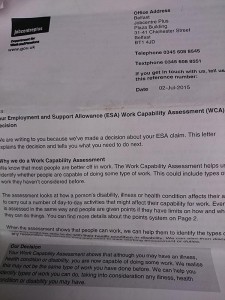
Fit for work letter

Which is the thing. I’m not talking about Mary in particular here, or her history. I don’t know enough about her history to go into it. I’m talking about the system Mary is stuck in, the way this bureaucracy behaves towards people who use it and the assumptions it makes about those people. I’m talking about a system which removes people’s small incomes at the stroke of a pen, and the amazing callousness that the DWP shows when it throws people with mental health problems off ESA. There’s no “We Get That Mental Health Conditions Are A Real Thing” going on in this letter, or even “We Get That Stopping Your Income Might Devastate You.” The assumption in this letter is that people who are found fit for work have been taking the piss and that everyone who is found fit for work is robust enough to deal with a major blow like a sudden and total loss of income. This, presumably, is how the DWP continues to “fix” people with mental health conditions and indeed to “fix” anyone who claims a disability benefit. Forget about eligibility for a minute, or whether or not people are “deserving,” so-called (nobody’s deserving as far as this government is concerned, so that conversation is barely worth faffing around with). The point is that this is how people are handled when decisions to stop their income are made.

Letter_page_two

Sightings of letters like this one and of people in Mary’s situation reeling around outside jobcentres are among the reasons why I await the outcome of Mike Sivier’s request for benefit deaths statistics with interest. There’s absolutely no concession in the above text-heavy letter to the fact that the sudden stop of ESA might have a very bad effect on someone with mental health problems, or that such a letter might make those problems worse. There’s certainly nothing at the front of the letter about help to sign on for jobseekers’ allowance for some income in the first instance, or help to navigate the difficult path to jobseekers’ allowance, or how someone who once claimed ESA might deal with JSA’s difficult, demanding and punitive jobsearch regimes (I don’t count the provision of the Jobcentre Plus phone number on page 2, or the warbling on about Work Coach help at a jobcentre as immediate and intensive support). For her part, Mary was going to try and appeal the fit-for-work decision: “I’m on medication,” she said. “I’m going to my doctor now to get the letters.” I gave her my number and have her address: hopefully, we can catch up and find out how things went. Suffice to say for now that I expect to see more and more people clutching these letters outside jobcentres as Osborne and the boys target ESA – and the people who collect it – for destruction. Cute, innit.

*Update Monday 20 July: sentence with * changed from “thought fit for some type of work” to “thought capable of some kind of work in future” as original could be interpreted as “fit for work” as in a WCA decision to end an ESA claim altogether. Also added “and of attending work-related activities” inside the bracket, as agree with commentator below that the work-related activities requirement for WRAG should be made clear as part of that sentence. Good ESA WRAG definition here.

Social security and voting Tory

So…

Just after the general election this year, I stayed in Dorset and visited the Soul Food kitchen in Weymouth at breakfast-time one Friday. Soul Food does meals for people who have benefit problems, or who are in and out of street homelessness. I spent a lot of time with people there a couple of years ago. When I visited in May this year, I recorded an interview with an older woman who I’ll call Leanne for this post. Leanne was a wheelchair user: cerebral palsy, she said. We talked for a long time. She spoke about the government’s harsh application regime for employment and support allowance. She talked about her social housing flat, which she said she’d been living in for years. She revealed a deep dislike of the social care types who she seemed somehow to answer to: “ I’m always told I’m spending other people’s money,” she said. Anyway, since we’d just had a general election, I thought I’d ask Leanne who she’d voted for. She told me that she’d voted for the Tories. “Doesn’t make any difference,” she said.

I don’t know why I’m telling you this story, except to say that life rolls this way outside of twitter. I meet up with people and they say things, and there we are. I speak to a lot of people who genuinely think of political engagement as a luxury enjoyed by other people. Their own minds are busy elsewhere: mainly caught up in a series of run-ins with bullying bureaucrats as far as I can tell (“I’m always told I’m spending other people’s money,” etc). That’s where the main action is. People read the papers and follow the news, but they don’t imagine for a second that their experiences count towards anything that goes down there. I think that’s why this latest wittering about Labour as the party of welfare has not engaged me. It seems a while since people I hang out with talked about Labour as social security champions.