Putting disabled people in flats with totally inaccessible upstairs toilets, giving pregnant women airbeds because there’s no furniture: more from the housing frontline

This is the fourth article in my series with a frontline council homelessness and housing officer who has worked in housing offices across London and Greater London for 15 years.

There’s a full transcript from this interview at the end of this post.

In this article, the officer explains how basic human dignity and any notion of safety or comfort have gone by the wayside for homeless people in austerity.

The erosion of these basics speaks volumes about society’s real opinions of people in homelessness and hardship. We do better by our dogs.

The officer says that at one council recently, pregnant and sick and disabled homeless people (one person just had major renal surgery) were given cheap airbeds (which didn’t always inflate) to sleep on in temporary accommodation, because there were no proper beds.

There was nothing in the way of furniture at all in these places. Giving homeless people an airbed to take to the accommodation had just become par for the course. Cheap airbeds which often broke were considered good enough, even for people who had trouble moving around and standing up:

“Some woman who was like seven months’ pregnant. You know – she was enormous, because she had this huge big baby in her belly. She was given an airbed to pump up… There was some old guy who’d had an operation. I can’t remember what the operation was – I think it was a kidney operation…? or something like that. He’s given this airbed to pump up.”

The officer also talks about a disabled person being placed in temporary accommodation in a split-level flat in London where the toilet was upstairs and couldn’t be reached by that person. The disabled person had to use a commode downstairs in the main room before a complaint was made and alternative housing found:

“The bathroom’s upstairs and they [the tenant] are like, “well, how am I supposed to use that? I’m in a wheelchair…. [I suppose] they’re [the council is] like, “well, you know, get a commode… shit in a carrier bag…”

So it goes these days, the officer says. Councils place homeless people in any accommodation that serves the two basic purposes of housing people in immediate need and getting them out of the office fast:

“It is just the fact every council is scraping the bottom of barrel a lot of the time for TA [temporary accommodation]. I think a lot of the time, they [councils] just put people in shit and just hope they don’t complain. If they do complain – okay, we’ll do something about it…but we will wait until they do that [complain].”

The officer says the airbeds situation came about because the council rented blocks of empty flats from landlords who bought flats to let out for as much money as they could get – but spent nothing on making the flats habitable.

The officer says that in the past, when there was more money around, councils would put in place programmes to make sure temporary accommodation was furnished:

“The council might say, “give us a ten-year lease on these and we will put some furniture in them, or something,”

but in austerity:

“Now, it’s just money-saving – like, “fuck it – we’ll just take it as it is and give somebody an airbed…These were really cheap airbeds, so you would get people coming back the next day saying, “this airbed didn’t even…it’s got a puncture, or the pump don’t work.” So, they spent last night sleeping on some half-inflated airbed.”

Continue reading

Intentionally homeless with kids? Council will house the kids but not you – ie, you’ll be separated from them. The hell with this.

This does my head in. It should do yours in as well.

I spent an hour this morning interviewing a young woman who has three kids under the age of 12.

She was evicted from her flat at the end of last year for rent arrears. I have a letter from her council to her MP which says the council is likely to find her intentionally homeless, because of those arrears.

The young woman believes that the council has found her intentionally homeless. She has no fixed address, so she isn’t sure where any post advising her of her situation is going, or if it is being posted at all.

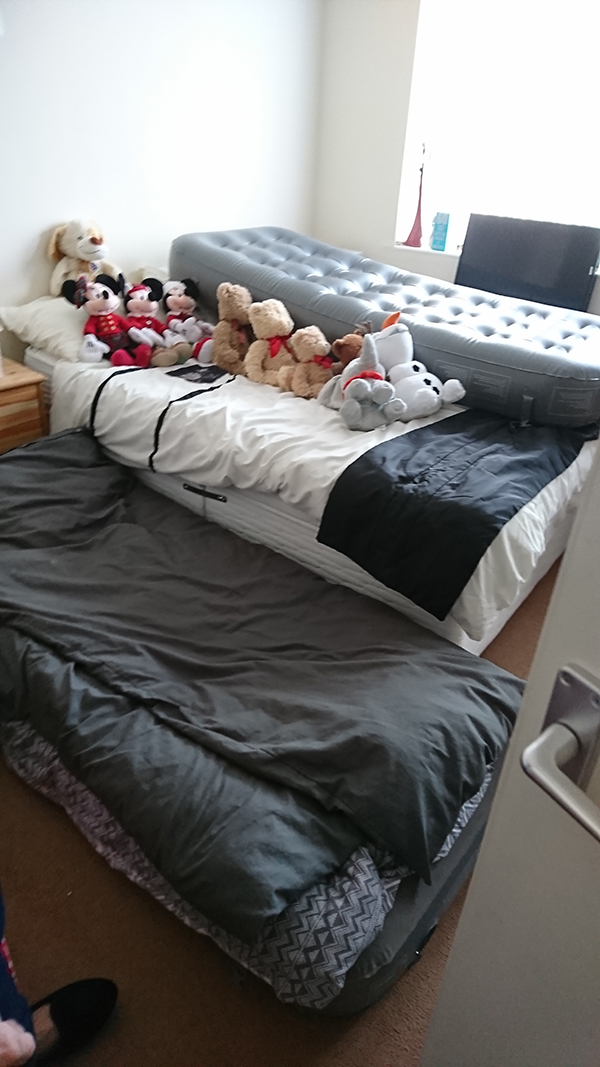
She’s sofa-surfing with her three kids at the moment – sometimes at a friend’s place and sometimes at her mother’s place. Her mother is in temporary accommodation herself and has eight family members in the flat with her. Two of the school-aged kids are sleeping on airbeds with their grandmother in the grandmother’s room. The older child sleeps on the floor in a room with two others.

At the end of that letter is this sentence:

“If [name removed] is found intentionally homeless, then the Housing Options team will not assist her into alternative housing and will only give her advice and support to find her own accommodation. A referral will, however, be made to Children’s Services in respect of the welfare of the children”:

In other words, people who are found intentionally homeless risk having their children removed, or, at least, having their children housed away from them. What a threat that is – and to so many people. So many people are evicted for rent arrears these days. So many women tell me that they are terrified that the council will remove their kids if they can’t find decent – or any – housing for them. Getting evicted and finding yourself without a roof is bad enough. Now, homeless people believe they risk losing their kids if they return to to their council to challenge an intentional homelessness decision, or if they approach a council for further housing help.

This shit has to stop. Councils cannot be permitted to threaten women with the loss of their children, just because those women are poor.

This situation is untenable. Let’s have some #metoo outrage about it. Imagine the headlines and fury if some council tried that that sort of threat on with a middle class family, or – gasp – a celeb.

“We’ll come after your kids.” I think not.

Image: the two airbeds on either side of the grandmother’s bed:

A rise in the number of rough sleepers? Bet those shocking numbers don’t show the half of it. Look at these two guys.

The Guardian has a story this morning about the shocking rise in the number of people who are sleeping rough.

The government should be smashed for that rise alone. Slashing social security to the point where more and more people sleep outside in this climate is a crime against humanity in anyone’s book. Winter is freezing cold, especially here in the north west. Forcing people to sleep outside during it is murderous. Simple as that.

Point I wanted to make is that there are people who may not appear in these counts, because they have options some nights – if you can call them options – which means they have a bed or couch for that night. Their existences ain’t exactly great. They’re still street homeless. They still have appalling experiences. They are still out a lot in the freezing cold and can be out any minute in the freezing cold. Someone needs to take Theresa May to meet and count these people, and to rub her nose in a few realities.

I’m thinking of two guys in particular – James, 50 and Roy, 64 – who I’ve interviewed in Oldham. They’re both street homeless – but they’re not always on the street.

James, who I often meet with, regularly stays with his friend Vance, who was street homeless for years, but was finally found a council flat about two years ago. This arrangement works well sometimes and badly at others. Late last year, James had the shit kicked out of him – apparently by another guy who was staying at the flat. A roof often comes with considerable compromise.

It certainly did for Roy, 64, who I spoke with at length at Oldham foodbank recently. Roy was street homeless (at aged 64, if you don’t mind – a crime in itself), but sometimes stayed with a “friend” in Chadderton who charged Roy money out of his benefits to stay on the couch. He attended the foodbank that day in the hope that someone could help him find somewhere better to stay.

You see the point. When you spend a lot of time talking with people who are in and out of street homelessness, you talk with many people who are street homeless, but who are sometimes able make other arrangements that remove them from view. Doesn’t mean they’re having a brilliant time of it. I don’t know how many of these people do or don’t appear in rough sleeper counts – the Guardian article makes clear that criteria for counting rough sleepers is strict and only takes in people who are outside. Whatever. My point is that government needs to be strung up for creating this hidden rough sleeper nightmare as well. Like I say – people don’t know the half of it.

Schizophrenia, aged 55, #PIP payments stopped, forced to the foodbank – why are guys like Andrew called society’s leeches but rich Carillion bosses are not?

Back to Oldham foodbank last week, where I talked at length with Andrew Smith, 55 [there’s a transcript from the interview at the end of this post].

Keep Andrew in mind when you read about the extraordinary salaries and bonuses trousered by people who are responsible for the Carillion disaster. Ask yourself how we arrived time and place where people such as Andrew must grovel for food at a foodbank while Carillion chancers are paid unbelievable sums of money for risking and destroying vital public services and jobs.

How dare anyone claim that people such as Andrew are the leeches?

Makes me sick.

Andrew was at the foodbank, because the DWP had stopped his Personal Independence Payment. This meant that Andrew was down several hundred quid a month*. He said the local CAB was appealing the DWP’s decision on his behalf.

Said Andrew:

“I said the wrong thing [at Andrew’s face-to-face PIP assessment] and they [the DWP] stopped it [Andrew’s PIP]… I’m just hoping they give it me back, because if I don’t [get that money], I’m going to be in an absolute mess.”

He was right about that. Andrew’s chances of getting the money elsewhere at his age and with his health problems were zero.

Andrew had a schizophrenia diagnosis. He also had varicose veins which ran the length of both legs (I won’t forget seeing those). He said that it hurt to walk – a statement that was extremely easy to understand when you saw the state of his legs. The DWP didn’t give a damn about the state of Andrew’s legs, though – or any other aspect of Andrew’s life. The department stopped Andrew’s PIP about three months ago. Some genius DWP decision-maker had decided that a man of Andrew’s age and with Andrew’s health problems could manage without money or support – or, I suppose, that he could find that money and support elsewhere.

I despair at these decisions – or at the people who make them, anyway. The benefits bureaucracy is disgusting. It stops people’s benefit money and consigns them to poverty at the stroke of a pen. People are not even given lead time or a grace period to deal with such decisions. They just get a letter saying the money’s stopped, or not coming, or whatever. Benefit decision-makers who cut guys like Andrew loose know full well that the Andrews of this world have neither the health nor the opportunities to make up lost benefit or support money. They can see people’s paperwork and the bank statements. They know the dire financial circumstances that people will be left in when money is cut. The bureaucracy makes the decision all the same.

The government and the DWP know that Andrew will not step out of a PIP assessment and into a job. Job opportunities are especially scarce when people are older. I’ll punch the next worthy who says otherwise. I’ve lost count of the number of men who I’ve talked to at foodbanks and jobcentres who are in their 50s and 60s, who did manual work when they were younger and who are now on the scrapheap. Fitters and joiners, painters and decorators, general kitchen assistants: their health goes and they’re dumped.

Andrew said that in his working days, he had jobs on building sites:

“I did wet stone walling with sand and cement,” and, “I worked on canals and paths at Greenfield… building sites.” Needless to say, Andrew can’t do that work now. He’s too old for it and his health has gone, as health does in these circles.

“They [the CAB] have put an appeal [against the DWP’s PIP decision] into tribunal and the tribunal should get it me back… I’m very poorly. I’ve got schizophrenia and I’ve got very serious varicose veins. Horrible, love… I said the wrong thing [at my PIP face-to-face assessment] and they stopped it.”

Yeah. That’s what they do. The bureaucracy casts people adrift and lets them sink. There’s no justification for that, no matter where you sit on the political spectrum and no matter what you think people should or should not have done to “take responsibility” in their lives. I don’t pay my taxes to keep people like Damian Green on the payroll, or to line the pockets of the swindlers who’ve run Carillion into the dirt. I pay tax to keep guys such as Andrew from having to visit foodbanks. Continue reading

DWP to disabled woman with bone fractures: Don’t miss hospital appointments. To meet Universal Credit conditions, you must show you’re trying to get better

Wtf indeed.

On Wednesday, I spoke at length with Karen Sheader, a Hartlepool women who is a director at the Shoot Your Mouth Off film production company for people with learning difficulties.

Karen has the bone condition osteopetrosis. She’s liable to serious bone fractures. Both her legs are broken at the moment.

She had to take leave from work, because of those fractures, and so applied for Universal Credit earlier this year. This was a shambles in itself – her claim took months to start and she got to the point where she was worried about losing her flat if she went into rent arrears while waiting for Universal Credit. More on that soon.

For now – the extraordinary comment her Universal Credit work coach made at one of Karen’s work-focused interviews.

The work coach said that Karen must make sure that she attended all her hospital appointments to meet Universal Credit claimant commitments – that conditions for benefits included proving that she was doing everything she could to “get better.”

What are these work coaches even talking about?

Are they saying that attendance at medical appointments is an actual condition for claiming benefits – or is it simply that they’re now all so programmed to bang on about getting back to work or into work that they come out with any rot that might serve as a threat? Maybe the DWP really thinks that the only reason anyone ever misses a hospital appointment is because they’ve chosen to avoid healing and avoid work as a lifestyle option. Thinking that about everyone must be hard. These clowns are obsessed.

Karen says she had literally never considered not attending her hospital appointments, because she would very much like to get better and to return to the job and organisation that she has put so much time into. Would have hoped the DWP knew that.

There are days when I wonder where the DWP’s mania for work at all costs will end – if it ends at all, that is. Don’t suppose we can count on that.

We’re obviously well on course for a point where people have their benefit money sanctioned for not only missing a medical appointment, but for missing an hour with the physio, or even a swim class, or maybe even for not shopping at health-food outlets. It’ll be compulsory to participate in any activity that some policy wonk imagines will hasten a return to health and to work.

There is and will be another kind of austerity death – the slow death through neglect

There’s much talk and fury (there should be more) about deaths related to benefit cuts: people dying after being found fit for work and people committing suicide following cuts to their benefits. There’s no doubt that current and one-time government ministers need to do jail time for this. And they will. There will most certainly be a reckoning.

There’s another sort of government destruction of people taking place that I want to raise again here.

It’s hard to quantify, but very obvious when you keep seeing it. A lot of people talk about it.

It’s the all-round annihilation of people’s health via the universal destruction of all the services they rely on – housing, care and income help in particular. The life expectancies of people in these situations MUST be adversely affected (to say the very least) by this all-round destruction. I really don’t care if anyone thinks such a statement is hysterical. It isn’t.

I know what I see. I keep interviewing people who are assaulted by government cuts on all fronts. Assault is not too strong a word.

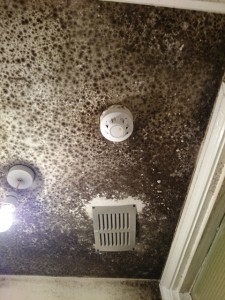
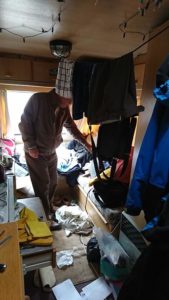
People live in cheap rented housing which is disgusting and full of mould (I’ve posted pictures of some places I’ve been in below). This is the only housing that people can afford on LHA rates. I’ve interviewed people who live in tiny, grotty, falling-apart static caravans because they can’t afford anything else.

People’s care services have disappeared, because they can just about achieve the daily basics such as shopping and dressing on their own. They’re left to it as a result. No matter that they struggle with other aspects of running a home, such as keeping the tiny places they must rent clean and clear of mould (you can see that in the pictures below).

They are getting older, but must drag themselves to weekly jobcentre meetings to talk about work they’ll never get. They’re banned from jobcentres because they lose their tempers (perfectly understandably) when the DWP insists they apply for jobs that everyone knows they’re not eligible for. They’re thrown out of jobcentres when they try to drop in the sick notes their doctors must keep writing to cover people’s very obviously deteriorating health. The hours I’ve spent posting or delivering sick notes to the DWP and jobcentres for people who everyone at the jobcentres knows is neither fit nor eligible for work – I tell you what.

The “lucky” people are supported by collectives such as the Kilburn Unemployed Workers’ group who really do make herculean efforts to keep things afloat for people. Other people just rot.

There’s no doubt in my mind that each of these problems hacks away at people’s health. Together and over time, these problems are dynamite. Because I see people again and again, I see the deterioration as it gathers pace over time – the weight loss, the worsening diabetes and respiratory health, and the decline in mobility. It’s neither hysterical nor naive to say that. I spend most of my time out talking with people who are in these situations.

People like me and plenty of others know what we see. We’re not the ones who are hysterical or in denial. Seriously. This is not exaggeration, or hysteria, or even the dreaded fake news. Fake news is the sort of thing you find in the average DWP press release – press releases which say, for example, that the DWP provides “tailored” services for sick and disabled people, even while jobcentre advisers are telling you that the DWP does nothing of the kind. I think that every mainstream outlet which publishes a DWP justification-for-policy statement at the moment is publishing fake news.

—————

Here are some pictures of places I’ve taken in the last few years.

You can’t tell me that the health of the people who lived in these places hasn’t been affected by these cramped, mouldly, filthy conditions. Anyone who says otherwise really is naive.

The man who lived in the first two places (he has learning difficulties and diabetes) has recently been found sheltered housing thanks to the efforts of the Kilburn Unemployed Workers’ Group.

Mould in one-room studio flats in London (kitchen, bed, living space all in one room):

Man in his 60s living in an old static caravan (Oldham):

Is anyone getting information out of the DWP at the moment?

I got a note from the DWP FOI yesterday to tell me a response to an FOI request that I sent last month about deductions from Universal Credit for tax credit debt would be delayed.

Of course – that’s happened before and not just to me. The point I making today is that I can’t get anything from the department on any front. The press office wouldn’t give me even a one line response to use about a fortnight ago for a question about private companies which do or don’t run Universal Credit contact centres (the department sent me a list I had and then I had to send another FOI. I couldn’t understand why the DWP wouldn’t just tell me who ran the contact centres).

And then there’s the fact that people’s requests for their own benefits paperwork go unanswered by the department.

Don’t like it.

“We’re cutting your benefit, but won’t say why. Get your arse to the jobcentre” – DWP to woman with serious mental health condition

Readers of this site will know I’ve written regularly about Maggie (name changed), a 41-year-old Northampton woman with a schizophrenia diagnosis.

Maggie has been sectioned in the past and has spent time in hospital.

Maggie receives the Employment and Support Allowance benefit. Up until recently, Maggie was in the ESA Support Group, which is the group for people with the highest support needs.

The DWP suddenly changed that about a month ago. Maggie was sent to a Maximus face-to-face assessment. She got a letter at the end of September which told her that her ESA claim had been downgraded. She was now in the ESA work related activity group (which means that she must attend jobcentre meetings about finding work) and her benefit money had been cut.

The DWP did not tell Maggie why it had suddenly decided she was able to look for work and live on less money. Her condition has not changed. It’s actually worsened since local mental health support services were cut. No reasons for this decision were included in the DWP’s letter.

Maggie rang the DWP to ask the department to send her a list of reasons for this decision to push her into the ESA WRAG group. The DWP said it would send her those reasons by post. That was three weeks ago. The list of reasons has not arrived. Maggie can’t properly challenge the decision to change her benefits without understanding exactly what it was about her condition that the DWP thought had changed.

However – the DWP HAS managed to send other post to Maggie in the last few weeks. The department sent her a letter which told her in no uncertain terms that she must turn up to her jobcentre for a work-related interview, or risk benefit sanctions. The DWP has no problem getting that sort of letter – ie a threatening letter – in the post. That part of the system works absolutely fine.

That letter about the work interview at the jobcentre arrived almost immediately after the letter which told Maggie that her benefit had been cut (I was actually speaking to Maggie on the phone about the first letter when the second one dropped through the door). Maggie had to attend that first work-focused interview at her jobcentre last week.

I am getting very, very sick of this. You think the sex scandals in parliament are bad. This sort of story is as bad and worse. This is cutting off support to people in great need and dropping them in it.

With one pen-stroke, David Gauke and the rest of the DWP’s geniuses cut money and support to someone who has previously been hospitalised because her mental health condition is so serious. Nobody gives a stuff about that, of course, or about the effects that such letters have on people whose are already struggling to keep things going. After cutting her money, all the DWP offered Maggie by way of “support” (ha) was a threat about attending a jobcentre meeting.

How do Gauke and his bureaucrats still get paychecks for running this intentionally disastrous system – the system that people in the greatest need in our society must use? The situation I’ve described above is exactly the sort of scenario that sets desperate and unsupported people up for suicide attempts – horrible threats, pressure and reduced money, and nobody to help (welfare support and advice in Northampton is hard to come by). It isn’t even subtle.

So much for government taking mental health seriously. Do me a favour.

I won’t be letting this one go.

Of course we don’t inspect all flats we put homeless families in. No resources. Mould, broken boilers: we know temp housing is foul

“[We] move [a homeless family] into [temporary accommodation] and of course it is full of cold and damp, and things don’t work, and there’s rats running around…”

“….I do remember somebody who did actually have a hole in the ceiling and rain was coming through.”

“Mostly, it’s mould is the biggest problem….you get some terrible places.”

“[When placing people in other boroughs]…They [the originating council] don’t have the resources to go and look at the accommodation before they move people into it.”

This is the second article in a series I’m writing with a housing officer who has worked (and still works) in council housing offices across London and Greater London*. There’s a transcript from this interview at the end of this post.

For this article, I asked the officer whether London councils inspect accommodation before they place homeless households in it. I was especially interested in checks on temporary accommodation when London councils send homeless households to other boroughs.

I asked, because I’ve interviewed quite a few people who’ve been disgusted at the standard of the accommodation that they and their families have been placed in both in and out of borough.

Councils ALWAYS insist to these tenants that temporary accommodation in other boroughs has been and is inspected, either by council officers, or by companies which manage that accommodation.

“That’s bullshit,” the officer told me (a view that tenants usually share).

“The biggest problem with accommodation is – obviously, a lot of councils are having to get accommodation out of their borough. [It’s] not always a long way out of the borough, but maybe the next borough, or the borough after that one.

They [the originating council] don’t have the resources to go and look at the accommodation before they move people into it.

They’ll ring up and say, “well, as long as they’ve got a gas safety certificate and an electrical safety certificate…” other than that, they ask the landlord, “is the accommodation nice and clean and all that?”

They’ll [the landlord] be like, “yeah, of course it is [laughs]…[then you] move somebody in there and of course it is full of cold and damp, and things don’t work, and there’s rats running around…”

“….I do remember somebody who did actually have a hole in the ceiling and rain was coming through. That was obviously somebody who got moved straight away… but obviously, they [the council] didn’t know that when they placed that person there. The landlord didn’t mention the hole in the roof, strangely enough.”

“Mostly, it’s mould is the biggest problem. That is a problem, because it’s health. It affects some people’s health and clothes, and everything else…you get some terrible places. It doesn’t even have to be that bad. You know if there is mould there, you ain’t going to get rid of it very easily.”

Continue reading

Total of 40 minutes and more on hold to the DWP’s Universal Credit Debt Management line

Keeping a record of these things:

Yesterday morning, I made two calls to the DWP’s Debt Management “helpline” – the 0345 850 0293 number that people who receive benefits, including Universal Credit, must use to sort out problems with debt money that the DWP deducts from people’s Universal Credit payments.

I had to call twice yesterday (I didn’t have all the information that DWP Debt Management required the first time around. Unfortunately, I had to make the first call to find that out). I was on hold for more than 20 minutes both times to that 0345 850 0293 DWP Debt Management helpline, as you can see in the image below. I also called the line on Friday and was on hold for more than ten minutes, before I had to hang up to deal with something else.

As far as I can tell, this number has a charge. (I have a phone contract which covers those charges – that’s why I make calls for people who don’t). I hope this is one of the numbers that David Gauke has decided will be free soon. All helplines lines should have been free in the first place (I’d ask the DWP’s press office where things are at on all of these lines, but their answer to all my questions these days is to submit an FOI. So I have).

People who ring the DWP Debt Management helpline only ring that number because they have a debt problem and are in serious financial hardship. They can least afford extra charges for phone calls:

I was calling on behalf of young woman who claims Universal Credit and whose story I’ve been covering. She is concerned about deductions for child tax credit debt that the DWP is taking from her Universal Credit payments. She disputes the tax credit debt. The DWP has taken over tax credit debt recovery for Universal Credit claimants from the HMRC.

Trying to get to the bottom of disputes and problems with deductions from benefits like this literally takes forever. It really does. It drives people out of their minds. The whole “process,” is unbelievably stressful. I can’t emphasis strongly enough the difficulties we’re having just finding the right people to talk to – or getting through to anyone at all.

I called Universal Credit on Friday to try and understand who to contact. We wanted to do two things – challenge the tax credit debt and stop the reductions from benefit. Universal Credit said we’d have to speak to the HMRC about challenging the tax credit debt decision, and then to DWP Debt Management about stopping or reducing the deductions the DWP was taking from the Universal Credit payments each month.

Universal Credit gave me two different numbers to call. There was no suggestion that Universal Credit could just me put through to DWP Debt Management. I had to make new calls all over again. I’ve literally spent the time I’ve had available since then on hold to DWP Debt Management.

I post this, because I want to keep talking about the problems that people who are on the lowest incomes and most in need have with these systems. Waiting on hold to a debt management department for more than 20 minutes when you’ve got a serious debt and income problem is dreadful. It really is. People have complicated situations, too. I had to call Debt Management twice yesterday, as I say, because I didn’t have all the information needed when I made the first call. That sort of thing happens all the time. It meant I had to find the information, dial DWP Debt Management again and wait another 20+ minutes for the phone to be answered.

This really is the sort of thing that has people climbing the walls.